

Piazza Partigiani is the first stop for most drivers coming into Perugia the day after Assisi, and the old town is still 493 metres above it, out of sight from the car park. Escalators built inside a buried sixteenth century fortress carry you up from there, past original brick walls, long before the streets of the centre begin.
In short: Perugia is 44 minutes from us, and it is a working city before it is a tourist one, built straight up a hill of nearly 500 metres, with an entire Renaissance quarter buried beneath the centre and crossed by escalators. This guide explains the geography before you set off, what to see between Corso Vannucci and the two museums inside the Palazzo dei Priori, and why it helps to know in advance what kind of city you are about to visit.
It is written for anyone with a day to spend on Perugia, perhaps starting from our agriturismo on Lake Trasimeno, Le Torri di Porsenna, roughly halfway between Florence and Rome. Better to know where to leave the car than find out by circling the old walls.
Perugia is not a bigger Assisi
The reason Perugia surprises anyone visiting straight after Assisi is simple: it is not a shrine town, it is the capital of Umbria, and the people living there work and study, not just pass through. The University of Perugia, founded in 1308, now has around 27,000 students; the University for Foreigners, which began in 1921 and became official in 1925, adds roughly a thousand more. Against a city of just over 162,000 residents, almost one resident in six is a university student.
One thing needs saying plainly: in high summer, when most of our guests arrive, the university is on holiday, and the part of the city that makes Perugia different from a hill town, full bars in the evening, students moving between lectures, is much harder to find. Anyone hoping for the university city the guidebooks describe finds mostly its tourist version in August. That is not a flaw in the city, just a detail worth knowing before arriving with the wrong expectations.
The vertical geography, and why it helps to understand it first
Perugia sits at 493 metres above sea level, on a hill the Etruscans chose for the same reason anyone arriving by car chooses it today: it is easy to defend and easy to see from a distance. The old town occupies the summit, and everything that matters, Piazza IV Novembre, the Palazzo dei Priori, the two museums on Corso Vannucci, sits up there. The practical problem is that almost no car park reaches that high: you leave the car further down, then climb.
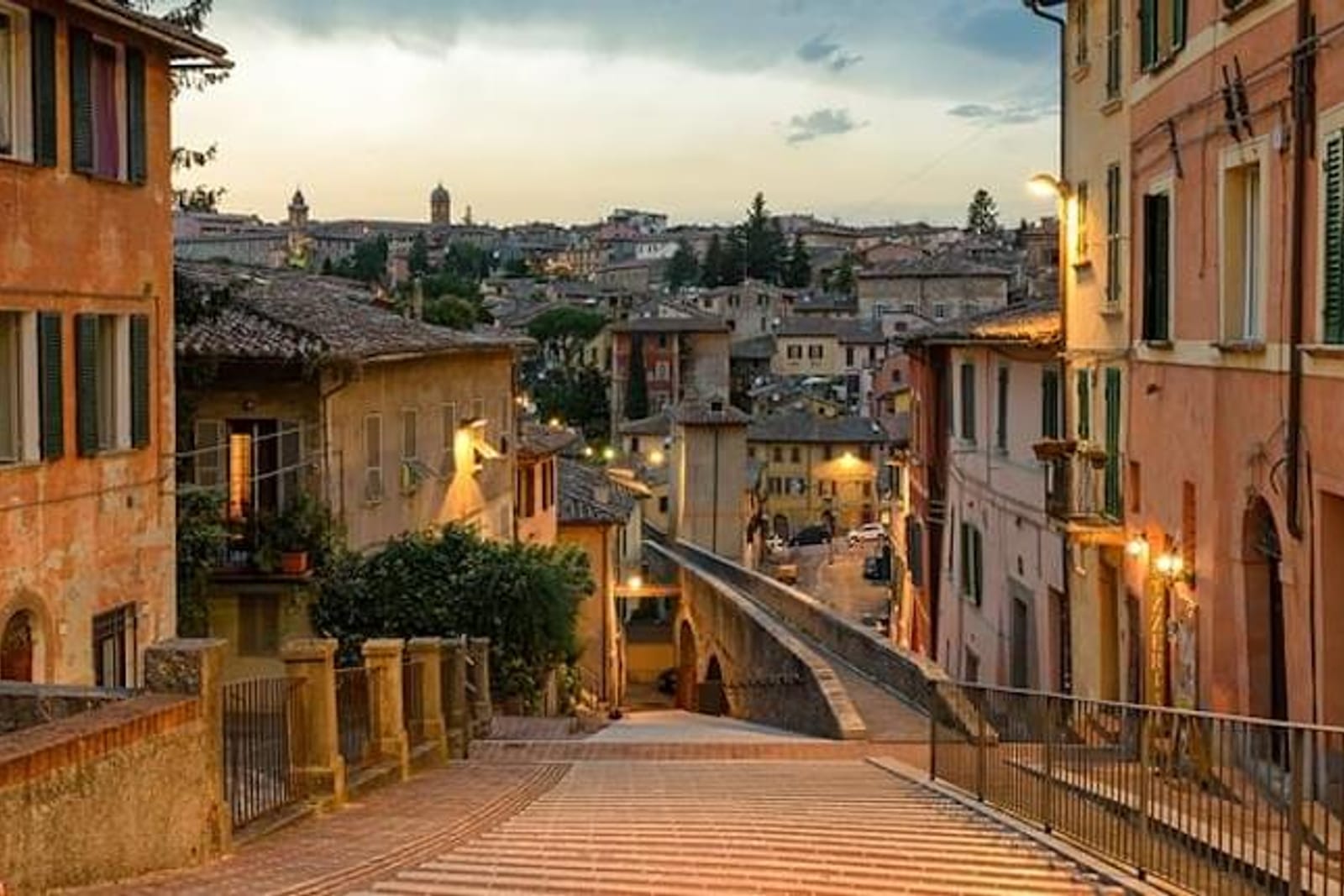
This is the point most people planning a day trip underestimate: Perugia is not walked from the car park the way a smaller hill town is. It is climbed, using one of two systems the city built specifically to solve the problem, and picking the right one changes the day.
Two ways up: the Rocca Paolina escalators and the Minimetrò
The first way, the more striking of the two, runs straight through a buried fortress. Pope Paul III had the Rocca Paolina built between 1540 and 1543, on top of the Baglioni family's houses, as punishment after the Salt War revolt: an entire section of the medieval city ended up absorbed into the foundations rather than demolished. The people of Perugia never forgave the Rocca: they destroyed part of it in 1848, and the rest fell after Italian unification in 1861. What remains is underground, lanes and houses restored between 1932 and 1965, open today with Alberto Burri's sculpture Grande Nero, from 1984, occupying one of the spaces.
Since 1983 a system of escalators has run through these spaces, linking the car park at Piazza Partigiani to Piazza Italia. Taking them means rising level by level inside a sixteenth-century building, original brick walls around you, rather than an ordinary stairwell.
The second way is more recent and more practical if arriving from the north or preferring a larger car park: the Minimetrò, running since 2008, connects Pian di Massiano to Pincetto, at the edge of the old town, over seven stations in about twelve minutes on a route of roughly three kilometres. It is an automated cable car built to ease traffic, not for the view: anyone wanting to understand the Rocca Paolina takes the escalators, anyone wanting the fastest way in takes the Minimetrò.
Piazza IV Novembre and Corso Vannucci, the heart at the top of the climb
However you get there, you arrive on Corso Vannucci, the main street that climbs gently up to Piazza IV Novembre. It is Perugia's promenade, where the city goes out for shopping or an evening drink, and it is the best place to understand what kind of city this is: not an open-air museum, but a square that still works as a square.
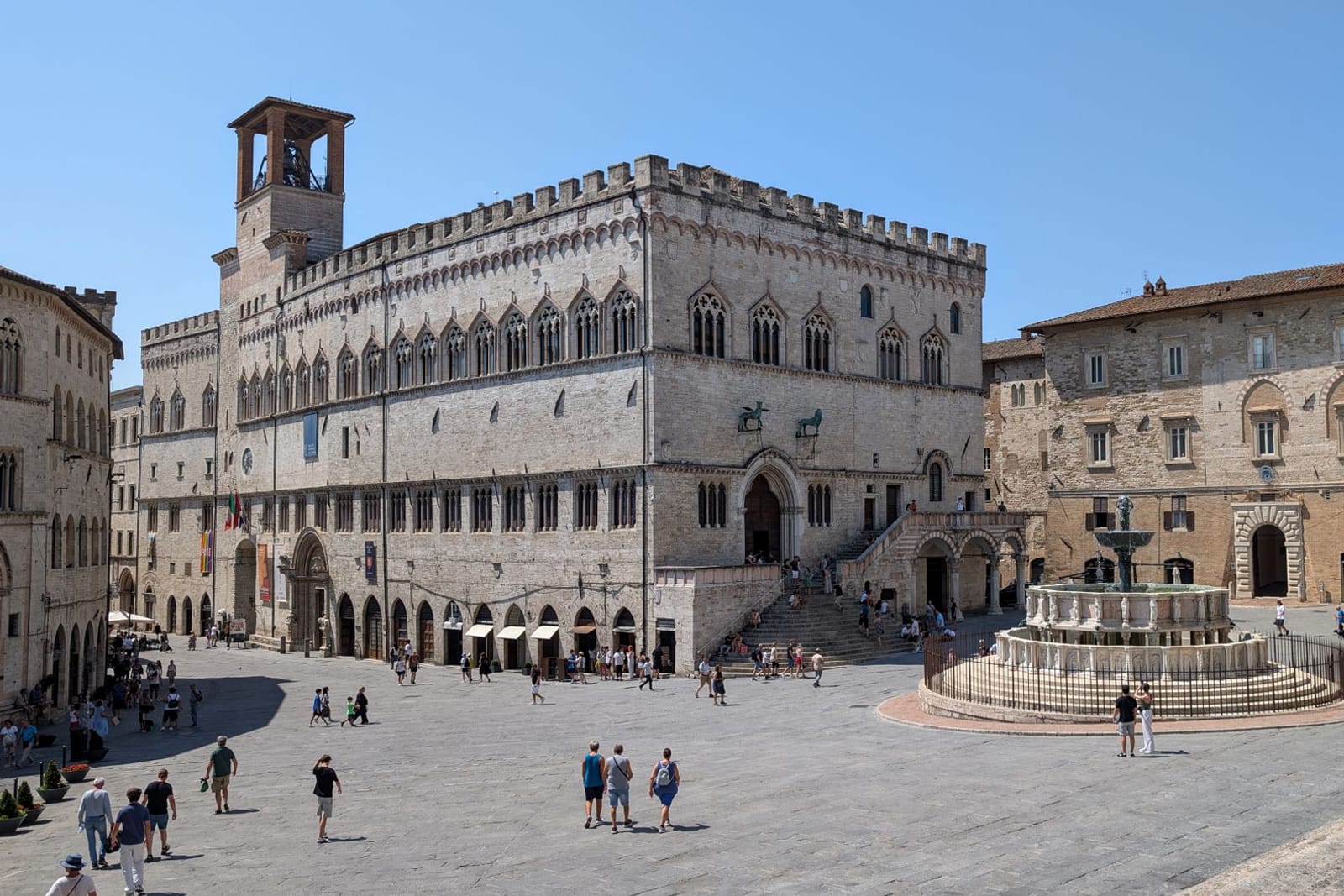
At its centre stands the Fontana Maggiore, built between 1275 and 1278 to celebrate the arrival of water in the city through a new aqueduct, which carried water from Monte Pacciano without pumps, by pressure alone. The lower basin, with twenty-five sides, carries reliefs of the twelve months and their zodiac signs, the liberal arts, biblical scenes and two of Aesop's fables; the upper basin, with twenty-four sides, shows saints, mythological figures and the personifications of Rome and Perugia. The reliefs are the work of Nicola Pisano and his son Giovanni, who signed one of them with an eagle.
The Palazzo dei Priori, closing one side of the square, holds two of the best reasons to stop for more than an hour in Perugia: the Galleria Nazionale dell'Umbria and the Collegio del Cambio.
Two museums in the same building: the Galleria Nazionale and the Collegio del Cambio
The Galleria Nazionale dell'Umbria occupies the top two floors of the palazzo, at Corso Vannucci 19: forty rooms across roughly 4,000 square metres, in its current layout since 2006. It is the most important collection of Umbrian painting anywhere, from the thirteenth to the nineteenth century: Piero della Francesca, Fra Angelico, Gentile da Fabriano, Duccio di Buoninsegna, and of course Perugino, trained right here.
The Collegio del Cambio, a little further along at number 25, was the seat of the moneychangers' guild, among the most powerful in Renaissance Perugia. Between 1498 and 1500 Perugino frescoed the Sala dell'Udienza: prophets and sibyls, cardinal virtues embodied by illustrious figures of antiquity, scenes from the life of Christ. Among the figures, in a painted frame made to look as though it hangs on the wall, he included his own self-portrait, the most direct way to look in the eye the artist who defined Umbrian Renaissance painting more than any other.
Together, the Rocca Paolina, the Galleria Nazionale and the Collegio del Cambio take at least an hour and a half, not counting getting there. With less time, pick one of the two museums rather than rushing both.
Etruscan Perugia, beneath and beside the medieval one
Before the medieval commune, before the Romans, Perugia was one of the twelve city-states of the Etruscan league, and two places recall that better than any museum. The first is the Pozzo Etrusco, the Etruscan Well, in Piazza Danti, cut in the third century BC beneath what is now Palazzo Bourbon-Sorbello: it drops over thirty metres, maximum diameter 5.60 metres, capped with blocks of travertine laid without mortar. A suspended glass and steel walkway shows it from above.
The second is the Arco Etrusco, also known as the Arco di Augusto, built in the second half of the fourth century BC and the most intact of the city's Etruscan gates. It takes its second name from Augustus, who besieged Perugia for seven months around 40 BC and, after taking it, had the gate rebuilt with the inscription AVGVSTA PERVSIA. It stands a few minutes' walk from Piazza IV Novembre, and walking under it is the simplest way to touch twenty-four centuries of history.
Chocolate, from Corso Vannucci to San Sisto
Perugia is also a chocolate city, and not only for one festival. Perugina was founded here in 1907, and in 1922 one of its partners, Luisa Spagnoli, invented the Bacio: gianduia chocolate, chopped hazelnuts and a whole hazelnut, coated in dark chocolate. She first called it "Cazzotto", meaning punch, for its shape; Giovanni Buitoni renamed it, convinced no customer would be comfortable asking for it by that original name.
The factory, at San Sisto just outside the centre, now houses the Casa del Cioccolato Perugina, a museum opened in 2007 for the company's centenary, booking required: a history museum plus a raised walkway over the production line. Autumn also brings Eurochocolate, one of Europe's largest chocolate festivals; the dates shift from one edition to the next, so check them before building a trip around it.
The Giardini Carducci, for finishing up high
If there is time for only one more thing after the museums, make it this: the Giardini Carducci, at the far end of Corso Vannucci, above the Rocca Paolina, at around 535 metres above sea level. Named after the poet Giosuè Carducci, who wrote his Canto dell'Amore here, they have always been the city's easiest viewpoint: from here you can see the Umbrian valley, and on clear days Assisi and Monte Subasio too.
It is a good place to close the day: stopping to read the view, working out where you climbed from, is a different way of looking at the same vertical geography that made the climb complicated a few hours earlier.
When to come: the lively city and the city on holiday
Perugia in July runs at a different pace to every other month: it brings Umbria Jazz, which fills the city with concerts for the whole month, from the big names on the main stages to free music in the streets. Anyone after the event will find Perugia at its liveliest; anyone after a quiet city should avoid those weeks on purpose.
April, May, June and September remain the most comfortable months: manageable heat for climbing on foot, the university active, fewer crowds than high summer. From November to March the city still rewards a visit, with fewer people about, though shorter days leave less room for museums, underground quarters and a steep climb.
From here to Perugia, by car or by train
Perugia is 44 minutes from Le Torri di Porsenna, the closest of the three Umbrian cities reachable in a day from here alongside Assisi and Orvieto, as covered in our guide to things to do in Umbria. Perugia and Assisi also sit on the same railway line through Terontola, on the southern shore of Lake Trasimeno, and anyone who would rather not drive can check the practicalities in our guide to getting to Lake Trasimeno.
Frequently asked questions
How far is Perugia from Le Torri di Porsenna?
A 44-minute drive, the closest of the three Umbrian cities reachable in a day from here, alongside Assisi and Orvieto. It is also reachable by train, on the same line that passes through Terontola and serves Assisi too.
Should I take the Rocca Paolina escalators or the Minimetrò?
The escalators if you park at Piazza Partigiani and want to see the buried Renaissance quarter inside the fortress. The Minimetrò if you are arriving from the north, prefer a larger car park at Pian di Massiano, or just want the fastest way into the centre.
How much time do you need to see Perugia in a day?
Allow at least an hour and a half for the Rocca Paolina, the Galleria Nazionale dell'Umbria and the Collegio del Cambio alone, more if you add the Pozzo Etrusco or the Arco Etrusco. A full day is enough to see the old town without rushing.
Is Perugia a good fit for anyone hoping for the Assisi atmosphere?
Not really. Assisi is a pilgrimage town built around a basilica; Perugia is the regional capital, with a university, shops and daily life carrying on around the monuments. They answer two different wishes, not interchangeable ones.
Is summer or another season better for visiting Perugia?
April, May, June and September give the most comfortable temperatures for the climb on foot. July brings Umbria Jazz and fills the city; August brings more tourists but the university is closed, so the student energy the guides describe is much harder to find.
What else is worth seeing beyond Corso Vannucci and Piazza IV Novembre?
The Pozzo Etrusco and the Arco Etrusco for pre-Roman Perugia, the Giardini Carducci for the view towards Assisi and Monte Subasio, and the Casa del Cioccolato Perugina in San Sisto if there is time to leave the centre.
- Perugia, Wikipedia
- Rocca Paolina, Wikipedia
- MiniMetro, Wikipedia
- Percorso e stazioni | Minimetrò spa, Minimetro Perugia
- Fontana Maggiore, Wikipedia
- Galleria Nazionale dell'Umbria, Wikipedia
- Nobile Collegio del Cambio - Moneychangers' Guild, Comune di Perugia
- Università per stranieri di Perugia, Wikipedia
- Università degli Studi di Perugia, Wikipedia
- Pozzo etrusco, Ministero della Cultura
- Arco Etrusco, Wikipedia
- This site is temporarily unavailable | Nestlé, Perugina
- Casa del Cioccolato Perugina, Perugia, Italia.it
- PUNTI PANORAMICI DI PERUGIA: BELVEDERE CARDUCCI E TERRAZZA DEL MERCATO COPERTO, Tipicamente Umbria
- Umbria Jazz, Umbria Jazz
- Parcheggi, scale mobili e panorama - Itinerari e escursioni a Perugia, PaesiOnline

Bruno e Marisella Batinti
Owners and hosts of Le Torri di Porsenna
Bruno and Marisella Batinti own Le Torri di Porsenna, the abbey they found derelict in 2014 and brought back as a charme agriturismo on the Umbria-Tuscany border. They live here all year: the roads, villages and seasons L'Almanacco writes about are the ones they drive every week.