
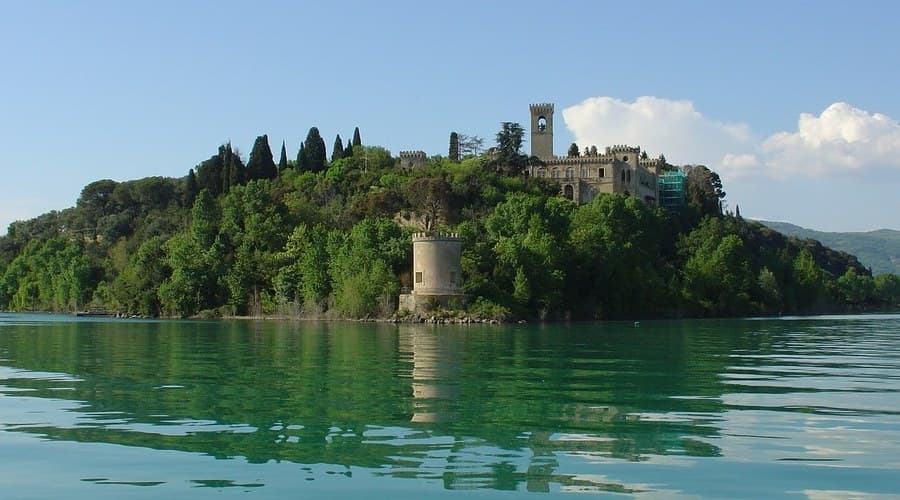

Paved promenade, gelato stands, a paid car park below the fortress walls at Castiglione del Lago: that is the single afternoon most people driving between Florence and Rome give this lake, parking, walking the walls, photographing the water, then leaving. It is a good afternoon, and also the one stretch of Trasimeno that looks like anywhere else. The ferry that leaves from that same car park passes close enough to Isola Minore for a proper look: the lake's only uninhabited island, privately owned, the one nobody ever sets foot on.
In short: Lake Trasimeno is best understood through its islands and its eastern shore, not the main lakefront promenade. Two days are enough to see one of the two visitable islands, two or three genuine villages, and the spot where Hannibal destroyed a Roman army. This guide runs through the three islands and what separates them, the villages in the order we would revisit them, the battlefield, and the month to time your trip around.
It is written for someone with two or three days and a car. We are five to ten minutes from the south shore, in the Umbrian countryside just over the Tuscan border, so a lot of these roads are simply how we get to the shops.
Lake Trasimeno in Umbria, not Tuscany
Lake Trasimeno sits in Umbria, the region immediately south of Tuscany, on the road between Florence and Rome, 44 minutes from Perugia, Umbria's regional capital. It is close enough to Tuscany to feel like an extension of it: the shared border runs along the lake's western edge, and Cortona and Montepulciano, both firmly Tuscan towns, are closer to the water than several Umbrian ones. For the wider region beyond the lake, see things to do in Umbria.
A car is effectively required here. Public transport is built around the needs of residents, not sightseeing, and the villages, wineries and agriturismi that make the area worth a multi-day stay sit well off the rail line. More on that below.
The lake in numbers, and why they matter
Trasimeno is Italy's fourth-largest lake by surface area, at 128 square kilometres, just under Lake Como. That is where the resemblance to the great northern lakes ends: here the average depth is 4-5 metres and the maximum is 6. It sits at 258 metres above sea level, in a basin with no natural outlet.
That explains three things you notice straight away. The water warms up very early in spring, because there is so little of it to heat. There are no sheer cliffs or dark water: the shores slope gently and the landscape is made of low hills, reed beds and olive groves. And the water level swings a great deal over the year.
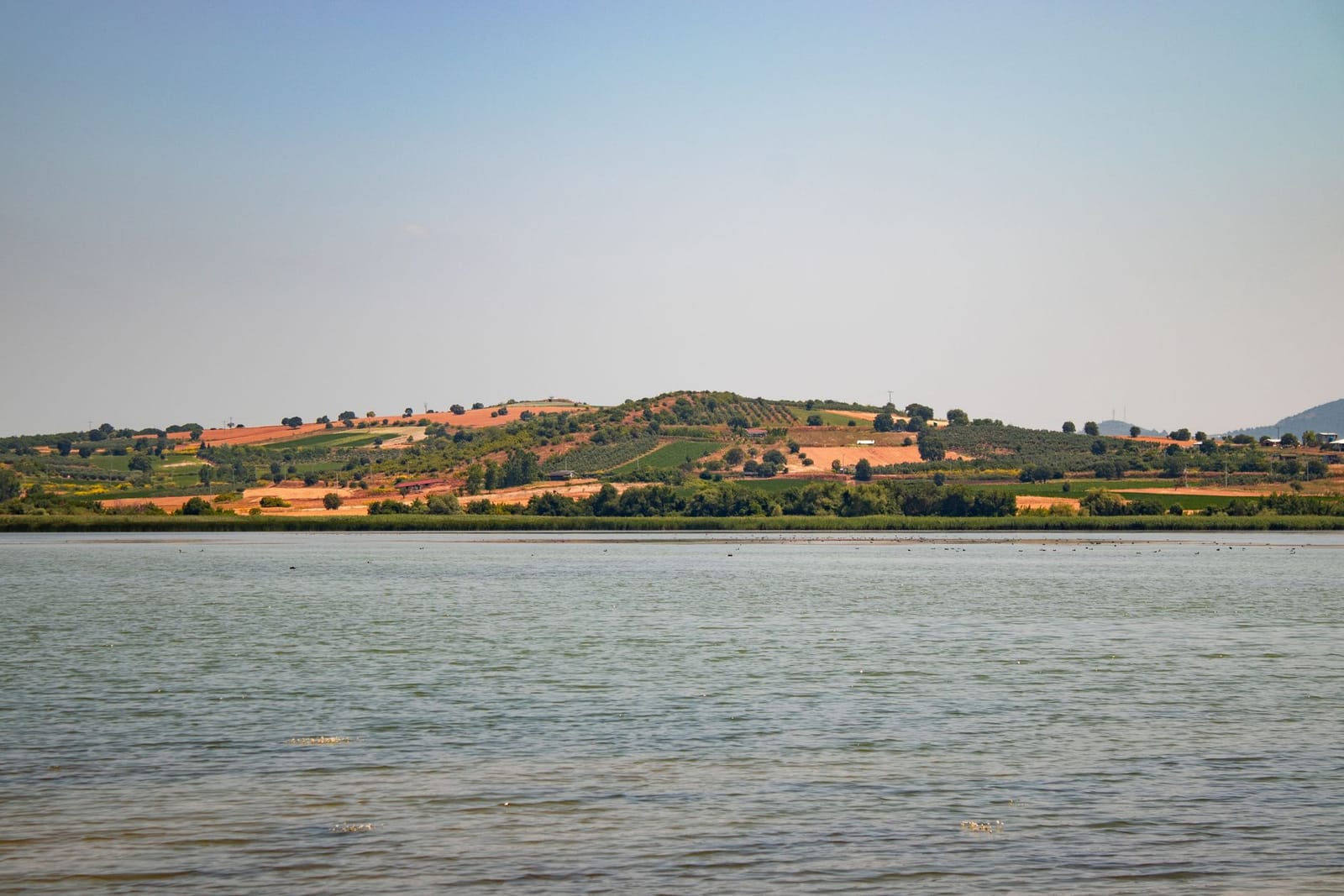
The lake has no natural outflow. It has an artificial one, a drainage canal opened in 1898, but in practice it lives on rainfall. The level is at its lowest between September and October and at its highest between April and May. Anyone who arrives in late summer and finds twenty metres of exposed lakebed in front of the beach has not found a lake in trouble. They have found Trasimeno in September.
The three islands, and which one to take the ferry to
There are three islands and only two can be visited. Pick one and do it properly: they are not interchangeable and do not work well on the same day.
Isola Maggiore, the only inhabited one
Twenty-four hectares, eighteen residents, a frazione (hamlet) of the comune of Tuoro sul Trasimeno. It is the only one of the three where people still live year-round, and it shows: there is a main street lined with stone houses, not a reconstruction built for visitors.
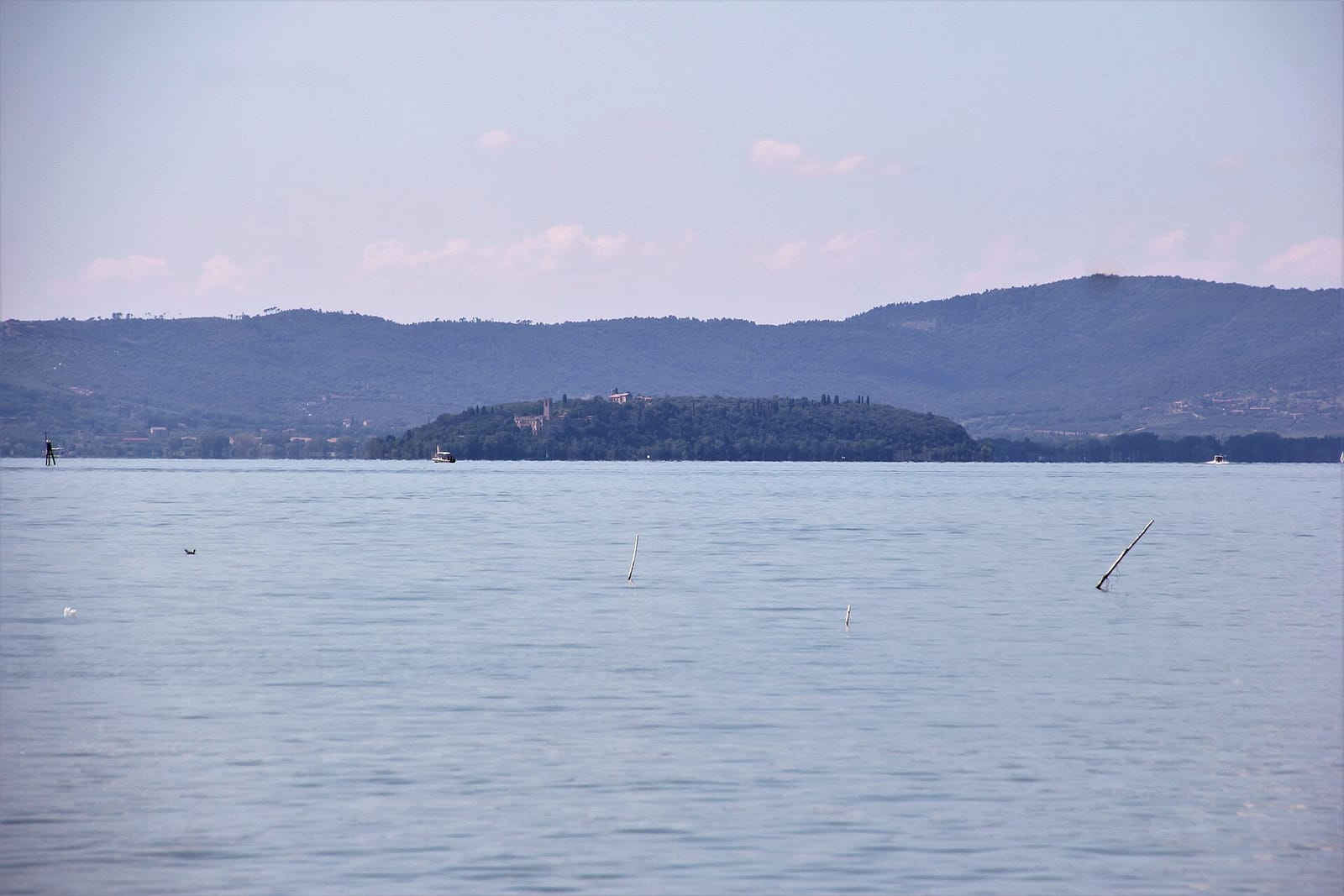
Two things set it apart from any other Italian lake island. The first is that in 1211 Saint Francis of Assisi spent Lent here in retreat; in 1328 a church and convent were built for the Franciscans in memory of that stay. The second is the lace. In 1904 the Marchesa Elena Guglielmi brought a teacher over from Ireland to instruct the island's women in Irish crochet lace-making. The tradition survived and now has its own museum, housed in a fifteenth-century building.
Also on the island: the church of San Salvatore, from the twelfth century, San Michele Arcangelo, from the thirteenth, and Castello Guglielmi, built up in layers between the fourteenth and nineteenth centuries.
Isola Polvese, the largest
Sixty-nine and a half hectares, administratively a frazione of Castiglione del Lago. Home to only a couple of families, and only some of the time: it is not a village, it is an island park.
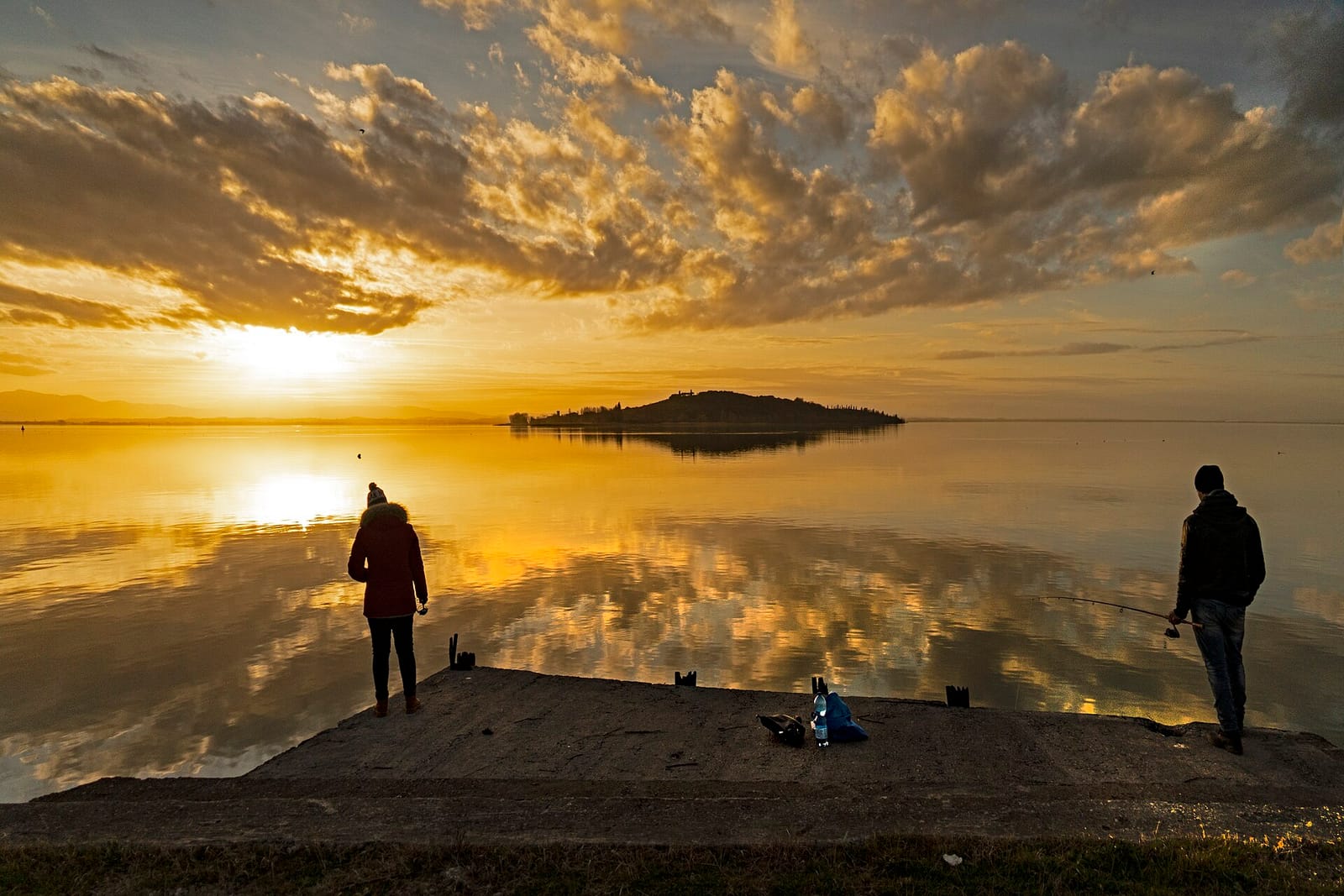
Since 1995 it has operated as a scientific-educational park, a permanent outdoor classroom for schools and visitors, with an environmental education centre recognised by the Region of Umbria and the Province of Perugia. In practice: footpaths, a small lido, outdoor picnic areas, and a restaurant in season. You come here to walk and be outside, not to see monuments.
The ferry to Isola Polvese leaves from San Feliciano, on the eastern shore. One caveat: Busitalia suspended this line on 29 June 2026 because of the lake's water emergency, and as this page was last updated the suspension is still in force. Check the Busitalia site before planning the day.
Isola Minore
Uninhabited and privately owned. It cannot be visited. You look at it from the ferry, and that is entirely fine: putting it on an itinerary is the quickest way to tell that the itinerary was copied from somewhere else.
The ferries, and the one thing to check before you go
The navigation service is run by Busitalia. Isola Maggiore is connected to Tuoro Navaccia, Passignano sul Trasimeno and Castiglione del Lago; Isola Polvese to San Feliciano.
The 2026 water emergency changed that picture: on 29 June Busitalia suspended the Polvese line, boats may run at reduced capacity, and boarding with bicycles or unfolded pushchairs is suspended. These are the operator's own stated restrictions, published on the same page as the timetables.
Which routes run, and how often, changes between high and low season, and some crossings operate only on public holidays or only at weekends during parts of the year. We deliberately do not publish timetables here: they change several times a year, and a wrong timetable on a page is worse than no timetable at all. Check the Busitalia website the day before, and call the navigation office if in doubt.
One practical note matters more than most: the last return crossing is the constraint on your whole day. Miss it on Isola Maggiore and you will find a bed for the night. Miss it on Isola Polvese and you will not.
The lakeside villages, in the order we would revisit them
Castiglione del Lago is the most visited and best equipped, and it is right that it comes first: the Rocca del Leone fortress and its walkway along the walls give you the overview you need to understand the lake's geography. The downside is that in July and August the lakefront promenade is the most crowded and least distinctive part of the whole Trasimeno shoreline.
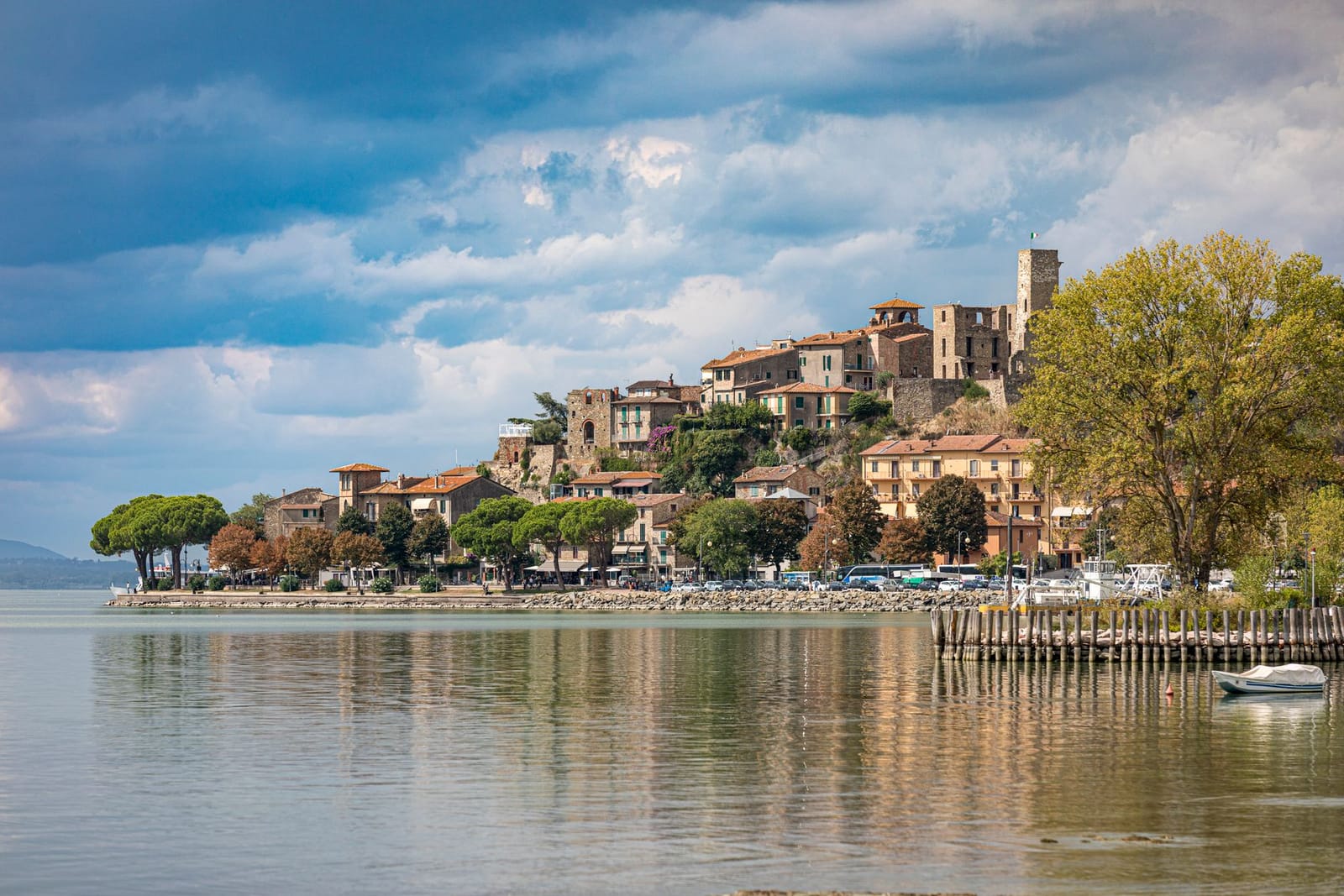
Passignano sul Trasimeno has a narrow old centre climbing up from the harbour, and it is the ferry hub on the northern shore. You can also reach it by train.
San Feliciano, on the eastern shore, is the place where the lake still resembles a fishing lake rather than a resort. It is the port for Isola Polvese.
Monte del Lago, Torricella, Sant'Arcangelo and Borghetto are small and take ten minutes to walk through. None justifies a special trip on its own, but the road connecting them is the best stretch of the lakeside drive.
The full circuit of the shore fits comfortably into a day with three or four stops. Drive it anticlockwise from the south, so that the best stretch of road, between San Feliciano and Passignano, comes in the afternoon, when the light falls from the west across the water. If you would rather cover that distance on two wheels than four, cycling round Lake Trasimeno covers the route in full.
Where Hannibal destroyed a Roman army
In June 217 BC, during the Second Punic War, Hannibal set an ambush on the lake's northern shore and destroyed the army of the consul Gaius Flaminius. It ranks among the worst defeats in Roman history, and it is one of very few ancient battlefields in Italy that can still be read on the ground, because the terrain between Tuoro and Passignano has stayed recognisable.
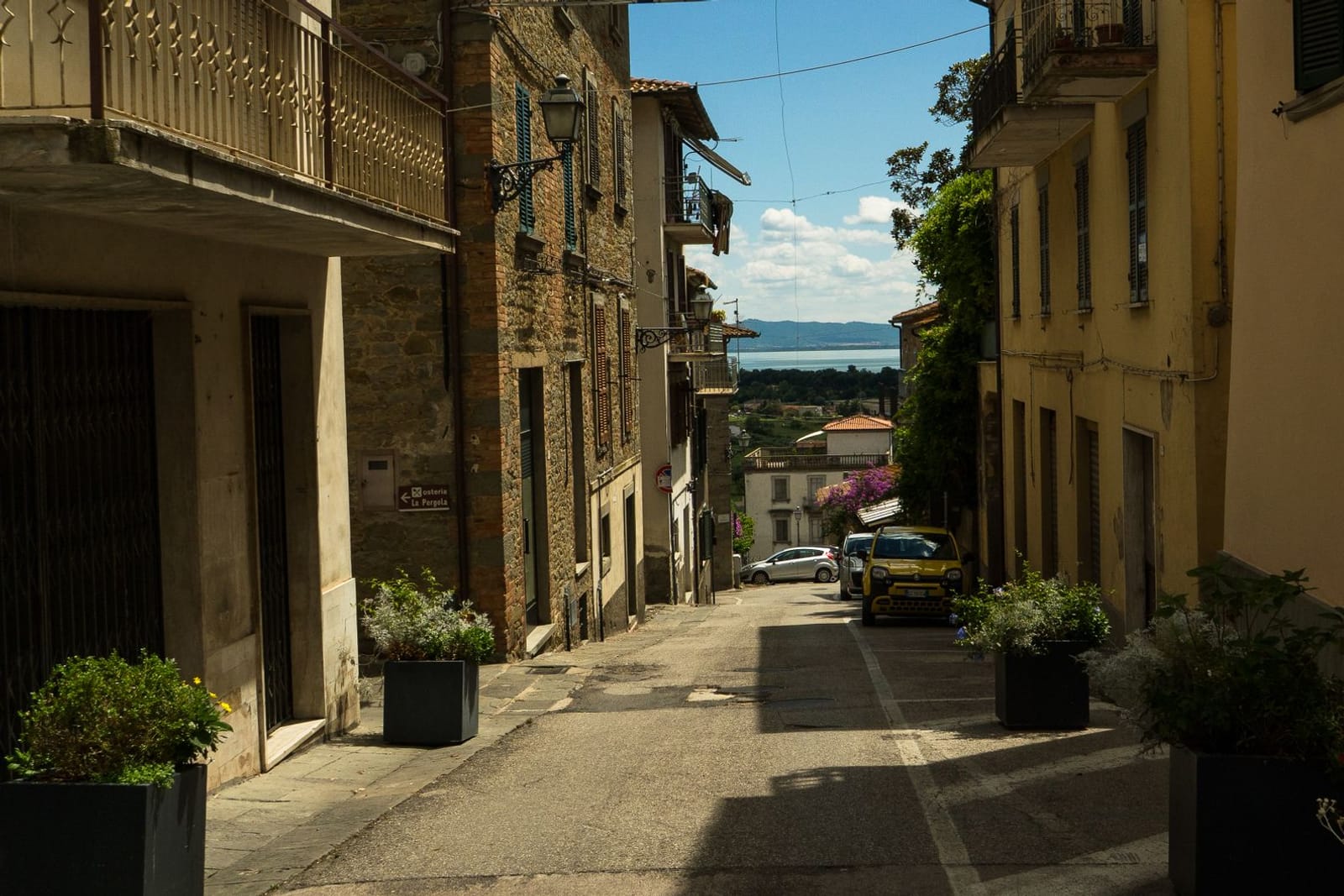
Today the area is covered by a signposted trail through Tuoro and the hills behind it. To be honest: there are no ruins, just a landscape and information panels. Anyone expecting an archaeological site will be disappointed; anyone who has read up beforehand can easily spend three hours there.
When to come, and when not to
May and June. The lake is at its highest level, the surrounding countryside is green, and the ferries are already running a full timetable. This is the best time of year, full stop.
September. The water is still warm, the villages empty out, and the light changes. It is our favourite month, with the low-water caveat above.
July and August work well if you are here to swim and use the equipped beaches. Much less so if you are after quiet: these are also the two months when the heat in the basin really makes itself felt. For a family trip built around the beaches and the ferries, see Lake Trasimeno with kids.
From November to March the lake is beautiful and nearly empty, but half the facilities are closed and the ferry routes are cut back to a minimum. It is a season for people who have already been, not for a first visit.
Getting around: you will need a car
The railway serves Passignano, Tuoro and Castiglione del Lago; everywhere else, the hillside villages, the wineries, the agriturismi and the eastern shore, a car is genuinely necessary. If you are arriving from outside the region, how to reach Lake Trasimeno covers the road, rail and nearest airports in full.
What is just outside the lake
Trasimeno has the advantage of sitting right on the border between Umbria and Tuscany, which changes a multi-day stay considerably. From us, on the south shore at Petrignano del Lago, Cortona is 22 minutes away, Chiusi and Città della Pieve 20, Montepulciano 30. Perugia is 44 minutes, Pienza 46, Val d'Orcia 52, Assisi an hour.
Put another way: you can sleep by the lake and spend a full day in Val d'Orcia without moving your luggage. It is why this belt of hills works better as a base than as a stop on the way to somewhere else.
If your trip runs over several days, Cortona in One Day and Montepulciano and Vino Nobile are the two most natural day trips from here; where we are and what is nearby has the exact distances.
Frequently asked questions
How much time do I need to see Lake Trasimeno?
Two full days let you see one of the islands, two or three of the lakeside villages, and Hannibal's battlefield without rushing. With just one day, choose between an island and a tour of the villages.
Can you swim in Lake Trasimeno?
Yes, there are equipped beaches at Castiglione del Lago, Passignano, Tuoro and on Isola Polvese. The lake is shallow, so the water warms up quickly in spring, but for the same reason the shoreline drops and the lakebed turns muddy by late summer.
Which island on Lake Trasimeno should you visit?
Isola Maggiore if you want the inhabited village, its churches and the lace museum. Isola Polvese if you want to walk, swim and be outdoors. They are not interchangeable and do not work well as a single day.
How do you get to the islands on Lake Trasimeno?
By ferry, the only boat crossing to the islands, run by Busitalia's navigation service. Isola Maggiore is connected to Tuoro, Passignano and Castiglione del Lago; Isola Polvese to San Feliciano. Which routes run changes between high and low season, and since 29 June 2026 the Polvese line has been suspended for the water emergency: check Busitalia before setting out.
What is the best time of year to visit Lake Trasimeno?
May, June and September. In April and May the lake is at its highest level and the countryside is green; by September the water is still warm and the villages empty out. July and August work if you are here for swimming, much less so if you are after quiet.
Do you need a car to visit Lake Trasimeno?
Practically, yes. The railway serves Passignano, Tuoro and Castiglione del Lago, but the hillside villages, wineries and agriturismi (working farms with guest accommodation) are away from the stations, and the bus network is built for residents, not visitors.
- Lago Trasimeno, Wikipedia
- Isola Polvese, Wikipedia
- Isola Maggiore, Wikipedia
- Servizio di navigazione sul Lago Trasimeno, Busitalia
- Estate 2026: limitazioni operative per emergenza idrica sulla navigazione del Trasimeno, Busitalia

Bruno e Marisella Batinti
Owners and hosts of Le Torri di Porsenna
Bruno and Marisella Batinti own Le Torri di Porsenna, the abbey they found derelict in 2014 and brought back as a charme agriturismo on the Umbria-Tuscany border. They live here all year: the roads, villages and seasons L'Almanacco writes about are the ones they drive every week.