
Most people who go round Lake Trasimeno stop on the shore: Castiglione del Lago, Passignano, perhaps a ferry. The hills to the south, towards the Tuscan border, are left out of the loop. Yet in Panicale there is a Perugino fresco in a small church 250 metres from the walls, and in winter you can only get in on a guided visit at fixed times.
In short: Panicale and Paciano can be seen comfortably in half a day by car, Panicale first. In Panicale you want Perugino's San Sebastiano, the little theatre and the viewpoint over the lake; in Paciano the ring of walls and the lanes. Here is the right order, the opening times to check and what you can skip.
This guide is written for anyone with half a day free and a car who has already seen the best-known stops around the lake. If that is not you, start with our guide to what to see around Lake Trasimeno, which says nothing about these two villages.
Where they are and why they go together
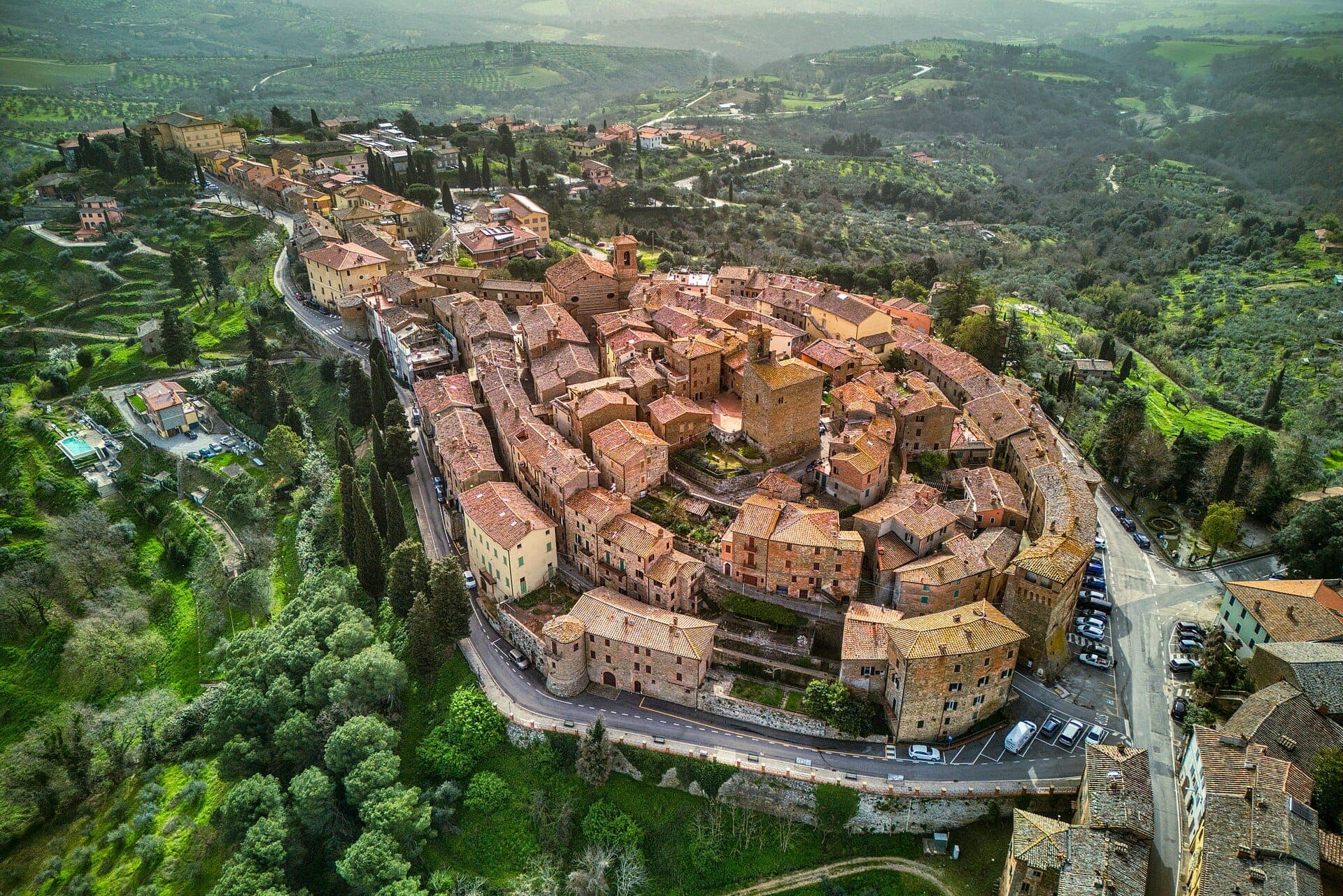
Panicale and Paciano stand on the hills south of the lake, near the Tuscan border, in two neighbouring municipalities. Both belong to the club "I Borghi più Belli d'Italia". Panicale is 450 metres above sea level, Paciano about 390.
A footpath links them too: from the village of Paciano to that of Panicale there is a scenic route of about 3 kilometres, which local guides call the landscape of Perugino. It shows how close they are, and if you have the legs for it you can walk it. To get there you need a car: these are hill villages, not lakeside ones.
Panicale: the village on three levels
The centre of Panicale keeps the layout of a medieval castle, with two entrances, one towards Perugia and one towards Florence, and three squares set in concentric circles. Entering by Porta Perugina you reach piazza Umberto I, with the octagonal travertine cistern of 1473 and the fourteenth-century Palazzo Pretorio. From there you climb: on the second level is the square of the collegiate church of San Michele Arcangelo, rebuilt in Baroque style in 1618, and at the top piazza Masolino, the highest point, from which the view takes in the lake and the borderlands between Umbria and Tuscany.
The village can be walked in no time, because it is small. Inside the walls the main stop is the collegiate church, which holds a Nativity of 1519 by Giovan Battista Caporali, a pupil of Perugino, and an Annunciation attributed to Masolino da Panicale.
Perugino, outside the walls
The work you come for is the Martirio di San Sebastiano, frescoed by Perugino in 1505. It is in the church of San Sebastiano, at the far end of the Borgo Regio, about 250 metres from the walls: it was built in the late fifteenth century next to a lazaretto, in a time of plague.
The fresco is signed and dated, and shows the saint tied to a column inside a portico of Renaissance architecture, with archers around him. Between the arches you can see hills and a piece of the lake: according to the Terre del Perugino circuit, that landscape is inspired by the view over Trasimeno that you get just outside the church. It is worth stepping out to look at that view after the fresco.
Visits to San Sebastiano change with the seasons
This is the point to check most carefully. At the time of writing, from June to September the church has daily opening hours. From October to March it can only be visited on the urban trekking tour that leaves from the Tourist Office, with booking recommended. From November to February the tour runs on Saturdays, Sundays and public holidays, with morning and afternoon departures; in March and October the days are different again.
The Terre del Perugino circuit publishes the up-to-date times on its San Sebastiano page, and for days other than those listed it invites you to write and ask for a visit. We do not repeat them in detail here precisely because they change: check them before you set out, and do not turn up on a winter weekday without having booked.
The guided visit includes San Sebastiano, the Teatro Cesare Caporali, the Museo del Tulle (the Tulle Museum) and the church of the Madonna della Sbarra, leaves from the Tourist Office and lasts two hours.
The theatre, one of the smallest in Italy
The Teatro Cesare Caporali is described as one of the smallest theatres in Italy. It has a horseshoe plan, two tiers of boxes and a gallery, all in wood decorated with stucco. It was rebuilt to a design by the architect Giovanni Caproni and opened to the public in 1858; the curtain, painted by Mariano Piervittori, shows the condottiero Boldrino da Panicale receiving the keys of Perugia.
It is still a working theatre, with a season of plays and a chamber opera festival. One practical point for those arriving by car: the theatre stands in a pedestrian zone, so you park outside and walk up, on some uphill stretches.
Tulle embroidery and the Madonna della Sbarra
Just outside Porta Fiorentina stands the sixteenth-century church of Sant'Agostino, since 2001 the Museo del Tulle: it collects the tulle embroidery of the ars panicalensis, a local craft revived at the start of the twentieth century. A little further on, the church of the Madonna della Sbarra, from 1625, with four large gilded angels on the high altar, now houses a collection of sacred objects and vestments.
These are the two lesser-known stops in Panicale, and they are included in the same guided visit as San Sebastiano and the theatre. Anyone who books that does not need to organise these separately.
Paciano: walls, lanes and no hurry
Paciano has a fan-shaped layout of thirteenth-century origin, on three parallel streets joined by lanes. The village is enclosed by a fourteenth-century wall of about 600 metres, with eight towers and three gates: Fiorentina, Perugina and Rastrella. Entering by Porta Rastrella you come to Palazzo Cennini, which is private, and a little further on the Etruscan well, restored in the 1990s, from which the trail of the village's ancient waters begins.
In piazza Repubblica stands the stone town hall, and a little further on the seventeenth-century Palazzo Baldeschi, with a hanging garden: it houses the multimedia museum TrasiMemo, the Banca della Memoria del Trasimeno (Trasimeno's memory bank), devoted to local trades and know-how. For paintings there is the Museo Parrocchiale (parish museum) in the church of San Giuseppe and the picture gallery in via della Pitalessa, with a Crucifixion of 1452.
Paciano has no single work to photograph like Panicale's Perugino. It is a place for walking, where the best parts are the circuit of the walls, the views towards the lake, the Val di Chiana and Monte Amiata, and the olive groves around the village. If you are looking for one monument, you will not find it here.
The right order, watch in hand
The order we recommend is Panicale in the morning and Paciano in the afternoon, for a precise reason: in Panicale the times are fixed, in Paciano they are not. Reach Panicale with a little margin before the guided visit starts, so you have time to park and get to the Tourist Office: the visit lasts two hours, and then you are free.
Then lunch, in either village, and Paciano for the rest of the afternoon. A practical rule that comes from knowing the places: do not leave Paciano until last if the light fades early. In winter the sun sets early, and the walls are better appreciated in good light.
If you have more time you can walk the 3 kilometres between the two villages, but then you need to plan the return: these are two villages, not a loop. If you have less, do Panicale only: Paciano can wait.
What is not worth the detour
Honestly: if you are short of time and not interested in art, Panicale on its own is worth more than the two together. Paciano is pleasant but quiet, with very little to visit indoors; we do not publish opening times for the Museo Parrocchiale and the picture gallery, so ask Paciano's information office before counting them as a stop.
And Perugino is not Città della Pieve: there the master left more works, in the same centre. If you only have time for one village with Perugino, read Città della Pieve: Perugino's birthplace and choose according to the works you want to see.
Widening the loop
The two villages fit well into a wider tour of the lake. If you also want to see the shore, you will find the rest in Castiglione del Lago: a guide to the town. For everything else, our things to do page lines up the stops in the area, and our rooms are handy for coming back to sleep without moving your luggage.
Frequently asked questions
How long do you need to see Panicale and Paciano?
Half a day is enough for both if you choose what to do in Panicale. The guided visit covering San Sebastiano, the theatre and the Museo del Tulle takes two hours; for Paciano, in our view, a couple of hours on foot without rushing is plenty.
Where can you see Perugino in Panicale?
In the church of San Sebastiano, outside the centre, about 250 metres from the walls. The fresco of the Martirio di San Sebastiano is signed and dated 1505 and has a landscape on the back wall that recalls Lake Trasimeno.
Is the church of San Sebastiano always open?
No. From June to September it has daily opening hours; from October to March it can only be visited on the urban trekking tour leaving from the Tourist Office, with booking recommended. The times are published and kept up to date by the Terre del Perugino circuit, so look before you set out.
Can you drive up to the Teatro Cesare Caporali?
No, the theatre is in a pedestrian zone of the historic centre. You park outside and walk up, with some uphill stretches.
Is Paciano really one of the most beautiful villages in Italy?
Yes, it belongs to the club "I Borghi più Belli d'Italia", as Panicale does. The reason is its almost intact medieval layout, with the fourteenth-century walls and the olive-grove landscape around.
Can you walk from Paciano to Panicale?
Yes, there is a scenic route of about 3 kilometres, described as the "landscape of Perugino". It starts at Porta Perugina in Paciano and passes the Torre di Orlando and the remains of Paciano Vecchio.
- Chiesa di San Sebastiano - Panicale, Umbria Tourism
- Teatro Cesare Caporali - Panicale, Umbria Tourism
- Paciano, borgo medievale sulle colline del Trasimeno, Umbria Tourism
- Panicale, terra di artisti e condottieri, I Borghi più belli d'Italia
- Paciano, silenzio, natura e pace, I Borghi più belli d'Italia
- Chiesa di San Sebastiano, orari di apertura e visite, Terre del Perugino
- Teatro Cesare Caporali, orari e visite, Terre del Perugino
- Paciano, piccola perla tra il monte e il lago, Terre del Perugino
Bruno e Marisella Batinti
Owners and hosts of Le Torri di Porsenna
Bruno and Marisella Batinti own Le Torri di Porsenna, the abbey they found derelict in 2014 and brought back as a charme agriturismo on the Umbria-Tuscany border. They live here all year: the roads, villages and seasons L'Almanacco writes about are the ones they drive every week.