
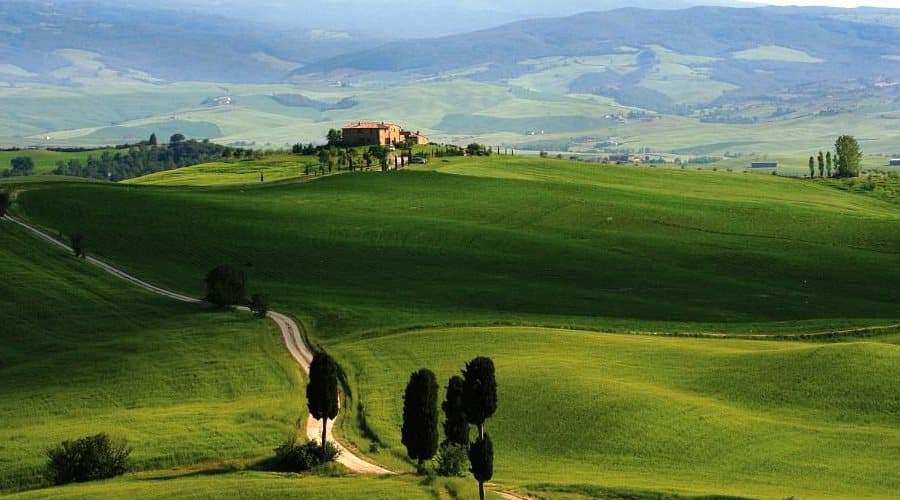

On the SR2 just outside San Quirico d'Orcia there is a bend that people have already renamed "the cypresses" on Google Maps. On a summer weekend it has another feature too: cars parked wherever they stop, doors open, engines running, and visitors walking into the wheat field for the right shot. The farmer next door has put up signs banning drones, and the local council has copyrighted commercial use of images of the grove. It is the most photographed landscape in Tuscany, and one of the few places where the average visitor spends more time looking for somewhere to park than looking at what is in front of them.
In short: Pienza and the Val d'Orcia make an easy day out, but not if you only stop at the viewpoints along the SR2. This guide covers the town Pope Pius II had built as a Renaissance model, the pecorino still sold on the same street, the square in Bagno Vignoni that is literally a thermal pool, the fields where Ridley Scott filmed Gladiator, and where it is actually worth leaving the car.
It is written for anyone with a free day from our agriturismo on Lake Trasimeno. We are in Umbria on the Tuscan border, near Lake Trasimeno, roughly between Florence and Rome, and this stretch of countryside needs a car. Pienza is 46 minutes from us. The Val d'Orcia, meaning the cypresses, Bagno Vignoni and San Quirico d'Orcia, is 52 minutes.
Pienza, the town a pope wanted to be ideal
Pienza was called Corsignano when Enea Silvio Piccolomini was born there in 1405. Elected pope in 1458 as Pius II, he returned to his birthplace the following year and decided to rebuild it according to the ideals of his age: a town designed on paper to embody Renaissance harmony, rather than one that had simply grown over centuries like everywhere else.
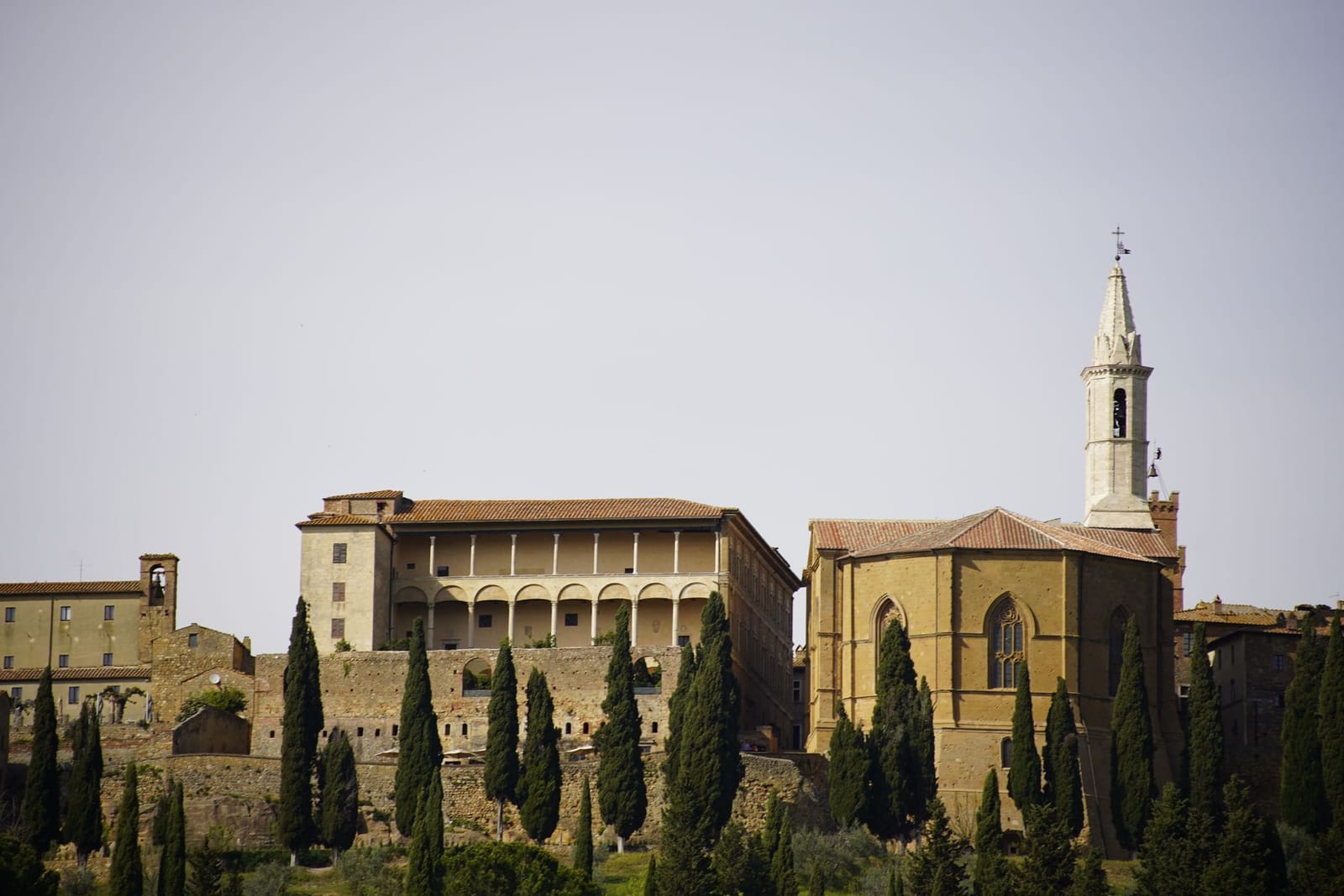
He gave the project to Bernardo Rossellino, a pupil of Leon Battista Alberti. The work, between 1459 and 1462, laid out Piazza Pio II with the Palazzo Piccolomini, the Palazzo Vescovile and the cathedral, consecrated on 29 August 1462. Inside, the cathedral follows the plan of a German hall church, the kind Pius II had seen during his years as a prelate north of the Alps: an unusual choice behind its Tuscan Renaissance exterior.
That is why Pienza's historic centre has been a UNESCO World Heritage Site since 1996, listed as the first application of the Renaissance humanist concept of urban design. It is a separate, older listing than the one covering the Val d'Orcia as a whole, which only followed in 2004. Few visitors realise these are two distinct recognitions, for two different reasons.
The centre on foot, and where to leave the car
Pienza's historic centre is a restricted traffic zone: cars do not go in. Visitors park outside the walls, in the council car park on Via Mario Mencatelli north of town, or along Via San Gregorio, on the provincial road by the petrol station.
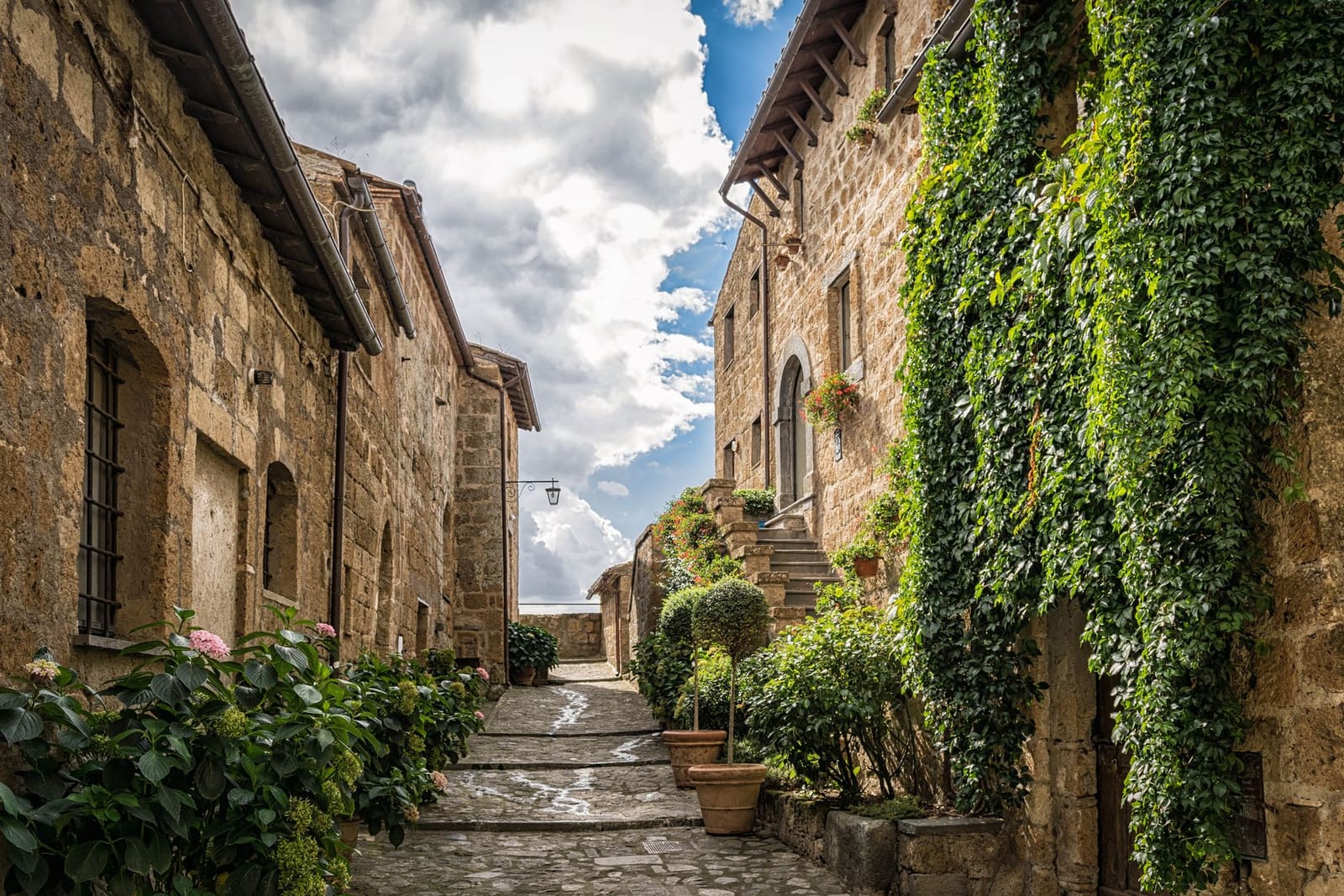
From there, you walk. Corso Rossellino crosses the whole centre in a few minutes, but it is the row of small pecorino shops, one after another, that slows you down more than the street's actual length. The Palazzo Piccolomini, with its hanging garden looking out over the Val d'Orcia and Monte Amiata, is open to visit: it is the spot where it is easiest to understand why Pius II chose this particular hill for his project. Anyone who likes waking up to that kind of view can find something similar closer to home in our treehouse stay between Umbria and Tuscany.
Pienza's pecorino, without a protected label, and not needing one
Pienza's pecorino is made with milk from sheep grazing the Sienese clay hills around the town, poor land that has given more wool and milk than crops for centuries. Local food history says Lorenzo de' Medici travelled from Florence for it in the fifteenth century.
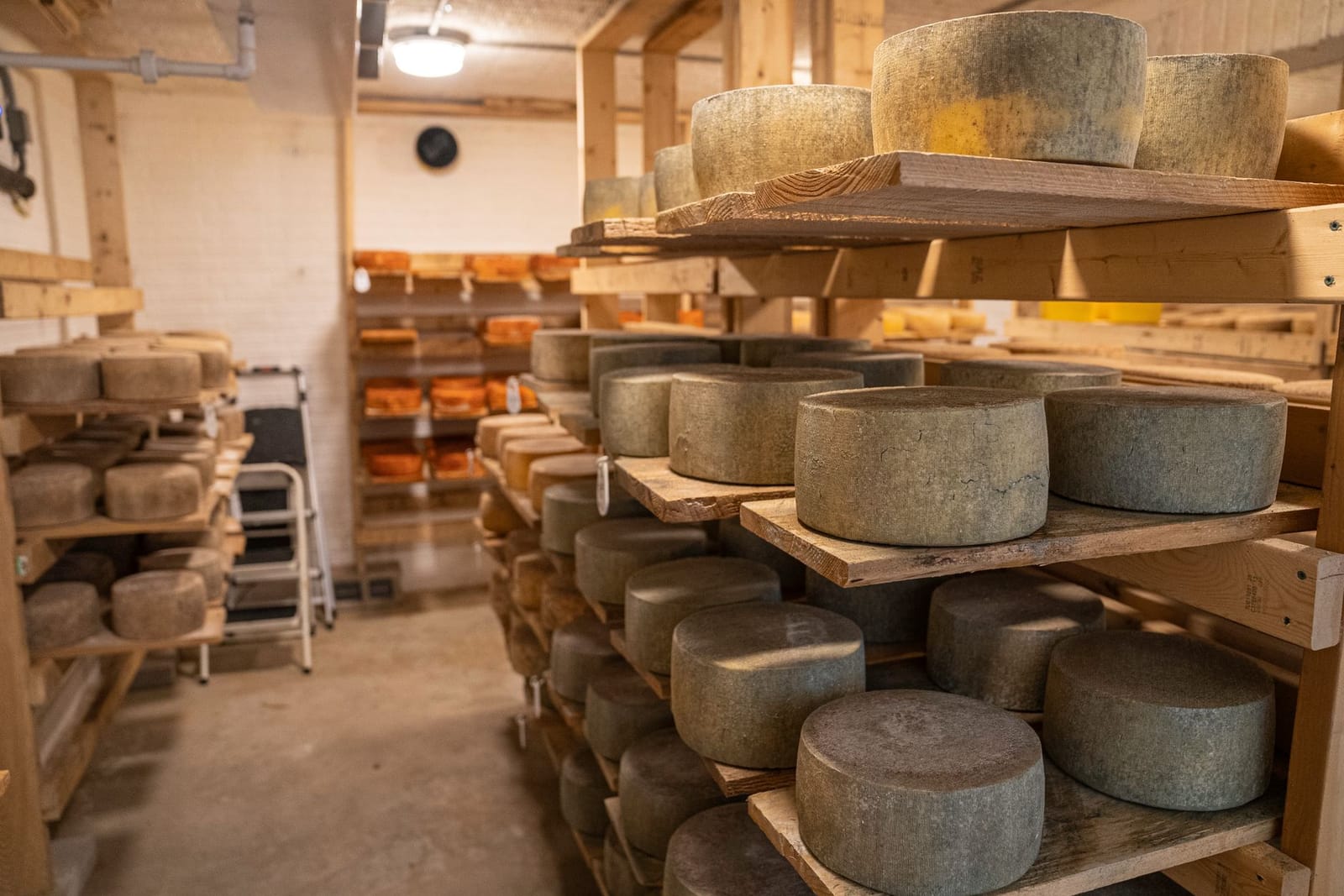
Unlike other Italian pecorino cheeses, Pienza's has never received EU Protected Designation of Origin status: in the 1990s, when the specifications were being drawn up, the large producers had no interest and the small ones lacked the political weight to push it through. The practical result today is that imitations carrying the same name, with no real link to the area, do circulate: the safest approach is to buy it directly from the shops in the centre, not to trust the label.
Every year, in the week of the first Sunday of September, the town hosts the Fiera del Cacio: pecorino stalls line the whole street, alongside the game of cacio al fuso, a form of bowls played by rolling a wheel of cheese towards a spindle fixed in the middle of the square.
The Val d'Orcia is a landscape, not a single place
The Val d'Orcia UNESCO site covers more than 61,000 hectares between the hills south of Siena and Monte Amiata, taking in the municipalities of Pienza, San Quirico d'Orcia, Castiglione d'Orcia, Radicofani and Montalcino. It is not a monument, nor a single view: it is the whole way farming and hilltop fortified villages were arranged during the Renaissance around an idea of "well governed" landscape, meant to be beautiful as well as productive.
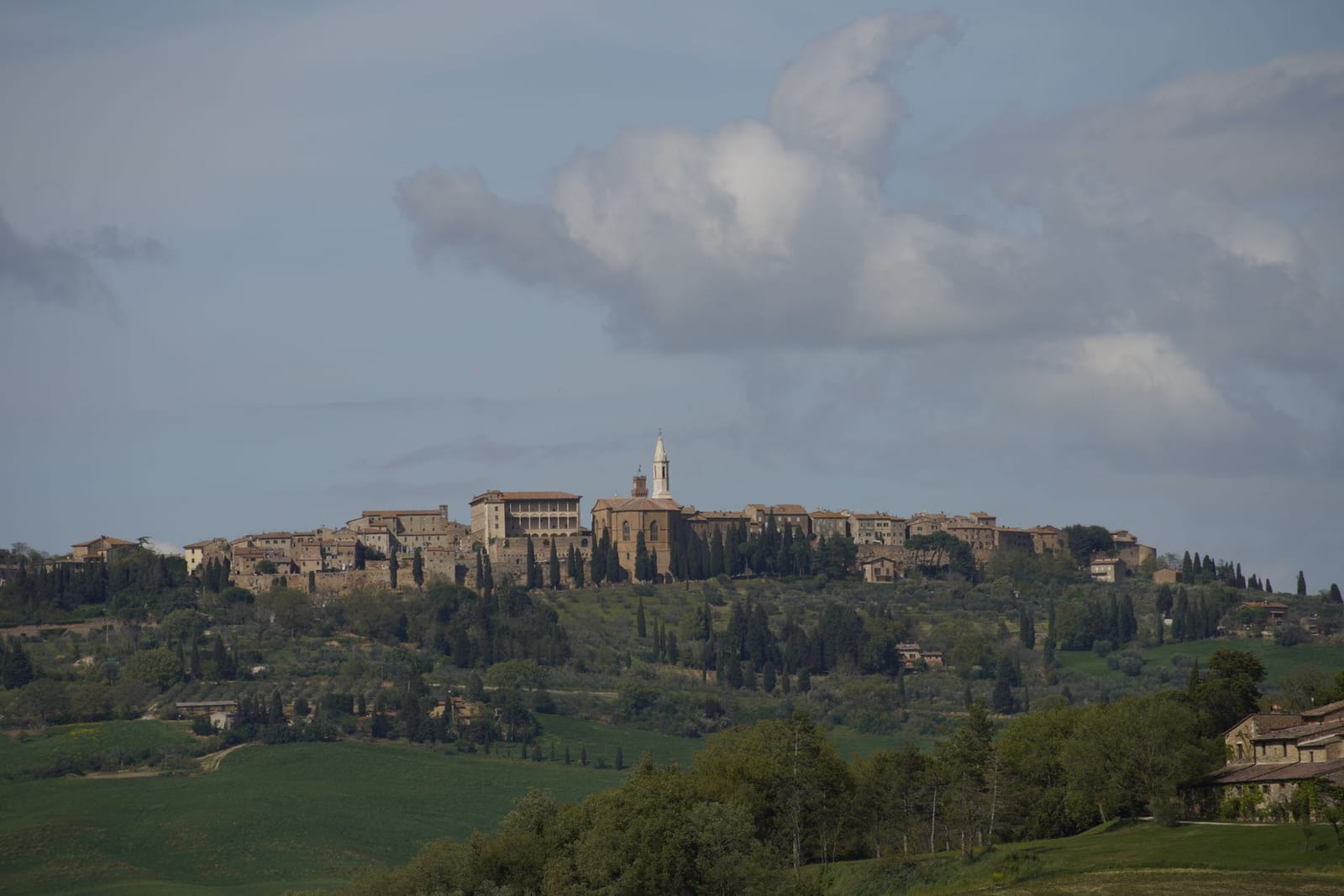
That, more than any single photograph, is why the Val d'Orcia is a World Heritage Site. Knowing that before you arrive helps you look past the single cypress tree: the point is not the tree, it is the whole hill around it.
The most photographed cypresses, and why it is worth stopping elsewhere
The best known group of cypresses stands along the SR2, the old Via Cassia, just north of San Quirico d'Orcia, in a small spot called I Triboli: a ring-shaped grove on a rise among cultivated fields, with a small car park on either side of the road. A few minutes' walk away, up a dirt track beside the main grove, there is a second, smaller and quieter one.
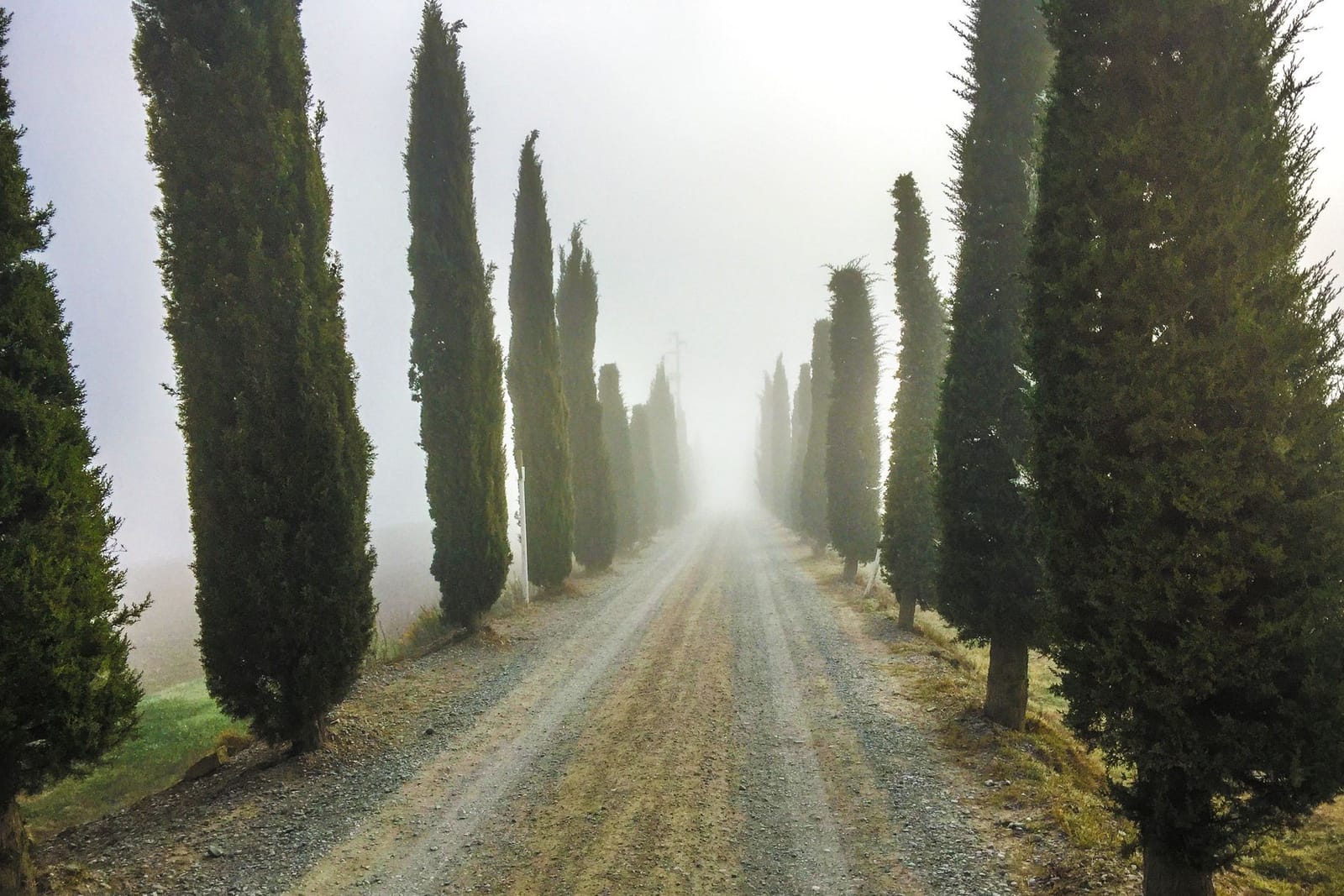
Honestly, though, it is one of the least relaxing spots in the whole Val d'Orcia during high season. On the same Via Cassia, near Podere Poggio Covili in the municipality of Castiglione d'Orcia, coaches have been documented stopping on bends, cars parked in the middle of the road, and tourists walking into rows of wheat and alfalfa for a better shot, with real damage to the crops.
That is not a reason to skip the area, but to change the time of day: early morning or late afternoon, when the light is better for a photograph anyway, the traffic thins out and the fields stay fields rather than becoming something to walk through.
Where Ridley Scott filmed Gladiator
Part of the reason this stretch of the Val d'Orcia is so recognisable is that cinema used it deliberately to stand in for paradise. The wheat field scenes Maximus walks through, in his dream and at the end of Gladiator, released in 2000, were filmed along the dirt road at Terrapille, about three kilometres south of Pienza: the spot now has a small car park and a viewing terrace, and has become as fixed a stop as the San Quirico cypresses.
The scenes at Maximus's home in Spain were filmed instead near San Quirico d'Orcia, at the Poggio Manzuoli farm, recognisable by the cypress avenue leading up to the building.
Bagno Vignoni, the square that is a pool
In Bagno Vignoni, the main square does not have a fountain at its centre. It has a rectangular pool of thermal water, ringed by porticoes, which has given the village its name since the Middle Ages. Catherine of Siena bathed there, during a stay between 1362 and 1367; Enea Silvio Piccolomini sought relief for his gout there too, before becoming Pope Pius II, and Lorenzo de' Medici for his arthritis. In the fifteenth century, under Piccolomini's own patronage, it was Bernardo Rossellino, the architect of Pienza, who built the Renaissance loggia around the pool.
Today, swimming in that pool, the Piazza delle Sorgenti, is not allowed: it is a protected monument. The Parco dei Mulini just outside the village, where the thermal water flows freely down towards the old mills, is also closed to bathing under a council order. Anyone who genuinely wants to get into the hot water can do so at the thermal pools of a few hotels in the village, which are open to day visitors as well as guests.
San Quirico d'Orcia and Monticchiello, the villages left behind
San Quirico d'Orcia is a historic stop on the Via Francigena, the pilgrim route that once linked Canterbury to Rome. Inside its walls are the Horti Leonini, a Renaissance garden commissioned around 1580 by Diomede Leoni on land granted by Francesco I de' Medici. Unlike most gardens of its time, it was designed as public space from the start, meant to welcome passing pilgrims: box hedges laid out in a cross pattern, an avenue of holm oaks, a statue of Cosimo III de' Medici at the centre. The council has owned it since 1975 and keeps it open every day.
Monticchiello, a hamlet of Pienza on a hill a little further south, is instead the kind of place you can arrive at and find the square empty even in August, except for one thing. Every summer, without a break since 1967, its residents write and perform a play about their own history, in the village square. It began as a response to the collapse of the sharecropping system that was emptying the village out: the Teatro Povero di Monticchiello remains one of the few surviving examples of popular "autodramma" theatre in Italy.
The valley's wine: Orcia DOC, not Vino Nobile
The Val d'Orcia has its own appellation, the Orcia DOC, distinct from the Vino Nobile di Montepulciano, which we have written about separately. The rules call for Sangiovese-based reds, at least 60% of the blend, and Trebbiano-based whites, at least 50%, with a maximum yield of 10 tonnes per hectare. These are different vineyards from Montepulciano's, scattered across the hills of San Quirico d'Orcia, Castiglione d'Orcia and Pienza itself, producing wines less known outside the area but made to go with local food: pici pasta, pecorino, wild boar.
Anyone already planning a day around wine would do better to choose between the two rather than add them both to the same day as Pienza and Bagno Vignoni: the road does not comfortably hold both.
How to plan the day
Allow a full day to do Pienza, Bagno Vignoni and a third village, either San Quirico d'Orcia or Monticchiello, properly, without adding a fourth stop just because it is on the same map. Start early: Pienza is best seen before the coaches arrive mid-morning, and leaving the San Quirico cypresses for the way back, towards evening, avoids both the queue and the flat midday light.
If your stay allows for more than one day across the border, Cortona in a day is the nearest Tuscan trip from here, and our guide to what to see at Lake Trasimeno covers the days spent instead just a few minutes from home, well short of the border. For the rest of Umbria beyond the lake, see things to do in Umbria.
Frequently asked questions
How far is Pienza from Le Torri di Porsenna?
Pienza is 46 minutes by car. It is the first Tuscan stop on this day out, and the nearer of the two.
Why do Pienza and the Val d'Orcia have two different drive times, if Pienza is part of the Val d'Orcia?
Because we measure the two separately. Pienza, the town, is 46 minutes away; the rest of the area, where the San Quirico d'Orcia cypresses and Bagno Vignoni are, is 52. Pienza is part of the Val d'Orcia UNESCO site, but it is also a town in its own right, with its own distance from us.
Can you swim in the thermal pool at Bagno Vignoni?
No. The historic pool in Piazza delle Sorgenti is a protected monument and swimming is banned, as it is in the nearby Parco dei Mulini. To actually get into the area's hot water, use the thermal pools at a few hotels in the village, which are open to non-guests too.
Where were the Gladiator wheat field scenes filmed?
Along the dirt road at Terrapille, about three kilometres south of Pienza. The scenes at Maximus's home were filmed instead near San Quirico d'Orcia, at the Poggio Manzuoli farm.
How do you avoid the queue of cars at the Val d'Orcia's most photographed cypresses?
Go early in the morning or late in the afternoon, not in the middle of the day on a summer weekend, when traffic on the SR2 near San Quirico d'Orcia genuinely grinds to a halt. The same applies to the Terrapille road and the famous curved cypress avenue near Castiglione d'Orcia that became an advertising icon, both as much a photo stop as I Triboli.
Can you see Pienza and the Val d'Orcia properly in a single day?
Yes, if you choose one further village, either San Quirico d'Orcia or Monticchiello, rather than adding both. Trying to fit in Montalcino too, or a full day of wine on top, means rushing everything.
- Val d'Orcia, Wikipedia
- Pienza, Wikipedia
- Palazzo Piccolomini, Pienza, Wikipedia
- Bagno Vignoni, Wikipedia
- Bagno Vignoni: cosa vedere, dove fare il bagno e altre info, Colli Senesi
- Bagno Vignoni, la grande vasca rettangolare dove si bagnarono Santa Caterina da Siena e..., La Mia Terra di Siena
- Bosco dei Cipressi di San Quirico d'Orcia - Tutte le info per la visita, Lorenzo Taccioli
- Overtourism in Val d'Orcia: il turismo di massa minaccia il paesaggio, SiViaggia
- Set of the film 'The Gladiator' - Terrapille farm road, Val d'Orcia
- Storia del Teatro Povero, Teatro Povero di Monticchiello
- Horti Leonini, Wikipedia
- Tappa 36: da San Quirico d'Orcia a Radicofani, Visit Tuscany
- Fiera del Cacio, Pienza, Sagre Toscane
- Italy's Coveted PECORINO DI PIENZA, Cheese Connoisseur
- Dove parcheggiare a Pienza, Informagiovani Italia
Bruno e Marisella Batinti
Owners and hosts of Le Torri di Porsenna
Bruno and Marisella Batinti own Le Torri di Porsenna, the abbey they found derelict in 2014 and brought back as a charme agriturismo on the Umbria-Tuscany border. They live here all year: the roads, villages and seasons L'Almanacco writes about are the ones they drive every week.