
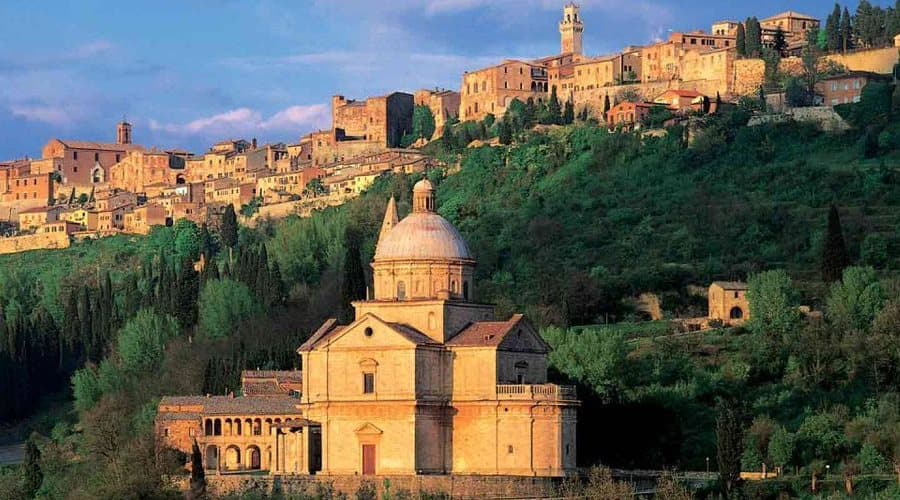

We ask most guests staying more than two nights whether they have a plan for their free day. The most common answer is "we thought we would do a Tuscany day", said as though it meant driving somewhere else entirely. From Le Torri di Porsenna, our agriturismo (a working estate with guest rooms) in Umbria, it is a 30-minute drive to Montepulciano: closer than it looks on a map of Italy, and already over the regional border.
In short: Montepulciano can be seen properly in a day, but the wine that carries its name is worth understanding before you drink it. This guide covers what to see in the historic centre, how the cellars cut into the tufa beneath the Renaissance palaces actually work, what Vino Nobile DOCG really is, and the hours when the town changes character because of coach traffic.
It is written for anyone staying with us who has one free day, a car, and enough curiosity to want to know what they are drinking before they order it at dinner.
What makes Vino Nobile different from an ordinary Sangiovese
Vino Nobile di Montepulciano is a DOCG wine made with at least 70% Prugnolo Gentile, the local name for a Sangiovese clone that has adapted to these hills over centuries. The rest of the blend comes from other red grapes, with a small allowance for white ones: the only aromatic variety permitted is Malvasia bianca lunga.
The production rules require a minimum of two years' ageing before release; the Riserva needs at least three. That is not a bureaucratic footnote: it is the reason a young Vino Nobile and one with a few extra years on the label taste like two different wines, even from the same vineyard.
On 1 July 1980, Vino Nobile became the first Italian wine to carry the neck strip of the Denominazione di Origine Controllata e Garantita, Italy's highest wine classification. The producers' consortium, founded in 1965, still keeps the first set of neck strips ever printed. The poet and physician Francesco Redi had already crowned it in verse back in 1685: "Montepulciano d'ogni vino è il Re", Montepulciano is king of every wine.
Cellars cut into the tufa, beneath the Renaissance palaces
Underneath Montepulciano's historic centre runs a parallel town, carved out of the soft volcanic tufa rock: galleries and cellars that open up beneath several palaces along the Corso, the town's main street. Palazzo Ricci, commissioned by Cardinal Giovanni Ricci in 1534 to a design by Baldassarre Peruzzi, has cellars built on medieval foundations. Palazzo Contucci, built in the sixteenth century to a design by Antonio da Sangallo the Elder, has cellars older than the palace itself.
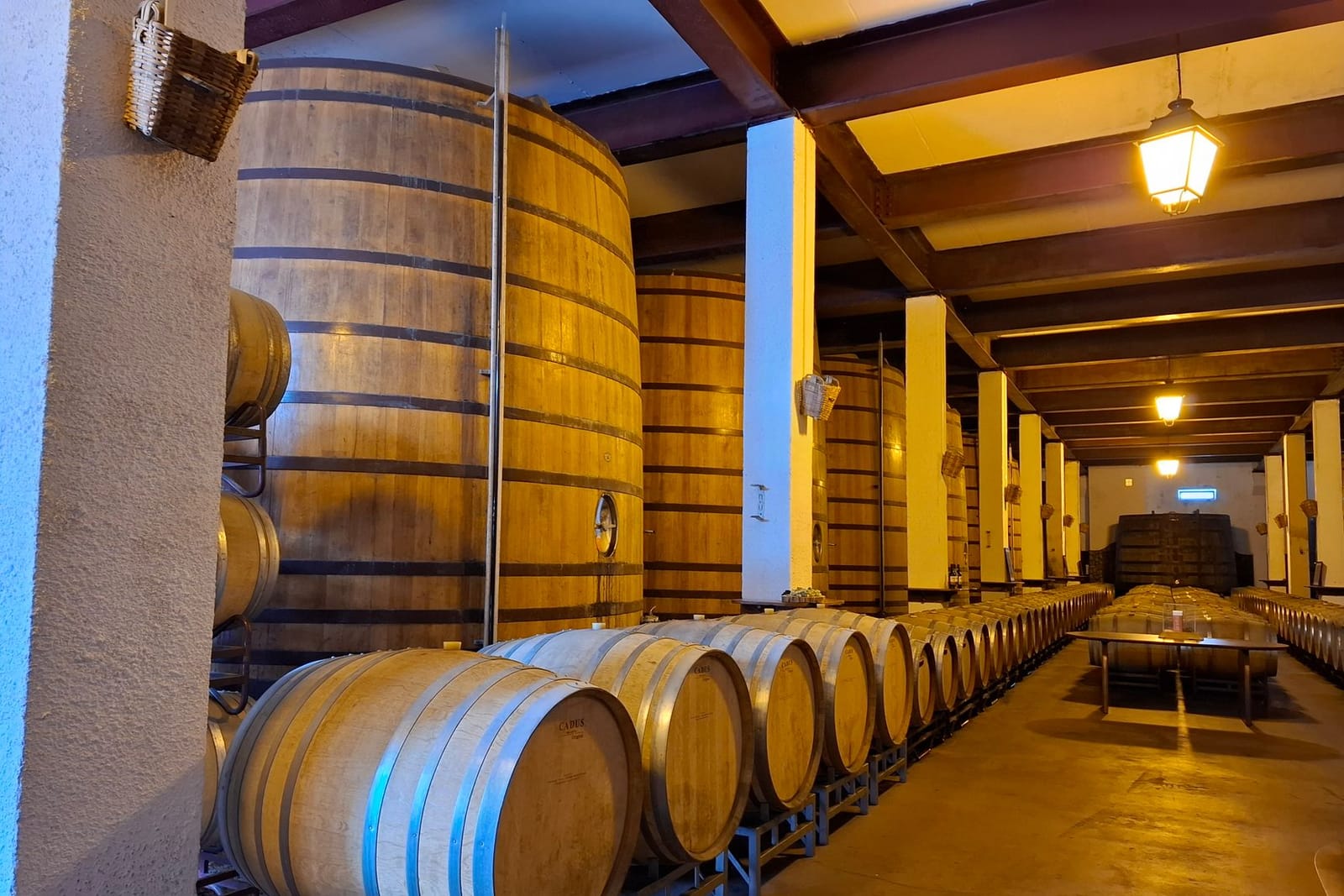
Inside the galleries are large wooden barrels, many still handmade, where Vino Nobile completes the ageing required by law. Some of the underground routes have also turned up Etruscan tombs, evidence that people were digging here long before the wine arrived.
Visiting conditions vary from cellar to cellar: some keep regular hours, others work by appointment only or at certain times of year. Check with the individual producer before you go rather than assume you can simply walk in.
The Palazzo Comunale tower, and what you can see from the top
The Palazzo Comunale, on Piazza Grande, dates from the thirteenth century but was remade in the fifteenth by Michelozzo, the same architect who worked in Florence for the Medici: the resemblance to the Palazzo Vecchio is no accident.
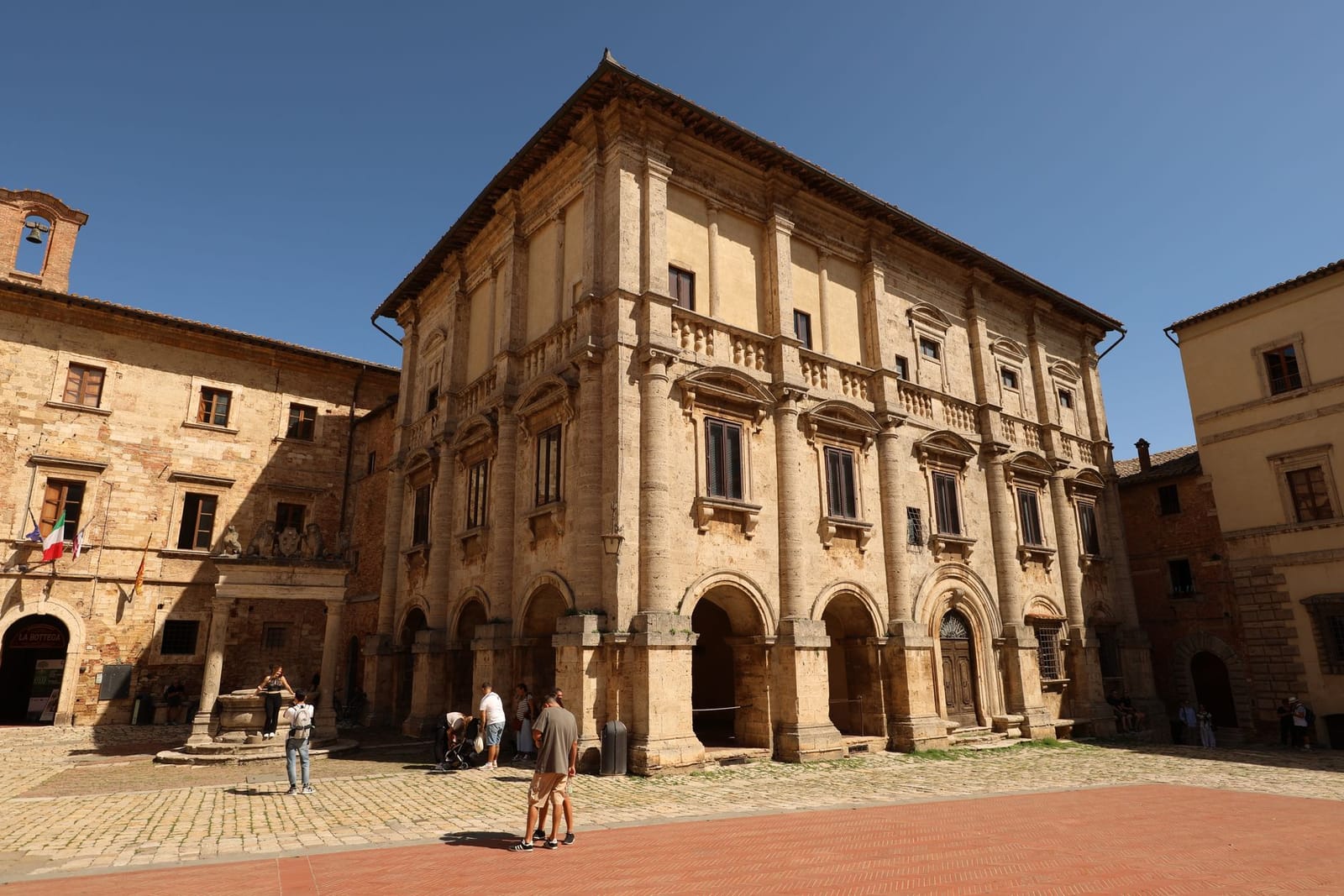
You can climb the tower. From one side you look over the Valdichiana with the lakes of Montepulciano, Chiusi and Trasimeno, as far as the Apennines. From the other, Monte Amiata, the Val d'Orcia, Pienza, Montalcino and, in the distance, the towers of Siena. On the clearest days you can even pick out the lake you set off from that morning.
The staircase is narrow and steep, with no easier alternative: anyone with knee problems or a fear of heights is better off enjoying the view from Piazza Grande instead.
The Tempio di San Biagio, standing alone outside the walls
The Tempio di San Biagio is the most isolated and most photographed building in Montepulciano: it stands by itself on a meadow just outside the town walls, rather than pressed between other buildings like the rest of the centre.
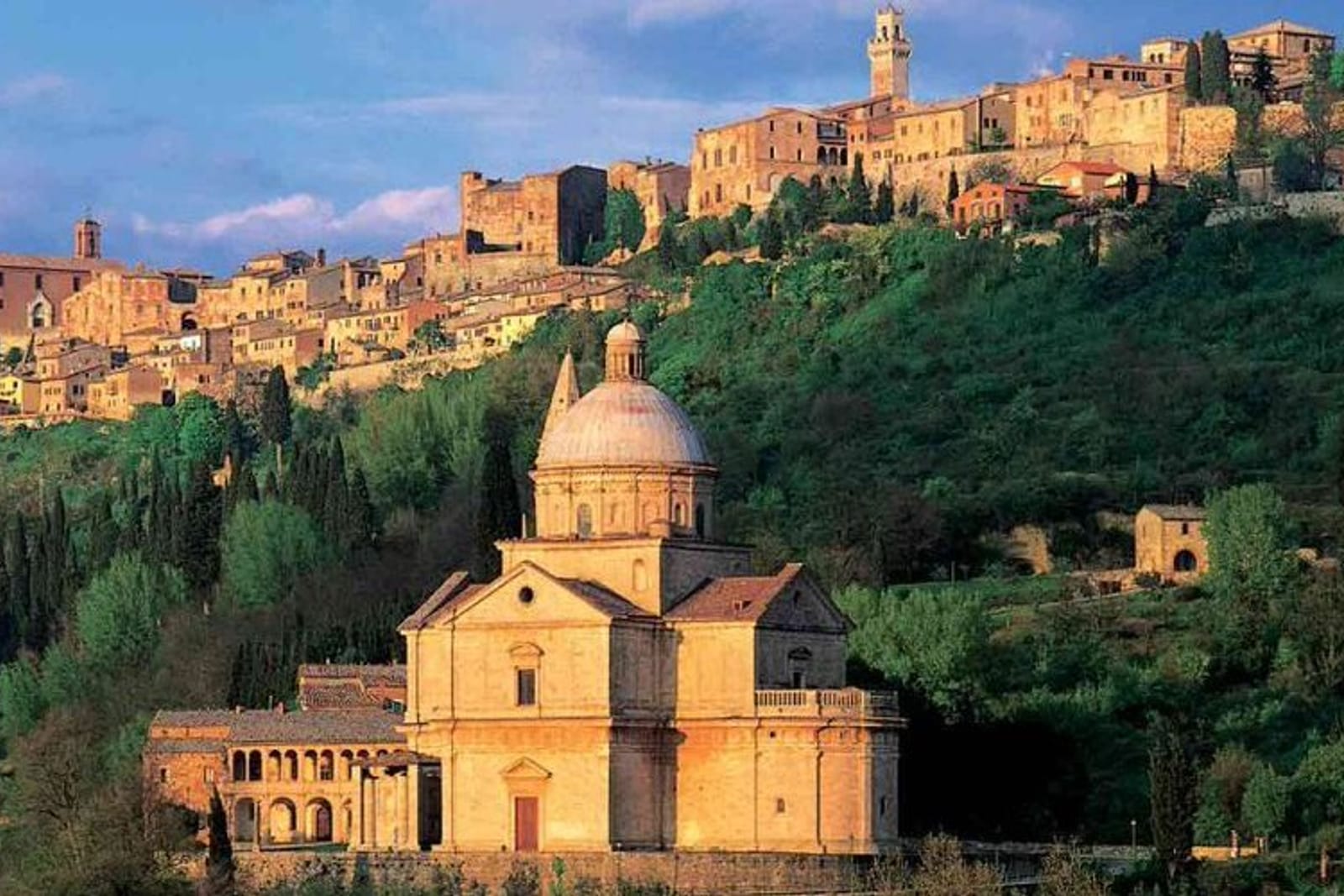
Antonio da Sangallo the Elder began building it in 1518, on a Greek-cross plan inspired by the basilica of Santa Maria delle Carceri in Prato, the work of his brother Giuliano, and by Bramante's design for St Peter's in Rome. The dome, thirteen metres across, was completed between 1536 and 1544.
Of the two bell towers the design called for, only one was ever finished, in 1564. That kind of unfinished ambition turns up elsewhere in Montepulciano too: the facade of the Duomo on Piazza Grande, built between 1586 and 1680 and not consecrated until 1712, is still bare brick.
The Corso, the street that climbs in an S
Montepulciano's historic centre sits inside three rings of fourteenth-century walls and forms an S-shape you can pick out clearly on a map. The main street, which everyone calls the Corso even though it changes name several times along the way, climbs from the Porta al Prato up to Piazza Grande, tracing that exact S.
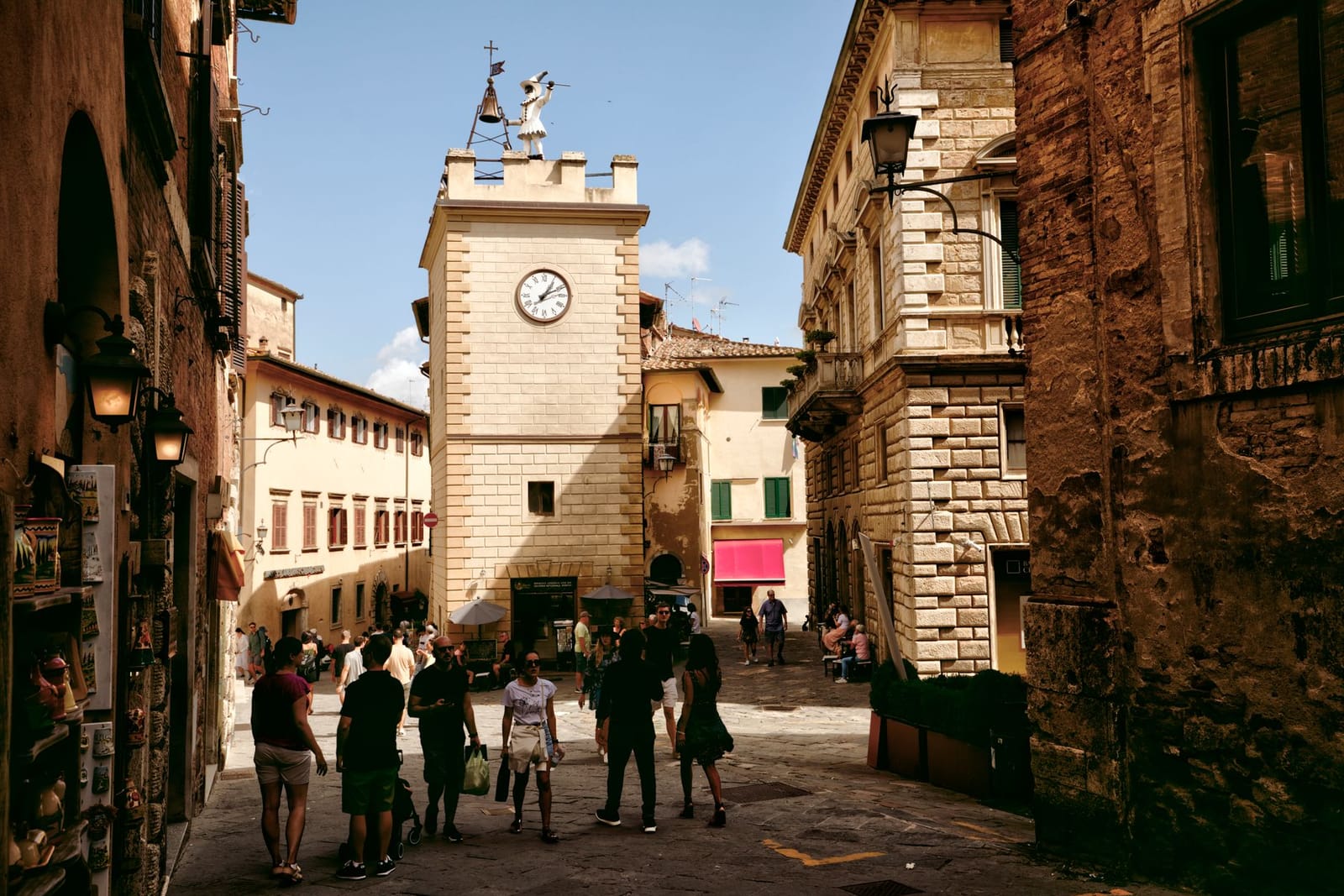
Renaissance palaces line both sides, built between the early fifteenth century and the mid-sixteenth, the period when Antonio da Sangallo the Elder, Vignola, Baldassarre Peruzzi and, later, Ippolito Scalza all worked here in turn. Walking the whole length without stopping takes a little over ten minutes: it takes longer the moment you pause at every doorway, which is almost impossible not to do.
The Bravio delle Botti, if your stay lines up with it
On the last Sunday of August, eight districts of Montepulciano compete in the Bravio delle Botti: two athletes per team push a barrel weighing around 80 kilograms uphill by hand, from the lower part of town all the way to Piazza Grande. The districts are Cagnano, Collazzi, Coste, Gracciano, Poggiolo, San Donato, Talosa and Voltaia, and the prize is a painted banner.
The race has old roots: a municipal statute from 1373 already set out its rules, then run on horseback, in honour of the town's patron saint. The horse race was banned in the seventeenth century on public-order grounds; the barrel version is more recent, introduced in 1974 by a local parish priest.
If your stay falls on that Sunday, stay into the evening: it is one of the few days of the year when Montepulciano fills up with local people rather than passing visitors.
The coaches, and the hours when Montepulciano is a different town
Honestly, Montepulciano runs on coach tourism, and that is the price it pays for sitting so close to Siena, Florence and the Val d'Orcia. Between late morning and early afternoon, in the busier months, the car parks outside the walls fill up and the stretch between Porta al Prato and Piazza Grande turns into more of a queue than a walk.
Arrive before ten, or come back after five in the afternoon, and you find a different town: the same streets, without the crush, and shopkeepers who have time to talk instead of working through a queue. That is not a small detail, because it is exactly during the busy midday hours that many of the shop windows selling local produce are aimed at people who will never come back, rather than at anyone who knows the difference.
Since you will be sleeping back with us that night either way, the simplest approach is to arrive early and be on your way again before the bulk of the coaches unload around midday.
What to bring home, and the wine it gets confused with
Vino Nobile is often the wrong bottle to pick if you want something to drink that same evening: it needs time. Rosso di Montepulciano, made with the same grapes but requiring a shorter minimum ageing, is the version meant to be drunk young, and it is what we would suggest for a plate of pasta with meat ragù the same night.
One last warning for any wine shop outside Italy: Vino Nobile di Montepulciano and Montepulciano d'Abruzzo have nothing in common beyond the name. The first is made with Prugnolo Gentile on these Tuscan hills; the second with the Montepulciano grape, grown in Abruzzo, a different region altogether, well away from here. Ask a shop simply for "a Montepulciano" and you risk going home with a completely different wine.
From here to Montepulciano, and what lies in between
From Le Torri di Porsenna to Montepulciano it is a 30-minute drive, crossing the border between Umbria and Tuscany almost without noticing: there is no large sign, just the countryside changing colour slightly. On the same road, a little earlier, you pass Chiusi and Città della Pieve, both 20 minutes from us.
If your trip allows for more than one day out, line up Pienza, 46 minutes away, and the Val d'Orcia, 52: they are the natural continuation of a day in Montepulciano, not a separate excursion. If you are basing yourself on the lake instead, read what to see at Lake Trasimeno and, if your trip allows for it, Cortona in One Day, the other excursion that works just as easily from here. For the rest of the region, our guide to things to do in Umbria sets out the towns and the seasons in full. Umbria and this stretch of southern Tuscany are best explored by car; buses exist but are built for local timetables, not for visitors moving between towns.
For a two-night stay built around wine and a slower pace, see a romantic weekend in Umbria. Back with us in the evening, the Vino Nobile you tasted in a cellar can turn up again at our restaurant, which cooks Umbrian and Tuscan dishes side by side: the simplest way to close the day without getting back in the car. Anyone planning the stay around it can see every room at our agriturismo on Lake Trasimeno.
Frequently asked questions
How far is Montepulciano from Le Torri di Porsenna?
A 30-minute drive, crossing the border between Umbria and Tuscany. It is the closest Tuscan hill town you can reach from here in an afternoon.
What exactly is Vino Nobile di Montepulciano?
A DOCG wine made with at least 70% Prugnolo Gentile, a local Sangiovese clone, aged a minimum of two years, three for the Riserva. In 1980 it became the first Italian wine to receive DOCG status.
Are Vino Nobile di Montepulciano and Montepulciano d'Abruzzo the same wine?
No, they share only a name. The first is made with Prugnolo Gentile on these Tuscan hills; the second with the Montepulciano grape, grown in Abruzzo.
Do you need to book ahead to visit the underground cellars?
It depends on the producer. Some cellars keep regular opening hours, others work by appointment only. It is worth checking with the individual cellar before you go rather than assuming you can simply walk in.
When is the Bravio delle Botti held?
On the last Sunday of August, when eight districts compete pushing barrels weighing around 80 kilograms uphill to Piazza Grande.
What is the best time of day to visit Montepulciano without the crowds?
Before ten in the morning or after five in the afternoon, when the coach parties have not yet arrived or have already left.
- Montepulciano, Wikipedia
- Vino Nobile di Montepulciano, Wikipedia
- Vino Nobile di Montepulciano, Wikipedia
- Chiesa di San Biagio (Montepulciano), Wikipedia
- Duomo di Montepulciano, Wikipedia
- Nobile Wine, Consorzio Vino Nobile di Montepulciano
- Bravìo delle Botti of Montepulciano | Il Bravìo, Bravio delle Botti
- Riaprono al pubblico il 1° aprile la Torre e la terrazza del Palazzo comunale, Comune di Montepulciano
- Montepulciano and the underground cellars - IL PATRIARCA - 4-stars Villa Hotel in Chiusi, Il Patriarca

Bruno e Marisella Batinti
Owners and hosts of Le Torri di Porsenna
Bruno and Marisella Batinti own Le Torri di Porsenna, the abbey they found derelict in 2014 and brought back as a charme agriturismo on the Umbria-Tuscany border. They live here all year: the roads, villages and seasons L'Almanacco writes about are the ones they drive every week.