

Anyone searching for "hot springs near Lake Trasimeno" finds pages that lump very different things together: open-air stone pools you enter for free, parks with sunbeds and opening times, wellness centres that are thermal in name only. For this guide we have kept only the places we could check against official sources, and they are all in Tuscany, across the border from Umbria.
In short: among the free hot springs of Tuscany and Umbria within reach from here are the free pools of San Casciano dei Bagni and those of the Fosso Bianco at Bagni San Filippo; the paid ones are the spa parks of Rapolano Terme and Terme Fonteverde at San Casciano. Bagno Vignoni is worth a visit, but its central pool is no longer used. Below you will find what is free, what is not, what you cannot do and who is worth the drive.
It is written for people staying a few days near the lake with a car: without one, most of these places are not easy to reach.
Before you set off: a wellness centre is not a spring
Let's be clear straight away, because the search for "terme" mixes up two things. A hot spring is water that comes out of the ground warm, with its own mineral composition. A spa is a facility with pools, saunas and treatments, which may or may not use that water.
Our spa is the second kind: a heated indoor pool, a Finnish sauna and a hammam, no thermal water. If you want to know what it is like, the farm-stay spa is explained separately. This guide is for anyone who wants to get into water that really is born hot.
San Casciano dei Bagni: the free pools
The village is in the Sienese Valdichiana. The free pools lie at the foot of the hill: from the entrance to the village you take a small road downhill to the covered wash-house, and the stone pools are two hundred metres further on, reachable only on foot. There are three, all accessible, and the main one has a recognisable triangular shape. The water is hot and sulphurous, and entry is free.
The sources we read say nothing about changing rooms, showers or lifeguards: behave as if there were none and see what you find on arrival. It is up to you to take your rubbish away and leave the place as you found it. According to the Italia.it entry, San Casciano has 42 thermal springs in all, and the public pools are only part of what it offers.
One detail that matters: access can be suspended. In 2020, during the health emergency, the council emptied the pools to discourage bathing. So "free" does not mean guaranteed, and before you set off it is worth checking the council's notices.
San Casciano dei Bagni, paid: Fonteverde
The same municipality has a thermal centre with pools and treatments, Terme Fonteverde, in the locality of Terme. On the website you book online or contact reception by phone or email, so it is best to plan ahead.
It is the right choice when the free pools do not suit you: you want a changing room, it is cold, or you simply do not fancy getting changed in a field. Opening hours and days vary and are on the centre's website, not in this article.
Bagni San Filippo and the Balena Bianca
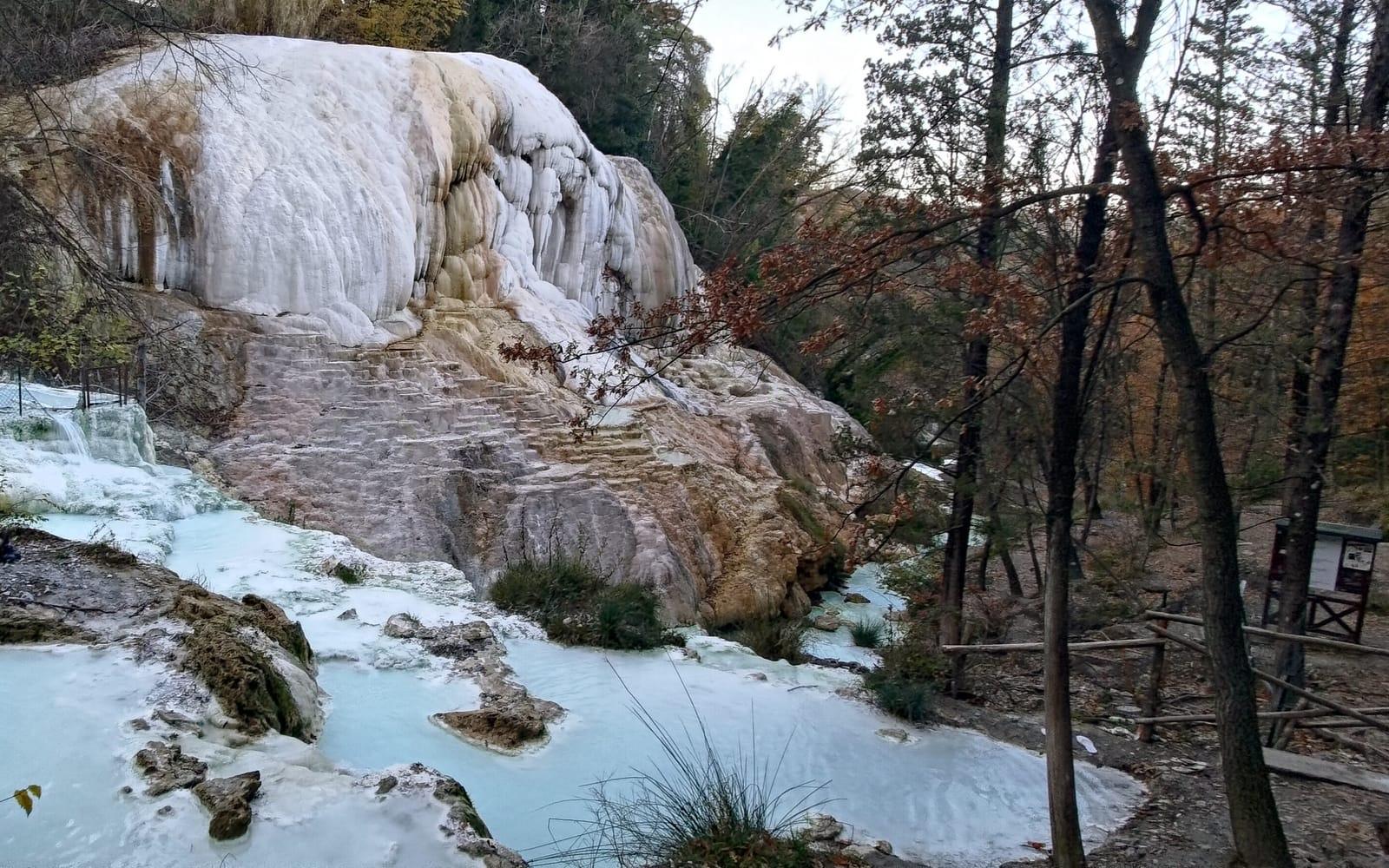
It is a small village between the Val d'Orcia and Monte Amiata, a few kilometres from Castiglione d'Orcia. Here the springs have built up, over time, formations of white limestone, little waterfalls and hot pools in a wood. The Fosso Bianco is the free bathing area, and you bathe in the natural pools along the stream.
The Balena Bianca (the White Whale) is the most photographed formation: a great block of limestone that looks like a whale's mouth, where the water gushes out at 48°C. It is also the most delicate part: touching it, walking on it or bathing near it is forbidden. For bathing there are plenty of other pools, and those are the ones to use.
You get there on foot, along a footpath through greenery, and the landscape changes: the amount of water and its course vary often, especially in winter, when the thermal water mixes with rainwater. The place you see in the photos is not necessarily the one you will find.
Bagno Vignoni: the square of water
Bagno Vignoni, a hamlet of San Quirico d'Orcia in the Val d'Orcia, has a square that is a rectangular sixteenth-century pool full of hot water, the Piazza delle Sorgenti. The water comes out at 52°C.
The honest point is this: according to the Italia.it entry on the natural hot springs of the Siena area, that pool is no longer used. You come to see it, not to get in. Anyone looking for a day in the water must look elsewhere. Otherwise Bagno Vignoni is a small village, suited to a short stop, and it pairs well with Pienza and the Val d'Orcia, which are on the same route.
Rapolano Terme: two spa parks in the Crete Senesi
Rapolano is the choice for anyone who wants a park with outdoor pools and sunbeds, not an adventure. There are two paid spa parks.
Terme Antica Querciolaia has an indoor building and a park with six outdoor thermal pools; according to the Visit Tuscany entry the pools are at different temperatures, with warm baths between 30 and 34°C. On the website you can enter without booking, but the same site strongly recommends booking, and you need to in order to choose a parasol and sunbed. For 2027 the site showed a closure for maintenance from 7 to 21 January inclusive: check the updated dates before you go. Terme San Giovanni has five pools, one covered and four outdoor, at temperatures between about 27 and 36°C, with water that comes out at 39°C.
It is the right stop when it is cold or raining: there is somewhere to change and rest. It is not the choice if you want somewhere wild.
Chianciano, in two lines
Chianciano Terme is the other spa town of the Valdichiana, but it has a story of its own that we have already told: you will find it in Chianciano Terme: what to see and where to stay. We will not repeat it here.
And in Umbria?
Anyone searching for "terme Umbria" expects something by the lake. Honestly: the thermal waters worth the trip from here are all on the other side of the border, in Tuscany, and that is why the guide moves over to that side.
One practical tip: notices are issued by the council of each place. For the San Casciano pools look at those from San Casciano dei Bagni, for Bagni San Filippo those from Castiglione d'Orcia, for Bagno Vignoni those from San Quirico d'Orcia.
Free or paid: how to build the day
The practical rule we give is this: the free pools are for half a day, the spa parks for a whole day. With the free pools the longest part of the plan is walking to the water and back; with a spa park you go to stay, and it is best to arrive in the morning.
The most sensible way to use the car is one place per day: the springs are scattered, and putting two in the same day means spending more time in the car than in the water. A combination that works: Bagni San Filippo or San Casciano in the morning, then lunch in the village. For Bagno Vignoni a stop is enough, and it fits well at the end of a day in the Val d'Orcia. Rapolano, on the other hand, holds up a whole day on its own: it is the choice when the weather is bad.
For the free pools bring a towel, a bag for your rubbish, sandals that can get wet and something dry and warm for afterwards: coming out of hot water in November, the air feels much colder than it is.
The downside of free hot springs: nobody manages the space, and the quality of what you find (water, cleanliness, upkeep) depends on whoever was there before you. At weekends they are more likely to be crowded: if you want peace, go on a weekday and early, or choose a spa park.
When to go, and what to check first
Hot water makes the most sense when the air is cool: in autumn and winter it is better than in July, when the heat takes away any wish to get into a hot pool. For the colder months we have written about what to do in Umbria in winter.
Before you set off, two simple checks: the council's website for any notices about the free pools, and the spa park's website for opening hours and closures. To rest after the day you can come back to us: the spa and the wellness packages are here, a few minutes from the lake.
Frequently asked questions
What are the nearest free hot springs to Lake Trasimeno?
Among those we have verified, the best known are the free pools at San Casciano dei Bagni and the Fosso Bianco pools at Bagni San Filippo, both in Tuscany. They are free, but the rules can change: check the town council's notices before you set off.
Are there hot springs in Umbria near the lake?
We have not found any from official sources that are worth the trip from here, and we would rather not name one from memory. The options we have checked are across the border in Tuscany.
Are the free hot springs always open?
There are no opening hours and no booking, but access is not guaranteed: at San Casciano in 2020 the council emptied the pools to discourage bathing during the health emergency. The council's website is the source to check.
What should you bring to the free hot springs?
A swimsuit, sandals that can get wet, a towel and a bag for your rubbish. For San Casciano the sources say nothing about changing rooms or showers, so it is best to arrive already in your swimsuit and bring something dry to change into; at Bagni San Filippo you walk through woodland on a footpath, so wear suitable shoes.
Is it better to spend a whole day at the hot springs or half a day?
With the free pools, half a day is usually enough. With a spa park like those at Rapolano it makes sense to stay longer, because there are more pools, at different temperatures, and a park to rest in.
Does the spa at your property use thermal water?
No. It is a spa with a heated indoor pool, a Finnish sauna and a hammam, designed for relaxation. It is not a hot spring or a medical centre, and it offers no treatments.
- Terme libere di San Casciano dei Bagni, Visit Tuscany, Regione Toscana
- Nuotano nelle vasche termali di San Casciano dei Bagni, scattate sanzioni e verifiche, gonews.it
- Bagni San Filippo, Visit Tuscany, Regione Toscana
- Fosso Bianco, Bagni San Filippo, FAI Fondo per l'Ambiente Italiano
- La piscina di Bagno Vignoni, FAI Fondo per l'Ambiente Italiano
- Bagno Vignoni, Italia.it, ENIT
- Terme naturali in provincia di Siena, Italia.it, ENIT
- Terme Antica Querciolaia a Rapolano, Visit Tuscany, Regione Toscana
- Terme Antica Querciolaia, orari e prenotazioni, Terme Antica Querciolaia
- San Giovanni Terme, Rapolano, Visit Tuscany, Regione Toscana
- Terme Fonteverde, San Casciano dei Bagni, Fonteverde Spa

Bruno e Marisella Batinti
Owners and hosts of Le Torri di Porsenna
Bruno and Marisella Batinti own Le Torri di Porsenna, the abbey they found derelict in 2014 and brought back as a charme agriturismo on the Umbria-Tuscany border. They live here all year: the roads, villages and seasons L'Almanacco writes about are the ones they drive every week.