

From certain bends in the road up from Chiusi, Chianciano Terme appears twice: up on the hill, the outline of a tower and a bell tower; down below, a spread of low hotels, tree-lined avenues and signage from other decades. These are two different places, grown in two different centuries, and most people searching "what to see in Chianciano Terme" are picturing the first without knowing they'll spend most of the day in the second.
In short: Chianciano Terme is two towns in one, a tiny medieval village at the top of the hill and a spa town built almost entirely during the twentieth century further down, and it's worth knowing that before you set off, so you're not disappointed. This guide covers what to see in both halves, what is left of the thermal baths after the collapse of state-subsidised spa tourism in the 1990s, the Etruscan museum that earns the stop, the novella Pirandello wrote here in a guesthouse in the centre, and what to actually expect if you're looking for a hotel in town.
It is written for anyone with a day or so to spend on it, coming from these hills on the Tuscan-Umbrian border, who would rather know what they're walking into before getting in the car.
Chianciano Terme sits in southern Tuscany, in the province of Siena, roughly 90 kilometres southeast of Florence and about 50 kilometres southeast of Siena itself, tucked between the Val di Chiana and the Val d'Orcia.
Two towns in one, and why it matters to know it upfront
The old core, Chianciano Vecchia, sits at the top of the hill where the village began in the Middle Ages. The spa town, the one most photos online actually show, grew up lower down and further north, along viale della Libertà, almost entirely during the twentieth century, when Chianciano became one of Italy's busiest spa-cure destinations.
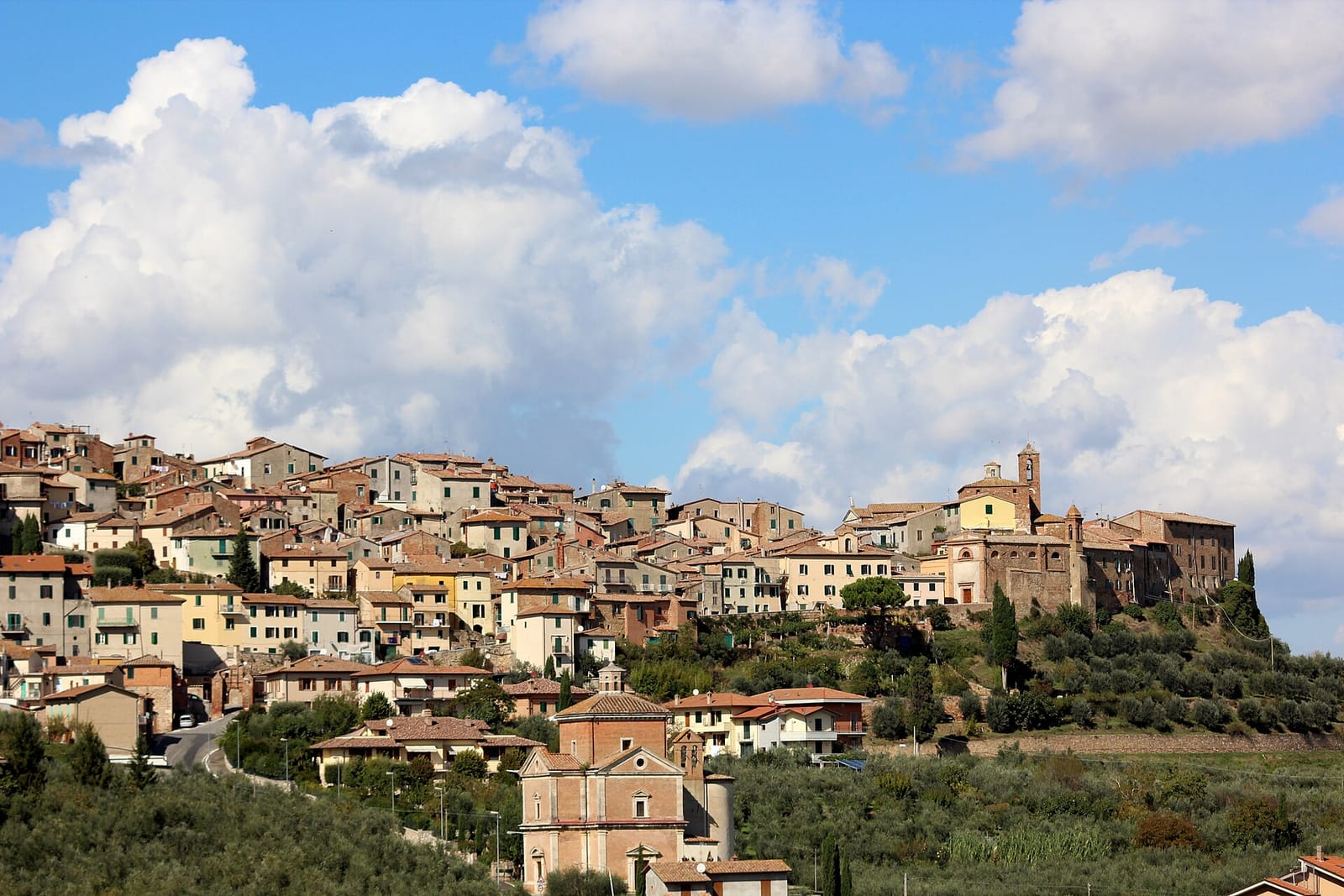
The two halves don't look alike and don't reward the same kind of visit. Chianciano Vecchia can be walked in a good half hour. The spa town, made up of hotels, avenues and parks, needs more time and more driving, because the distances between one point and another were designed for people staying a week, not for a day trip.
Chianciano Vecchia, the village the town's name hides
The old village is still enclosed within its medieval walls, which open at Porta Rivellini. Just inside the gate stand the small Chiesa dell'Immacolata, restored in 1588, and the Castello dei Conti Manenti, seat of the family that ruled Chianciano between the 12th and 13th centuries. From there, the lanes climb to the Torre dell'Orologio, the clock tower, and the Romanesque-Gothic Collegiata di San Giovanni Battista.
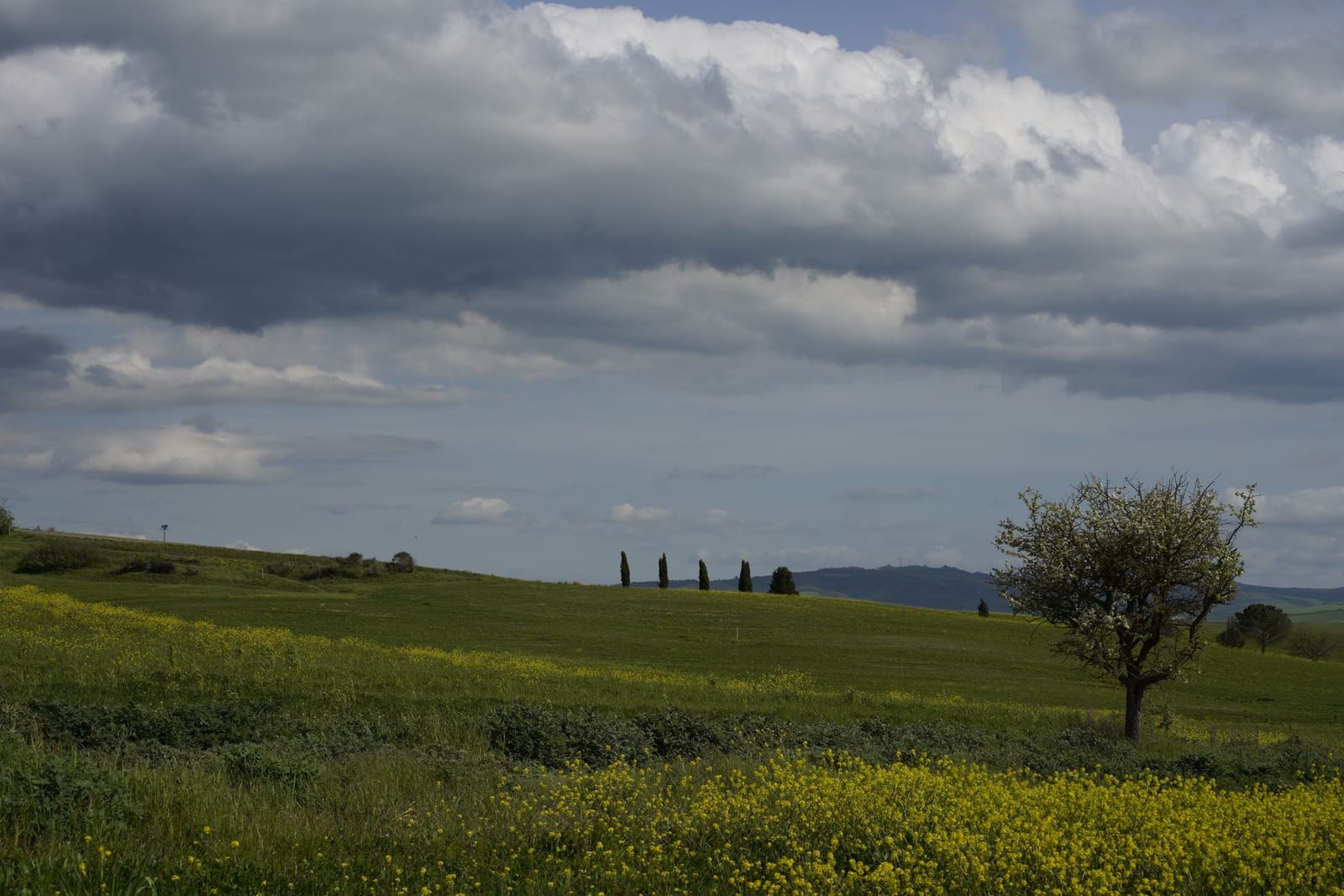
The point that rewards the climb is the panoramic terrace past the Collegiata: Monte Cetona on one side, Monte Amiata on the other, and on a clear day the view runs across the whole Val di Chiana. It's an outlook the spa town, lower down and hemmed in by hotels, simply doesn't have.
The boom and the bust: how Chianciano became what it is
The waters of Chianciano were already known in Etruscan and Roman times, but the town visible today dates from the early twentieth century, with the neoclassical spa buildings put up between the 1910s and the 1930s. After the war, Chianciano became one of Italy's leading destinations for so-called cure tourism, when the state paid dependent workers a special leave allowance to follow a course of thermal treatments, on top of their normal holiday.
The decline began in 1992, with the abolition of that leave. The town's accommodation stock, 332 establishments in 1992, fell to 189 by 2010 and to under 150 by 2012, according to figures reported at the time by Il Sole 24 Ore. The 2008 recession made things worse still. It's the honest reason the lower town still looks built for numbers far larger than today's: huge hotels standing next to others closed for years, wide avenues designed for traffic that no longer exists.
The spa town today: Parco Acqua Santa
Not everything stopped. Parco Acqua Santa, seven hectares of greenery at the heart of the spa town, still holds the two historic springs, Acqua Santa and Fucoli, with paths running among century-old trees and the Sala Mescita, the pump room where the waters were once drunk under medical supervision. At the entrance stands the Fontana dei Pavoni, a bronze fountain rebuilt in 1926 to a design by the architect Ugo Tarchi. The park is also home to the modern Terme Sensoriali wellness circuit, and a shuttle connects it to Terme Sillene, the town's other thermal facility.
We're not listing opening times, routes or treatment prices here: they change season to season, so check directly before you go. What can be said with confidence is that the park stays open for a walk even if you're not booking anything, and it's the simplest way to get a feel for what Chianciano was at its peak.
The Museo Civico Archeologico delle Acque, the Etruscans beneath the baths
Before the twentieth-century spas, on the same waters, there were the Etruscans. The Museo Civico Archeologico delle Acque, opened in 1997 in a former nineteenth-century granary, tells that older story: canopic urns, mostly from the Tolle necropolis, a reconstructed 6th-century BC princely chamber tomb found at La Foce, and fragments of the pediment decoration from the Etruscan temple of Fucoli, dating to the 2nd century BC.
It's a short visit, under an hour, but it reframes everything else: Chianciano's spas aren't an invention of mass tourism, they're the latest chapter in a much older story.
Pirandello and the two novellas born here
In the summer of 1905, Luigi Pirandello arrived in Chianciano with his wife Antonietta for a course of treatment tied to her health, and stayed for weeks at the Pensione Brugi Ronchi, just above the Collegiata. That stay produced two novellas, "Acqua amara" and "Pallino e Mimì", later collected in the 1922 volume "Novelle per un anno": they describe everyday life around the baths, the cures, the waiting rooms and the small vanities, told by someone watching more than being cured.
The stories are short, and you don't need to have read them before visiting, but they show that the rhythm of life at a spa resort, with its rituals and its waiting, was already like this more than a century ago.
Where to stay in Chianciano: what to actually expect
Relative to its size, Chianciano has one of the highest numbers of hotel beds in the province, a direct legacy of mass cure tourism. Many hotels still work on half or full board, built for week-long stays tied to a course of treatment rather than a single overnight stop.
Said honestly: quality is uneven. Alongside properties renovated in recent years, with their own wellness centres, there are hotels that still carry the furnishings and mood of the decade they were built in. Check recent photos before booking rather than trust the star rating alone.
Anyone who would rather stay in the countryside, outside the spa town but still close to Montepulciano and Chiusi, will find agriturismi with their own private spa on this side of the border, our own rooms included: it's a different kind of base, not a better or worse one, simply another way of staying in the same area. For the same idea of a spa without the hotel-town scale, see our agriturismo spa.
Villa La Foce and what's just outside town
A short distance away, towards the Val d'Orcia, stands Villa La Foce: built in the fifteenth century as a hospice for pilgrims and merchants travelling the Via Francigena, bought in 1924 by Antonio and Iris Origo, who together with the English architect Cecil Pinsent laid out, between 1925 and 1939, the Italian garden that can still be visited today, with box hedges, potted lemon trees and a wisteria-covered pergola. Iris Origo wrote about this land during the Second World War in her diary "War in Val d'Orcia", one of the most quoted accounts of those years in Tuscany.
Chianciano sits wedged between other places we've written about on this almanac: Montepulciano, 30 minutes from us, Chiusi and its Etruscan museum, 20 minutes away, and Città della Pieve, also 20 minutes. Anyone coming from here for any of them can easily add Chianciano to the same day, without leaving the same road.
When to come, and when Chianciano works best
Chianciano sits in a basin of the Val di Chiana, lower and more enclosed than the hills around Montepulciano or Cortona, so summer heat is felt more strongly here than on the surrounding hills. May, June and September remain the months for walking comfortably, both in the hilltop village and around the thermal parks.
Chianciano's practical advantage, for anyone planning a wider trip, is exactly that number of beds: on the weekends when Montepulciano or Cortona fill up, it's easier to find space here, even at short notice. Outside those months, a thermal detour still works well in the depths of winter: see Umbria in winter for what else stays open nearby. For the wider Umbrian side of a trip based here, our guide to things to do in Umbria covers the towns and the lake in full.
Getting there and getting around
The nearest station is called Chiusi-Chianciano Terme, on the historic Florence-Rome line, but it actually sits in the municipality of Chiusi, about 12 kilometres from Chianciano's centre: from there you'll need a taxi, a bus or a hire car to reach the town itself.
Once there, a car is still useful within Chianciano: the hilltop village and the spa town are separated by a climb that's comfortable enough by car but awkward on foot with luggage, and the car parks near Porta Rivellini fill up quickly around the middle of the day.
Frequently asked questions
How much time do you need to see Chianciano Terme?
Half a day covers the hilltop village, the Etruscan museum and a walk through Parco Acqua Santa. Anyone who also wants to see Villa La Foce nearby is better off setting aside a full day.
Is Chianciano Terme worth visiting if you're not taking the waters?
Yes, with the right expectations. Chianciano Vecchia, the archaeological museum and the thermal park are all there to see without booking any treatment. The lower town, outside those spots, is largely a town of hotels.
What is there to do in Chianciano Terme today, given the well-known decline of its spa tourism?
Parco Acqua Santa is still open for walking, the modern Terme Sensoriali offers a wellness circuit, and the hilltop village with its archaeological museum never stopped working. It is a smaller town than it once was, not a closed one.
How far is Chianciano Terme from Montepulciano?
Chianciano borders the municipality of Montepulciano directly, so it's a matter of minutes between the two. We only quote distances from our own property: Montepulciano is 30 minutes away from here, Chiusi 20, and both border Chianciano.
Is it better to stay in Chianciano Terme or in a countryside agriturismo nearby?
It depends on the kind of trip. Chianciano has far more beds and suits anyone who wants to stay put near the springs for several nights. A countryside agriturismo, ours included, is a different kind of base: fewer hotels to choose from, more open space around you.
Can you reach Chianciano Terme by train?
The station is called Chiusi-Chianciano Terme and sits on the historic Florence-Rome line, but it's actually in the municipality of Chiusi, about 12 kilometres from Chianciano's centre. You'll need a taxi, a bus or a hire car to cover that last stretch.
- Chianciano Terme, Wikipedia
- Chianciano Terme, Wikipedia
- Chianciano Terme chiusa per crisi, Il Sole 24 Ore
- Parchi termali da vivere, Vivi Chianciano Terme
- To Luigi Pirandelllo, Vivi Chianciano Terme
- Archaeological Civic Museum of Chianciano Terme, Visit Tuscany
- Villa La Foce, Visit Tuscany
- Stazione di Chiusi-Chianciano Terme, Wikipedia
- Chianciano Terme tra memoria, presente e futuro, SienaPost

Bruno e Marisella Batinti
Owners and hosts of Le Torri di Porsenna
Bruno and Marisella Batinti own Le Torri di Porsenna, the abbey they found derelict in 2014 and brought back as a charme agriturismo on the Umbria-Tuscany border. They live here all year: the roads, villages and seasons L'Almanacco writes about are the ones they drive every week.