
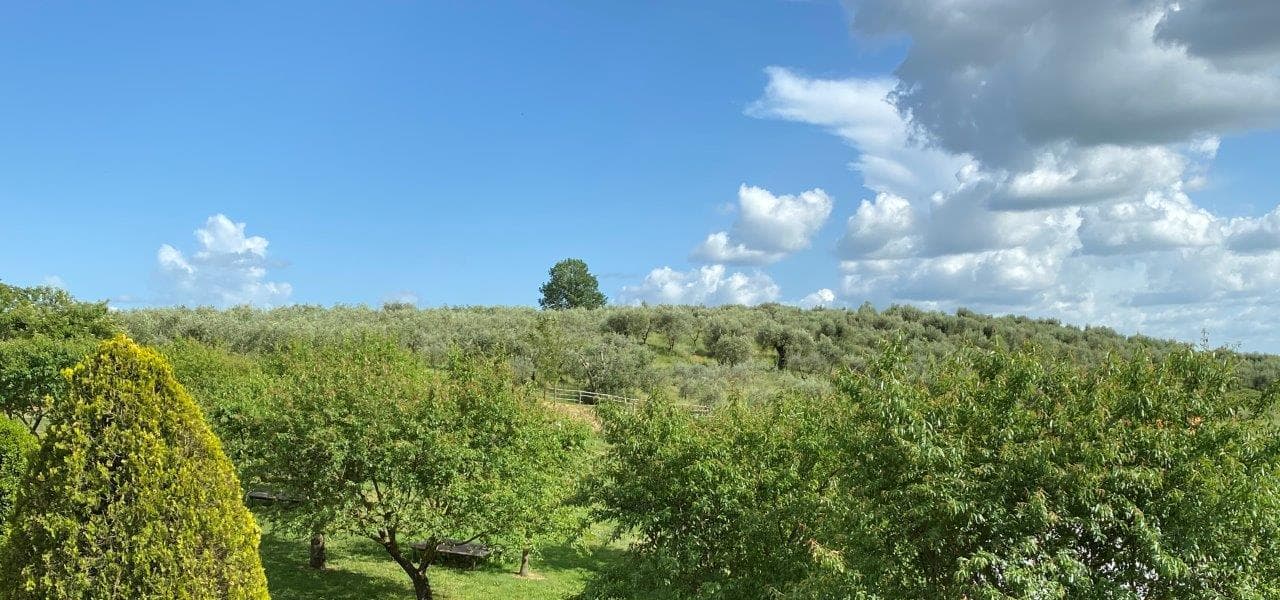

The sign by reception has read Le Torri di Porsenna for years. Some guests ask who this Porsenna was before they even ask what time breakfast starts, and it is a fair question: the name is not a marketing invention. The real answer is not here, but twenty minutes away, in Chiusi, where that name still turns up everywhere: on a street in the old town, over the entrance of a national museum, and in the name of a network of tunnels beneath the cathedral.
In short: Chiusi is the closest Etruscan city to us, and the only one in the area where the Etruscans are not a footnote to something else but the main reason to come: a national archaeological museum, painted tombs in the surrounding countryside, a tunnel network called the Labyrinth of Porsenna, and a royal tomb nobody has ever found. This guide covers what there really is to see, what needs booking ahead, where our own name comes from, and why Chiusi is also the easiest way to arrive here by train from Florence or Rome.
It is written for anyone staying with us who wants to see the Etruscan roots of this area first-hand rather than read about them on a panel, and for anyone arriving by train who wants to know exactly where they will get off. We are in Umbria, on the Tuscan border, roughly midway between Florence and Rome by road: a car is the practical way to reach us and to see Chiusi properly.
Who was Porsenna, and what our name says
Lars Porsenna was the legendary Etruscan king of Chiusi, towards the end of the 6th century BC: Roman tradition says he laid siege to Rome, in one of the most retold episodes of the city's early history. Our own name, Le Torri di Porsenna, pays tribute to him directly, and we say so plainly because it is a question we are asked often, and the honest answer is short. The building we occupy is a 1495 abbey, founded by seven Olivetan Benedictine monks who arrived from the Isola Polvese on Lake Trasimeno: seven centuries after Porsenna, with no archaeological connection whatsoever to the Etruscan era. The name is a tribute to the history of this area, not a direct lineage, and that distinction matters more than it might seem.
Chiusi, one of the twelve cities of the Etruscan League
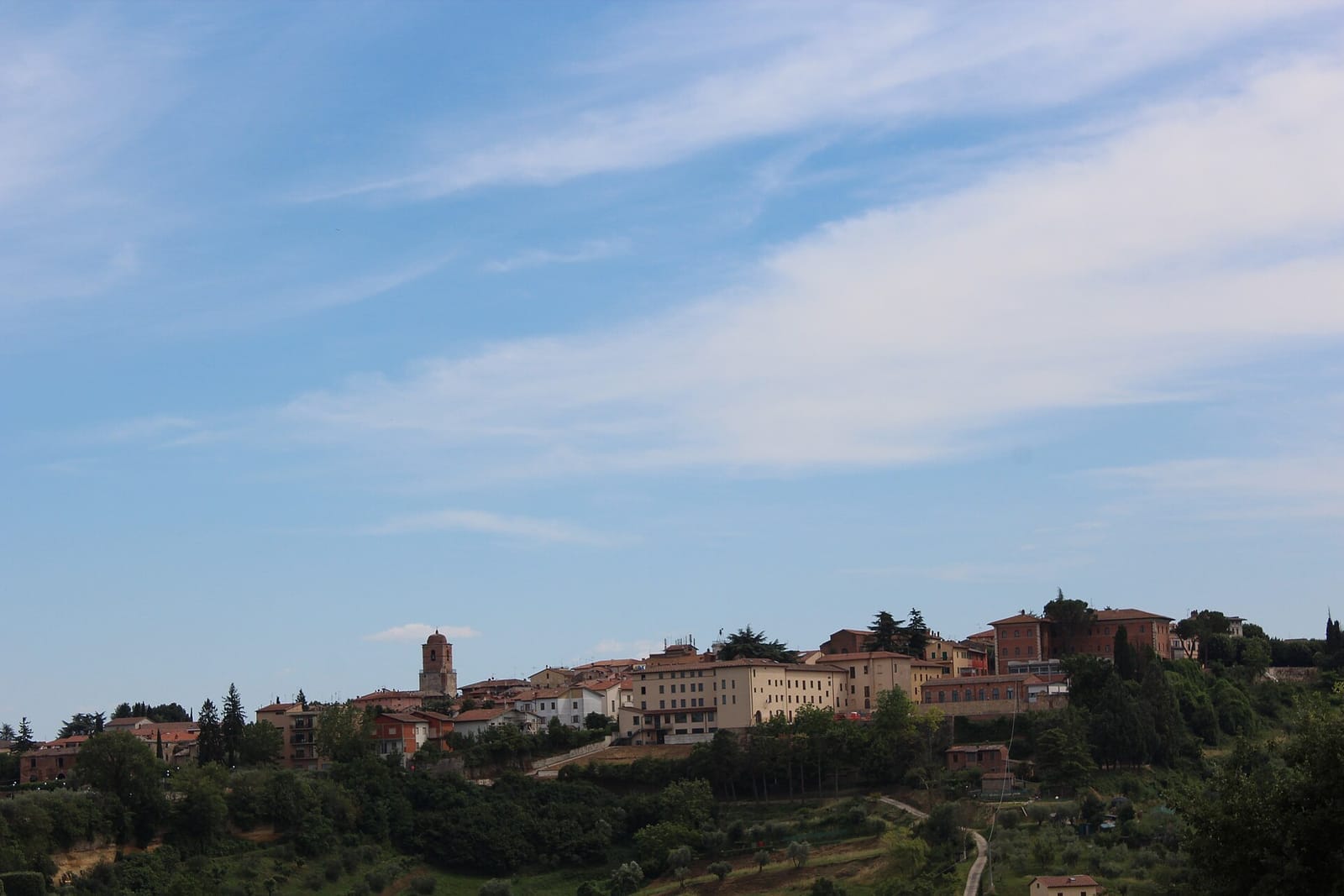
Chiusi, Clevsin in Etruscan, Clusium in Latin, and Camars in Umbrian according to some ancient sources: a detail that says something about how early this town sat at a crossroads of different peoples. By the 6th century BC it had become one of the most important cities of the Etruscan League, the confederation of twelve city-states: no ancient document lists all twelve with certainty, but Chiusi's name appears in every reconstruction historians have proposed. Today the comune has 8,058 residents (as of May 2026), on a hill 398 metres above sea level, bordering Umbria's Perugia province: a regional border, not just a provincial one, that runs a few kilometres from here.
The National Archaeological Museum, what it actually holds
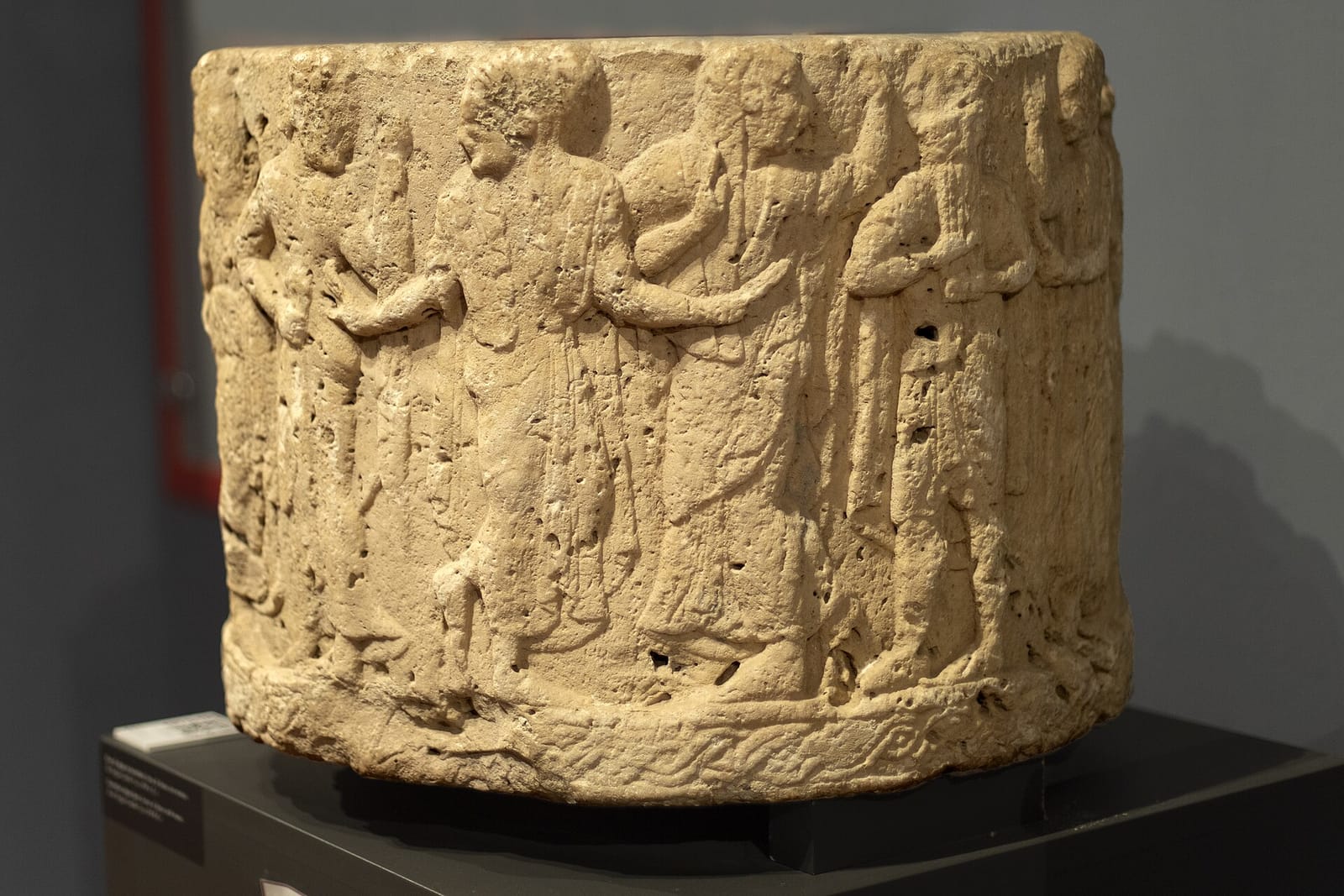
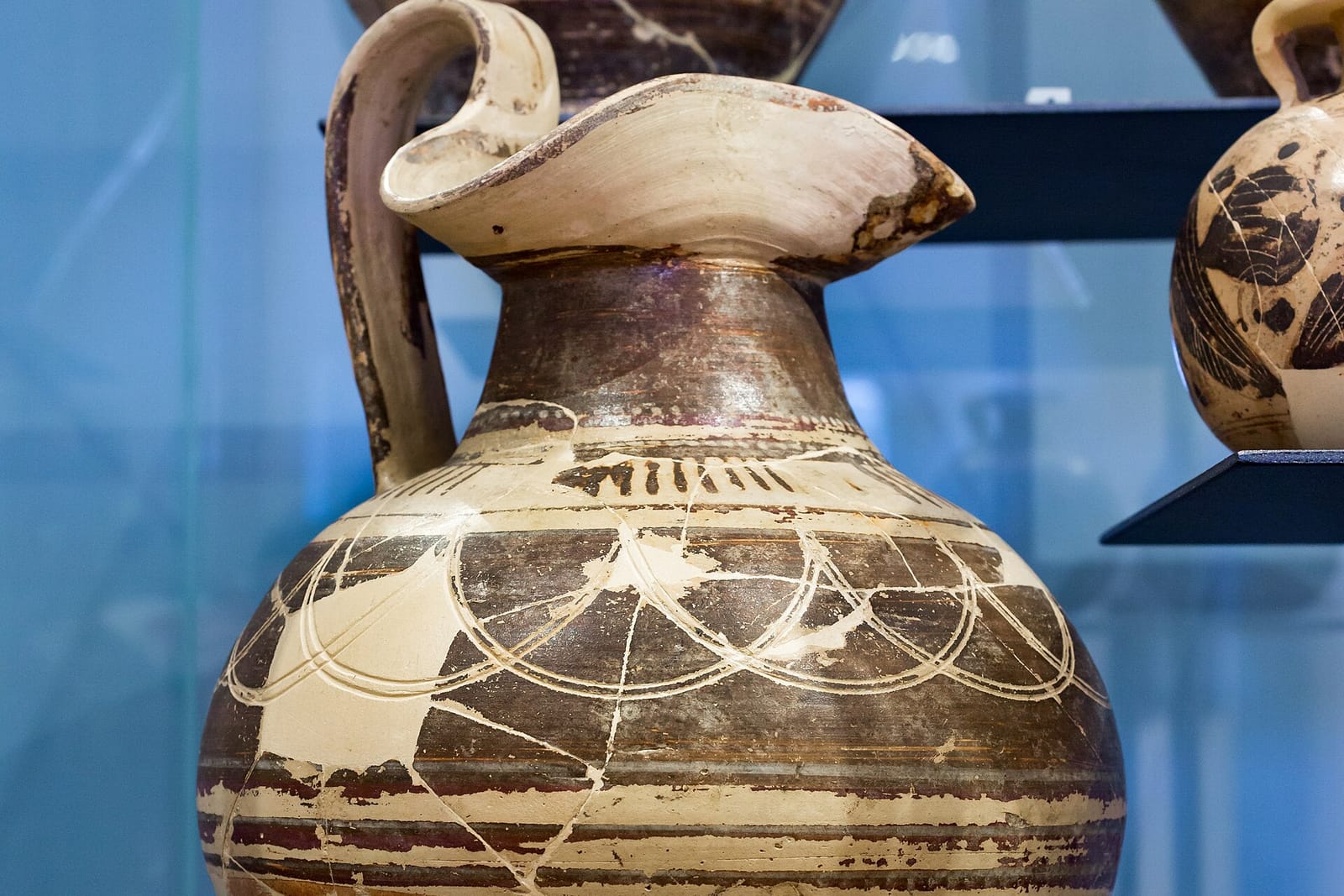
Chiusi's museum began in 1871 as a municipal collection, moved into its current neoclassical building in 1901, and became a state museum in 1963, a nationalisation that says something about how highly it was already rated a century ago. Inside are mostly canopic urns, human-shaped funerary urns that are more of a Chiusi speciality than of any other Etruscan site, alongside the town's characteristic sarcophagi: the collection spans a long stretch, from the Bronze and Iron Ages through the Etruscan, Hellenistic, Roman and even Lombard periods. It is not a huge museum, but it is a dense one: two to three hours are enough to see it properly, without rushing. In Cortona, 22 minutes from us, there is another important Etruscan museum, the MAEC: the difference is that there the Etruscans share the stage with the Renaissance and the rest of a medieval hill town, while here in Chiusi they remain the main reason to come. Orvieto, on the same Etruscan trail on the other side of the area, gets its own guide in Orvieto in a day.
The painted tombs in the countryside, by appointment only
In the countryside around Chiusi, not in the centre, the museum manages several painted Etruscan tombs: the Tomb of the Monkey, the Tomb of the Pilgrim, the Tomb of the Lion and the Tomb of the Hill, all from the 5th century BC. You cannot simply walk in: they are shown on request, through the museum's own staff, and which ones are open, on which days and on what terms changes over time, so the museum itself, not this page, is the right place to ask before you travel. Anyone who arrives in Chiusi without checking first sees the museum, the canopic urns and the sarcophagi, but risks leaving without having seen a single painted tomb: check before you travel, not on the day.
The Labyrinth of Porsenna, and why the name is misleading
Beneath Chiusi's cathedral and the piazza next to it runs a network of tunnels roughly 130 metres long, cut in the Archaic Etruscan period. The name it goes by today, the Labyrinth of Porsenna, comes from local tradition and from whoever found the first galleries in the 1920s, and links the site to the legendary labyrinth of Porsenna's tomb described by Pliny the Elder. Scholars consider the link inaccurate: it is more likely a water-supply system, with wells tapping the water table and channels collecting rainwater for the Etruscan town, rather than a funerary monument. It is guided-tour only, starting from the Cathedral Museum: you cannot walk it alone, and booking ahead is strongly recommended because places are limited. A separate underground circuit, the Museo Civico "La Città Sotterranea", exists elsewhere in town: do not confuse the two, either for the route or for the booking.
The tomb that has never been found
Pliny the Elder, citing Varro, describes Porsenna's funerary monument as an enormous structure of squared stone blocks, three hundred feet on each side and fifty feet high, containing a labyrinth so complicated that anyone who entered without a thread of string never found their way out again. It is a striking description, and it was also, in all likelihood, already partly legend in Pliny's own time. Nobody has ever identified with certainty where this monument stood: one repeated hypothesis places it at the Poggio Gaiella tumulus near Chiusi, but it remains a hypothesis, not an archaeological confirmation. Tourist material does not always say so plainly: Porsenna's actual tomb, the one Pliny described, cannot be visited, because nobody knows where it is.
Chiusi Scalo, the station that serves half the area
The Chiusi-Chianciano Terme station sits on the historic Florence-Rome line, opened in 1862, and is also the terminus of the branch line from Empoli: a genuine railway junction, not a village halt, with regional and InterCity trains stopping here daily. It lies in the comune of Chiusi, in the hamlet of Chiusi Scalo, down in the valley: the historic centre sits up on the hill, and anyone arriving by train needs a local bus or a fairly steep walk to reach it. The same station, as we cover in our guide to Chianciano Terme, is also the nearest arrival point for anyone staying there: it is roughly 12 kilometres from Chianciano. For anyone staying with us, though, a car remains necessary: not even the area's most important station removes the need for the hill road between here and the countryside.
Città della Pieve and Chiusi, same distance, opposite sides
Chiusi and Città della Pieve are both 20 minutes from us, but on opposite sides of the border and with a different character: one is the town of Perugino, Renaissance, Umbrian; the other is Etruscan down to its foundations, and already in Tuscany. You can see both on the same day, one on the way out and one on the way back, without adding to the drive. What ends up on the table changes too, depending on which side you are coming from: we cover that in more detail in The border cuisine of Umbria and Tuscany, where Chiusi is already the reference point for the Tuscan side of the table.
What does not work, honestly
It is only fair to say: almost everything that makes Chiusi worth the trip can only be seen by booking ahead, not by simply turning up. The Labyrinth, the painted tombs, and to some extent the museum outside its main opening hours: arrive without checking first and you risk seeing half of it. And the most evocative name of all, the Labyrinth of Porsenna, is probably not what it promises: not a royal labyrinth, but an Etruscan water system. Anyone hoping for the legend intact will be a little disappointed; anyone happy with the real history, which is still remarkable, will not be. The old town, outside the museum circuit, is small and quiet in the evening, closer to Città della Pieve than to Cortona: not the place for a lively night out.
How much time you need, and how to reach us
For the museum alone, two to three hours is enough, taken at a comfortable pace. Add the Labyrinth or a painted tomb booked in advance and it is worth planning for half a day; add both and it is close to a full day. Chiusi is 20 minutes by car from our agriturismo on Lake Trasimeno, the same distance as Città della Pieve: our surroundings page lists every distance from here, including the rest of this border area. Anyone arriving by train at Chiusi-Chianciano Terme still needs to allow time for the transfer to us: the station is a convenient way to travel, but it does not remove the need for a car once you are in this countryside.
Frequently asked questions
Why is the property called Le Torri di Porsenna?
The name honours Lars Porsenna, the legendary Etruscan king of Chiusi, whose city is 20 minutes from us. The 1495 abbey the property occupies has no archaeological link to the Etruscan era though: it is a tribute to the area's history, not a direct descent.
How far is Chiusi from Le Torri di Porsenna?
20 minutes by car, the same distance as Città della Pieve, but on the opposite side of the border: Chiusi is already in Tuscany.
Can you visit the Labyrinth of Porsenna without booking?
No. It is a guided tour only, starting from the Cathedral Museum: you cannot enter alone, and booking ahead is strongly recommended because places on each tour are limited.
Does Porsenna's tomb exist, and can you visit it?
The monument described by Pliny the Elder, with its legendary labyrinth, has never been identified with certainty. One hypothesis places it at the Poggio Gaiella tumulus near Chiusi, but it remains a hypothesis: there is no tomb of Porsenna you can visit knowing for certain it is the real one.
Can you reach Chiusi by train?
Yes. The Chiusi-Chianciano Terme station is on the historic Florence-Rome line, with regional and InterCity trains stopping there. It sits in the hamlet of Chiusi Scalo, down in the valley though: the historic centre is up on the hill, and you still need a car to reach us.
How does the Chiusi museum compare with the MAEC in Cortona?
In Cortona, 22 minutes from us, the MAEC is also an important Etruscan museum, but there the Etruscans share the stage with the Renaissance and the rest of a medieval hill town. In Chiusi the Etruscans are the main reason to come, not a strand in something else.
- Chiusi, Wikipedia
- Chiusi, Wikipedia
- Lars Porsenna, Wikipedia
- Dodecapoli etrusca, Wikipedia
- Museo archeologico nazionale di Chiusi, Wikipedia
- Labirinto di Porsenna a Chiusi - Ecomuseo Digitale Terre di Siena, Musei Senesi
- Orari e Biglietti dei Musei - Pro Loco Chiusi - Ufficio Turistico, Pro Loco Chiusi
- Stazione di Chiusi-Chianciano Terme, Wikipedia
- Chiusi-Chianciano Terme railway station, Wikipedia

Bruno e Marisella Batinti
Owners and hosts of Le Torri di Porsenna
Bruno and Marisella Batinti own Le Torri di Porsenna, the abbey they found derelict in 2014 and brought back as a charme agriturismo on the Umbria-Tuscany border. They live here all year: the roads, villages and seasons L'Almanacco writes about are the ones they drive every week.