
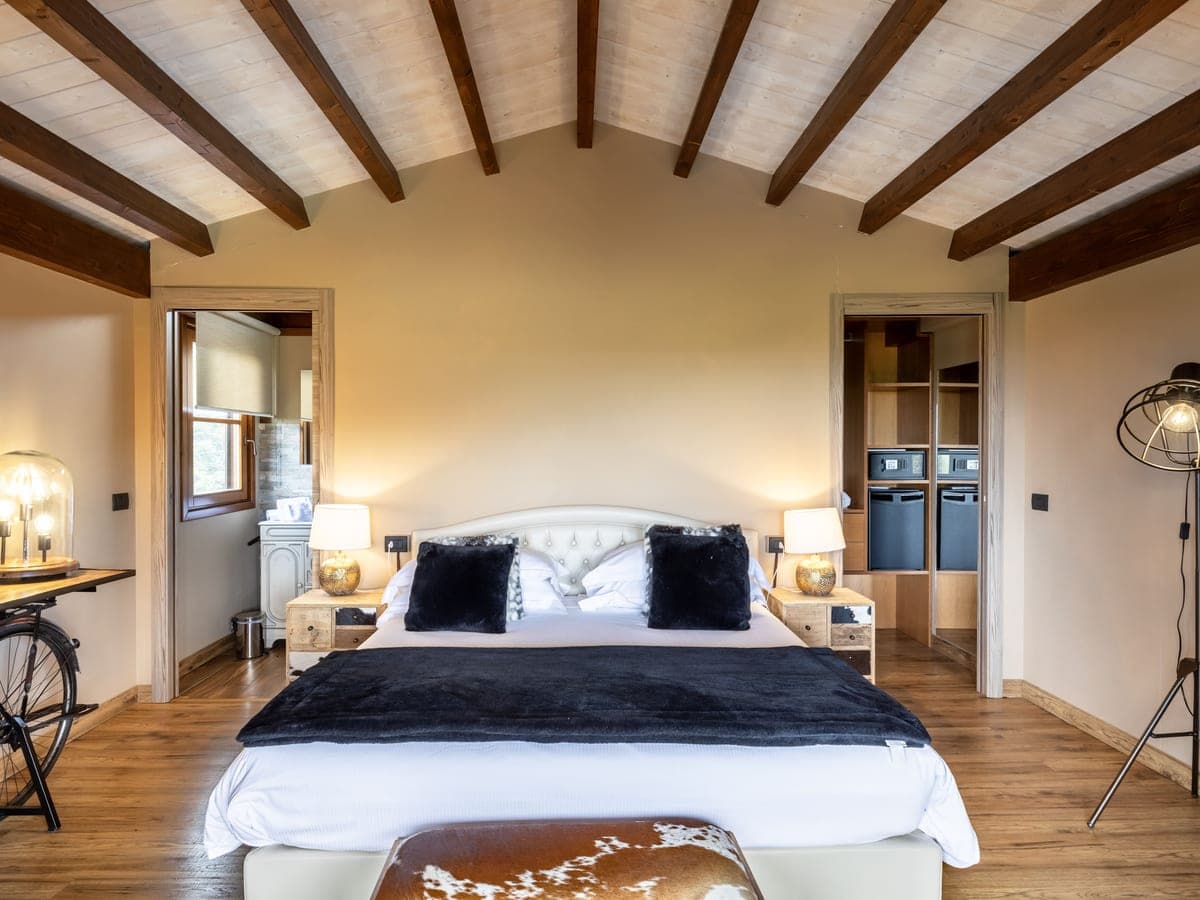

Our Treehouse at Petrignano del Lago stands four metres off the ground, built around a tree whose trunk still grows straight through the decking of the veranda. Type "treehouse Tuscany" into a search engine, though, and an address in Umbria is rarely what turns up first.
Our Treehouse stands at Petrignano del Lago, in Umbria, 22 minutes from Cortona and just the other side of the Tuscan border: it is not in the region the search term suggests, but it sits in the same run of hills, at the same distance from many of the same places. This guide covers how our treehouse is built, what to genuinely expect from a raised timber room like this one, who it suits and who it does not, and what lies within reach on both the Umbrian and the Tuscan side of the line.
It is written for anyone dreaming of a night among the trees in this corner of Italy. Whether the search that brought you here said Tuscany or Umbria, the ground you sleep on does not change either way.
Why "treehouse Tuscany" almost always leads to the same disappointment
The Italian search term behind this kind of stay is generic by nature: it describes an experience, not an address. Most people typing it are not checking Tuscany's administrative boundary. They are after a precise kind of night: raised, timber-built, surrounded by greenery, close enough to Florence, Siena or Arezzo for a weekend.
The result is that pages built to catch that search often stretch the boundary just enough to qualify: countryside stays in Umbria, sometimes further afield too, land on the same list without saying so plainly. That is not necessarily dishonest, it is simply how search optimisation works when the target is search volume rather than geographic precision. The problem shows up later, when whoever booked finds out on arrival that the pin on the map was never where they thought.
We are in Umbria, 22 minutes from Cortona: why that matters less than it sounds for a Tuscany search
Let us say it plainly, because it is the whole point of this page. Le Torri di Porsenna is an agriturismo, a working countryside estate combining rooms, a restaurant and a spa, at Petrignano del Lago, a hamlet of the comune of Castiglione del Lago, in the province of Perugia. We are in Umbria, not Tuscany, and we will not write otherwise to catch a search that is not really about us.
What is worth understanding is what that means in practice. We are 22 minutes from Cortona, the first Tuscan town you reach from here, and Val di Chiana, the agricultural plain that sits half in Umbria and half in Tuscany, is adjacent to the property. Lake Trasimeno is 5 to 10 minutes away. Perugia, Umbria's regional capital, is 44 minutes in the other direction. On the map, the whole area sits roughly midway between Florence and Rome, in the hills above the lake. Anyone searching for a treehouse near Cortona, Val di Chiana or Trasimeno finds exactly that here, even though the room itself is registered in a different region. The line on the map counts for less than it looks, once you are deciding where to actually spend the weekend.
How it is built: raised four metres up, with a veranda and a real tree
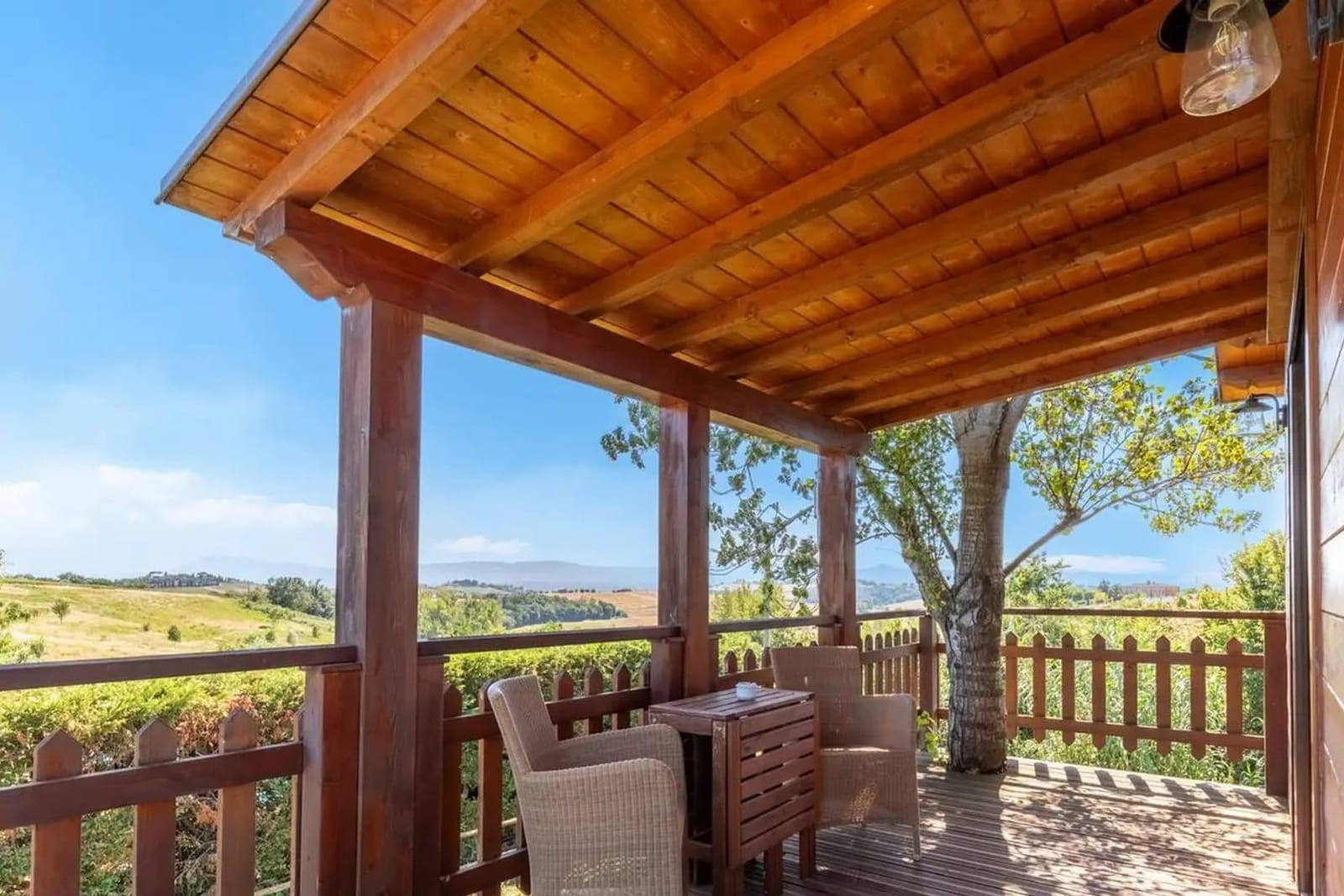
The Treehouse is a timber structure raised four metres off the ground, built beside a tree that still grows there: its trunk passes straight through the decking of the covered veranda, which opens onto uninterrupted views of the surrounding hills, with no other buildings in the way. The veranda holds a small table and two wicker chairs, meant for coffee or an evening drink before dark.
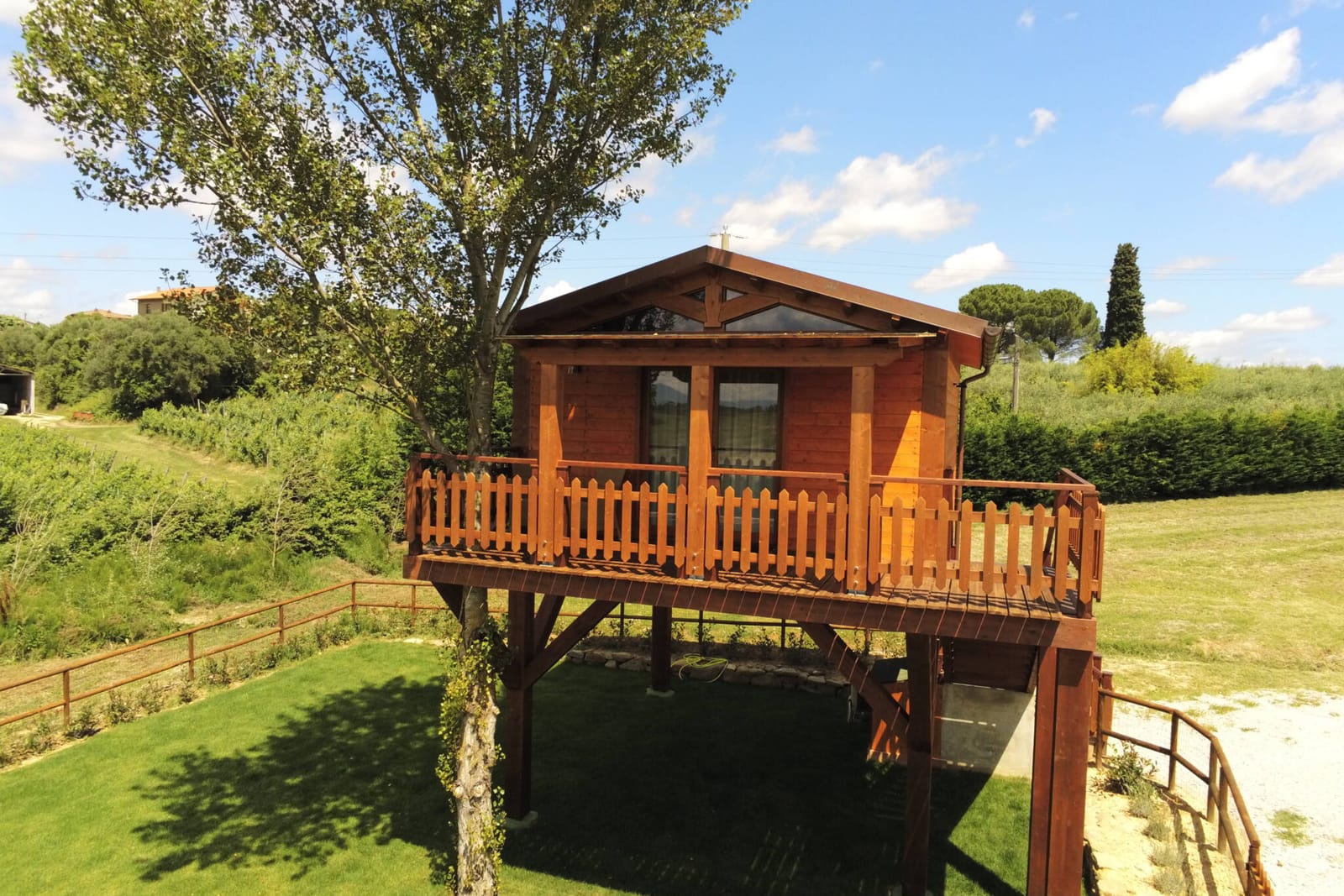
Inside, the ceiling follows a pitched roofline with exposed timber beams, in keeping with the rest of the property, a former monastery. There is a double bed and a private bathroom, and the furnishings are kept deliberately simple: this is not a loft flat, it is a room, built for spending as much time outside as in.
What is inside
The fittings cover the needs of a night, not a week: a double bed, a private bathroom with its own linen set and toiletries, a hairdryer, a safe, independent air conditioning, digital TV with Sky, an Illy coffee machine and a herbal tea set, and Wi-Fi. The minibar is charged separately, as in the property's other rooms.
We do not publish a floor area for this room, unlike the Junior Suite, which is 32 square metres including the bathroom: that is not a figure we have verified for the Treehouse, so it does not appear here. Anyone who needs exact dimensions before booking can ask the property directly.
Who it suits, and who it does not
The Treehouse is built for a couple, not a family or a group of friends: there is a single double bed, and the property's own rules rule out both children and pets, alongside smoking indoors. Anyone travelling with children or a dog will find room in the property's other categories, not this one.
It is also worth saying that, being raised four metres up, it cannot be reached without a few steps: this is not the right choice for anyone with mobility needs or looking for step-free accommodation. And anyone picturing a genuine house up among the branches, rainforest-lodge style, should be corrected straight away: this is a timber structure on stilts beside a tree, not inside its canopy. It is still the kind of experience that answers a "treehouse" search, but it is better to know that before booking than after.
The rest of the property stays open to you
Booking the Treehouse does not mean cutting yourself off from the rest of the estate. Le Torri di Porsenna is an agriturismo with a spa, set in a former monastery surrounded by roughly 450 olive trees: a heated indoor panoramic pool, a Finnish sauna, a hammam, plus an outdoor pool in the grounds. The restaurant serves Umbrian and Tuscan cooking, and the property also hosts weddings and events, should your stay fall near one. Couples sometimes choose the Treehouse for a proposal or an anniversary, and some marry here outright: our guide to getting married on the Umbria-Tuscany border covers what a wedding at the property actually involves.
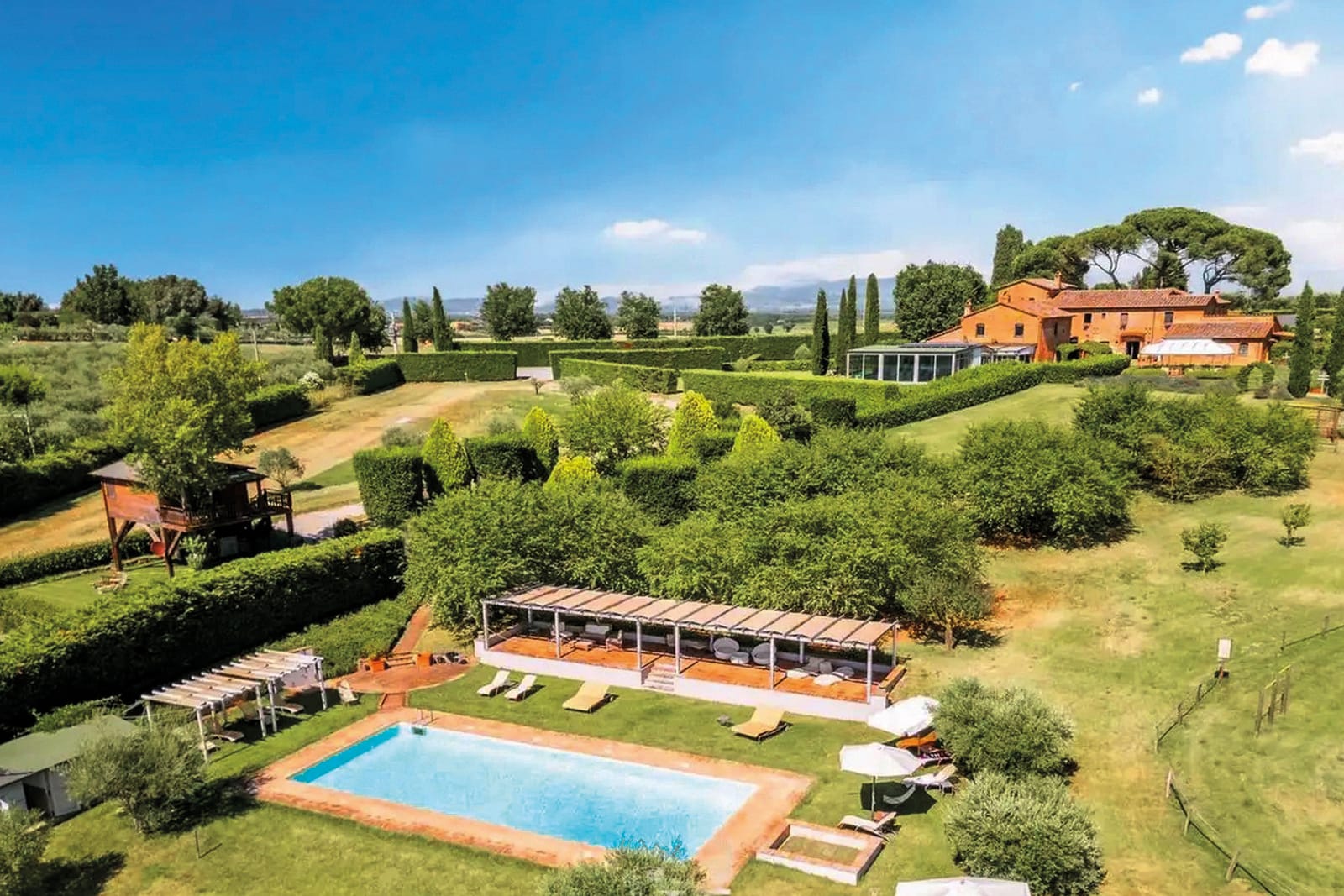
Check-in is from 15:00, check-out by 11:00. Parking and Wi-Fi are free across the whole property, not only in the Treehouse. These are shared spaces, used by guests from the other 12 rooms too, not reserved for whoever is staying in the treehouse: at a busy summer weekend the indoor pool may well have other guests in it, which matters if you are after a fully private retreat.
The other rooms, if the Treehouse is not for you
The property has 13 rooms across five categories: Doppia Comfort, Categoria Superiore, Superior Quadrupla, Junior Suite and the Treehouse itself. The first three suit anyone after the classic Umbrian look, exposed beams and terracotta floors, with more flexibility on children and pets than the treehouse allows. The Junior Suite adds a private patio and more space.
Anyone comparing all the options before choosing can do so on the rooms page, or look at the full Treehouse listing for photographs and a detailed description.
What lies within reach: from Lake Trasimeno to Val di Chiana
Sitting right on the border is, in practice, the reason to choose this area rather than narrow the search to a single region. Lake Trasimeno is 5 to 10 minutes away, easy for a day trip or a swim. Cortona, the first Tuscan stop on the list, is 22 minutes. Montepulciano is 30 minutes, Val d'Orcia 52. On the Umbrian side, Perugia is 44 minutes and Assisi an hour.
Staying here is not a choice between Umbria and Tuscany: it is choosing a base from which to reach both without moving your luggage. For more detail on the lake itself, our Lake Trasimeno guide covers the islands, the villages and the best time to come, and anyone planning a day in Cortona too can read a day in Cortona.
When to book, and how to get here
You will need a car. This is genuinely rural countryside, and both the Umbrian and the Tuscan side of the border are far easier to enjoy on four wheels than by public transport, which is built for residents rather than visitors. The nearest train stations are Chiusi and Terontola, but a hire car or taxi is still needed from either.
One practical tip, not a rule: keep the morning for the veranda before heading out. That is when the low light over the hills is at its best, and it is exactly the time that anyone who spends the evening out at dinner tends to miss. Beyond that, the same terms apply as for the rest of the property: check-in from 15:00, check-out by 11:00. Anyone extending the stay towards Val d'Orcia will find some pointers in a day in Val d'Orcia, and a couple with two days rather than one can plan the rest of it with our romantic weekend guide.
Frequently asked questions
Where exactly is the Torri di Porsenna Treehouse?
At Petrignano del Lago, a hamlet of Castiglione del Lago, in the province of Perugia, Umbria, just the other side of the Tuscan border. Cortona is 22 minutes away, Lake Trasimeno 5 to 10 minutes.
Is it really built up in a tree?
It is a raised timber structure four metres off the ground, with a covered veranda built beside a real tree whose trunk passes through the decking. It is not a hut in the branches, but it is not an ordinary ground-floor room either.
Is it suitable for children or pets?
No. The property's own rules exclude both, along with smoking inside. It is designed as a romantic suite for two, not a family room.
What is included in a stay?
Breakfast, Wi-Fi, independent air conditioning, a safe, digital TV with Sky, an Illy coffee machine and a herbal tea set. The minibar is charged separately, as in the other rooms.
How far is the Treehouse from Cortona and Tuscany?
Cortona, the first Tuscan town you reach from here, is 22 minutes by car. Val di Chiana is adjacent to the property, Montepulciano is 30 minutes away and Val d'Orcia is 52.
Is this the only genuine treehouse between Umbria and Tuscany?
Certainly not, and we would not claim otherwise. We can only speak with first-hand knowledge about our own. Before booking any other, check real photographs, seasonal opening and the property's own house rules.
- Castiglione del Lago, Wikipedia

Bruno e Marisella Batinti
Owners and hosts of Le Torri di Porsenna
Bruno and Marisella Batinti own Le Torri di Porsenna, the abbey they found derelict in 2014 and brought back as a charme agriturismo on the Umbria-Tuscany border. They live here all year: the roads, villages and seasons L'Almanacco writes about are the ones they drive every week.