

The general guide to Lake Trasimeno already explains that of the three islands only two can be visited, that Isola Maggiore has the lace museum, and that Polvese has been a park since 1995. All true, but it is the summary you need to decide whether to come, not what you need once you are actually stepping onto a ferry. It does not say what is left of the lace tradition today, that Isola Maggiore's castle has been under restoration since 2026 and cannot be visited, or why, for weeks in the summer of 2026, the ferries to Polvese stopped running.
In short: this guide goes inside the two islands you can visit, one at a time, and explains why the third stays off limits. It covers how Isola Maggiore went from fishing village to eighteen residents, what is left of the lacemaking today, what Polvese actually contains beyond the word "park", how long its paths really are, how the ferry works port by port, and what happens when it is the lake itself, not just the season, that stops the crossings.
This is written for someone who has already decided to catch a ferry and wants to know what they will find, not for someone still deciding whether to come to the lake at all: that is what the general guide covers. Lake Trasimeno sits in Umbria, inland between Florence and Rome and close to the Tuscan border; seeing any of this properly means having a car.
Isola Maggiore: from fishing village to eighteen residents
Eighteen people live on Isola Maggiore today, the same figure given in the general guide to the lake. It was not always like this. In 1578 the population reached six hundred, the highest number ever recorded: an enormous figure for twenty-four hectares, and proof the island was once a genuine fishing centre, not a marginal hamlet. By 1875, when its territory became part of the municipality of Tuoro sul Trasimeno, numbers had already fallen to around two hundred.
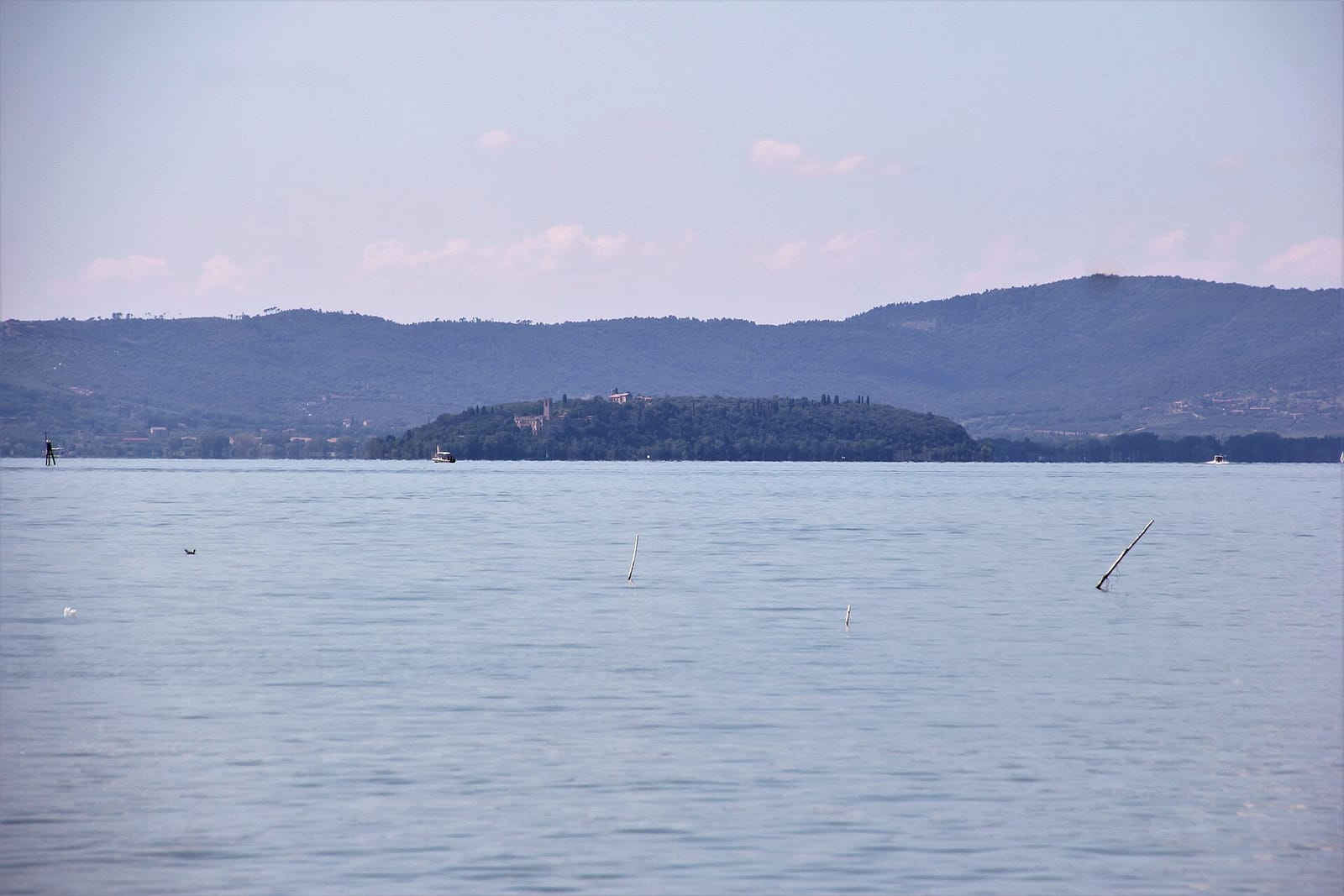
The real collapse came in the mid-twentieth century. The lake has no natural outlet, which leaves it prone to recurring flooding and silting, and that hit fishing hard: the trade that had sustained the island for centuries went into crisis, much of the population emigrated to cities and industrial centres, and the island never repopulated.
Lacemaking: a tradition broken twice, not an unbroken line
The general guide to the lake mentions that in 1904 Marchioness Elena Guglielmi brought a teacher over from Ireland to teach the island's women Irish crochet lace. What it does not mention is that the tradition was never continuous.
The school closed in the 1930s. Lacemaking only returned in 1963, when Maria Vittoria Semolesti founded a workers' cooperative to revive production and sale. That cooperative closed too, in 1975. Since then the craft has survived through individual lacemakers, who kept working outside their own front doors along Via Guglielmi, the same street where the museum now stands, in the fifteenth-century Palazzo delle Opere Pie. In 1996 a group of Semolesti's former students founded a women's cultural association to keep the technique from disappearing entirely.
The museum is always open to visit. Whether you also find a lacemaker at work outside her house depends on the day: it is a craft still practised by a few people, not a show staged for visitors.
Castello Guglielmi, under restoration since 2026
Castello Guglielmi, layered between the fourteenth and nineteenth centuries, sat abandoned for decades before restoration work began in July 2026, with the declared aim of turning it into a hotel.
That is good news for the building's future, but the rule for now is simple: while the site stays open, the castle cannot be visited, only seen from outside, set among greenery on the higher part of the island. Whether and when it reopens is not yet clear, so check locally before expecting to go in.
Isola Polvese: what is actually there beyond "a park"
It has been a scientific education park since 1995, but that label alone undersells what the island actually contains.
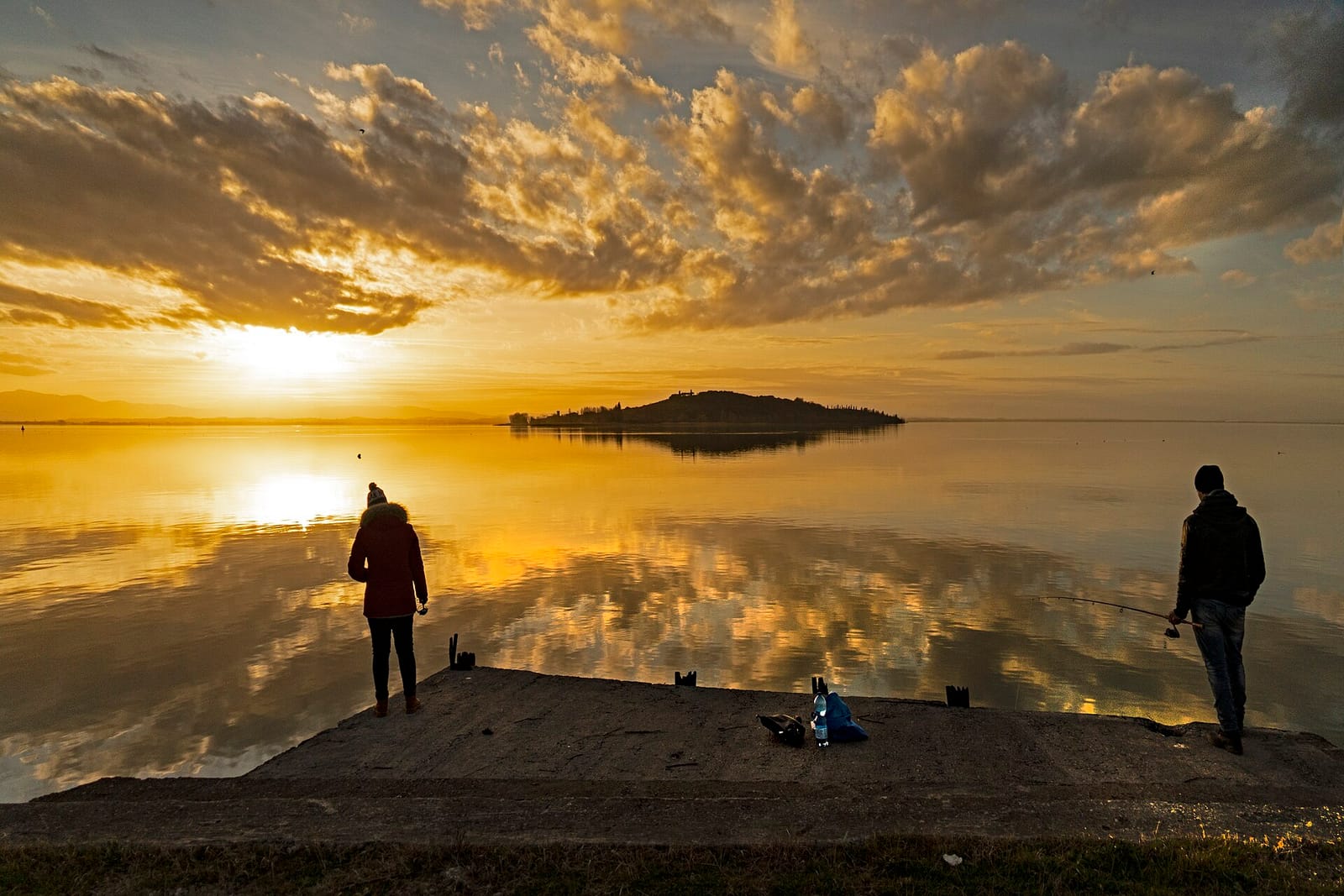
There is a fifteenth-century defensive castle, its keep rising around fifteen metres. There is a monastery, San Secondo, of Olivetan origin, remodelled between 1481 and 1492. There is the church of San Giuliano, documented as far back as 1028 as a parish church with a baptismal font. And there is the former church of Santa Maria della Cerqua, founded in 1416 and made a parish church in 1419, now deconsecrated and used as the orientation point for anyone setting off on foot along the paths.
The most surprising feature is the aquatic garden: a pool carved into the rock of an old sandstone quarry, built in the late 1950s to a design by the Florentine landscape architect Pietro Porcinai, and converted in 1965 into a pond planted with water lilies and lotus flowers. It is not what you expect to find in the middle of an Umbrian lake.
The island was privately owned until 1973: first by Count Vincenzo Pianciani from 1840, then by Biagio Biagiotti from 1939 to 1959, then by Count Giannino Citterio. The Province of Perugia bought it in 1973, beginning the process that led to today's park.
Polvese's three paths, and how far they really are
There are three signposted paths on the island, each marked by colour. The Percorso Centrale, green, follows the ridge for around 1.8 kilometres, historic and naturalistic in character, with views over the lake. The Percorso del Periplo, blue, circles the island along the shoreline for around 3.5 kilometres, nearly flat throughout. The Percorso delle Croci, red, is the shortest, around half a kilometre, near the old hamlet, the oil mill and the former pig sheds.
Put together, that is around six kilometres, with modest gradients, manageable for families with children: see Lake Trasimeno with kids for more on visiting with young children. It is a half-day walk, not a trek: anyone expecting to "do the island" in an hour on the shorter paths is wrong, but anyone expecting a serious challenge will be disappointed too.
Isola Minore: why it stays private, and what that actually means
The general guide to the lake says Isola Minore is uninhabited, privately owned, and cannot be visited. All true; here is why.
The island, around six hectares, administratively falls under the municipality of Passignano sul Trasimeno, not Tuoro like Maggiore. It was inhabited until the fifteenth century; sources disagree on why it was abandoned, some pointing to raids by pirates and adventurers, others, citing the writer Matteo dall'Isola, to a forced transfer to Tuoro ordered by Perugian magistrates after disputes among residents. What remains are the ruins of a church dedicated to Santa Mustiola, which housed a hermit until the eighteenth century.
Today it has no real landing point and no ferry service, and is covered in dense holm oak and stone pine woodland that shelters a cormorant colony. It is private: according to the available sources it belongs to a noble Perugian family, the Counts Baldeschi. Seeing it from the ferry, just over four hundred metres from Isola Maggiore, remains the only proper way to see it.
How the ferry actually works, port by port
The service, run by Busitalia, is not the same for both islands. Isola Maggiore can be reached from three ports: Tuoro Navaccia, Passignano sul Trasimeno and Castiglione del Lago. Polvese is reached only from San Feliciano. That is not accidental: Maggiore sits closer to the northern shore, while Polvese is comfortably reachable only from the nearest port on the eastern shore.
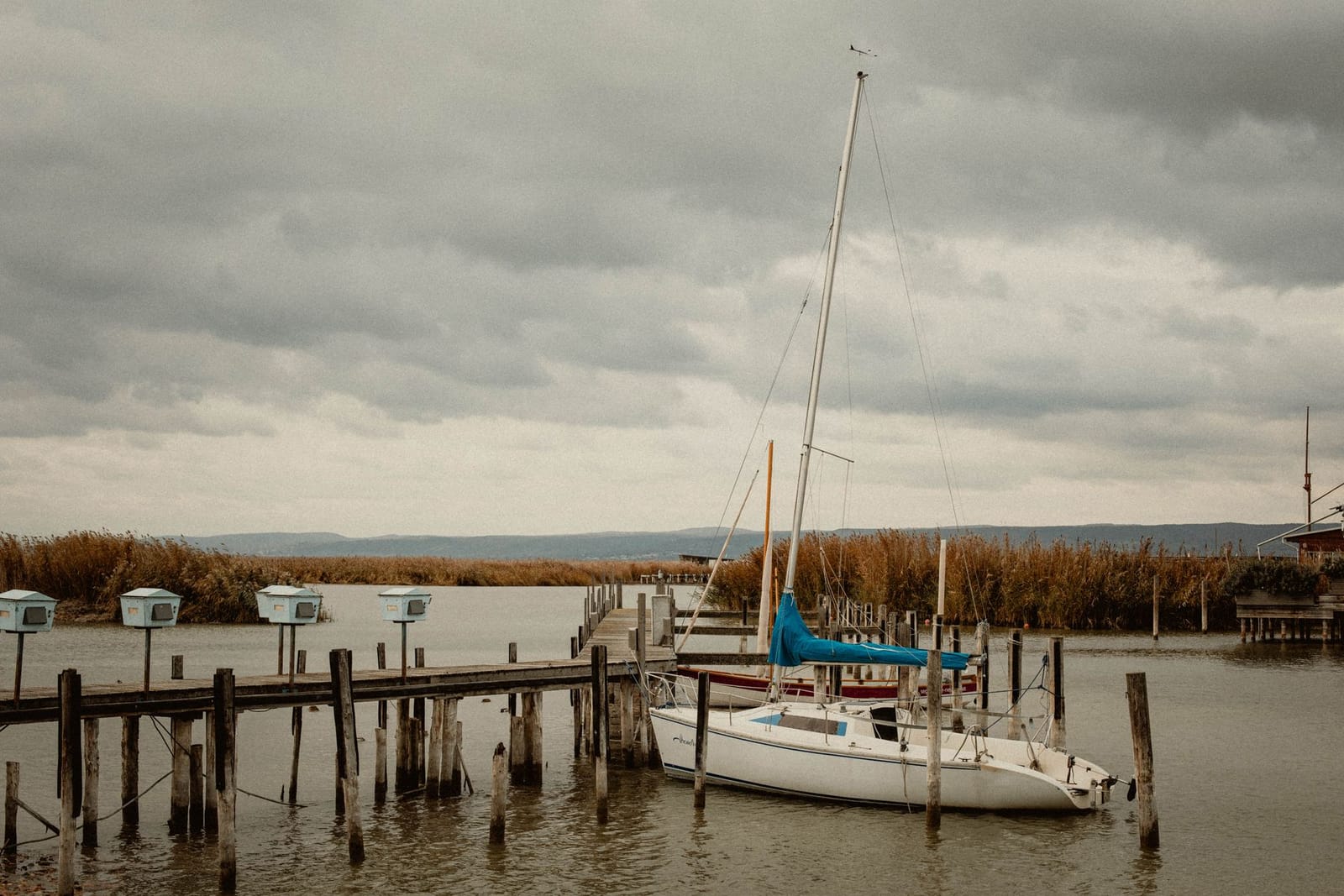
Two practical details rarely written down anywhere. Bicycles travel on all lines, for a daily supplement, on specific sailings and not on public holidays. Dogs over 35 centimetres at the shoulder need a muzzle and a supplement; smaller dogs must be carried or kept in a carrier.
We are not listing timetables or fares here: they change several times a year, and a wrong timetable printed on a page is worse than none at all.
When it is the lake itself that stops the ferries
Lake Trasimeno is shallow and has no natural outlet: it survives almost entirely on rainfall. That is a structural feature of the lake, not a seasonal one: in a dry year the level can drop far enough to stop the ferries altogether, not just change their timetable.
That is what happened in the summer of 2026. From 29 June, Busitalia suspended the San Feliciano-Isola Polvese line: the water level had dropped enough to make navigation risky, with a real danger of running aground mid-crossing. A free alternative transport service was arranged for the weeks that followed, on weekends from early July and then daily until the end of August. From 31 August, the Castiglione del Lago-Isola Maggiore line was also suspended, replaced by a shuttle bus.
It is the same water instability that centuries ago put fishing on Isola Maggiore into crisis, just reversed: back then there was too much water and the lakebed silted up, in the summer of 2026 there was too little and boats risked touching bottom. That is why checking Busitalia's page before setting off always matters: a line can be suspended from one day to the next because of the water level, not only because the season has changed.
Which island to choose, and whether both make sense in one day
The basic steer: Isola Maggiore for anyone who wants the inhabited village, the churches and the lace, with the castle closed while the restoration works last; Polvese for anyone who wants to walk, swim and be outdoors, and now knows the park also holds a castle, a monastery and a water garden few people expect.
Doing both in the same day is technically possible only if you accept spending much of it in the car: the departure ports sit on opposite sides of the lake, San Feliciano to the east, Tuoro and Passignano to the north. Getting from one ferry to the other means a real drive around the shore, not ten minutes. Better to choose one island, do it properly, and leave the other for another stay.
One last practical note on Polvese: the restaurant and hostel only open in season, with hours that change more than you would expect on such a small patch of land. Bringing water and something to eat is still the sensible choice.
Beyond the islands
The islands are one part of Trasimeno, not the whole of it. Anyone with more than a day can combine them with a tour of the lakeside towns, covered in full in what to see at Lake Trasimeno, or stop in Castiglione del Lago, also one of the three ports for Maggiore. For the wider region, see things to do in Umbria, and for a longer stay, how to plan three days across Umbria covers more ground.
We are 5 to 10 minutes from the lake's southern shore at Le Torri di Porsenna: for exact distances to the islands and the rest of the area, see our surroundings page, and for booking a stay there are our rooms.
Frequently asked questions
Can you visit the castle on Isola Maggiore?
No. Restoration work began in July 2026, with the declared aim of turning the castle into a hotel, and it cannot be visited while the building site stays open. It is visible from outside while walking around the island. Check locally on the state of the works before expecting to go in.
Can you still see lace being made on Isola Maggiore?
The lace museum is always open, in the fifteenth-century Palazzo delle Opere Pie on Via Guglielmi. Finding a lacemaker at work outside her house too is possible but not guaranteed, it depends on the day, it is a craft still practised by a few people, not an organised show.
How much walking is there on Isola Polvese?
The three signposted paths add up to around six kilometres, with modest gradients. All three can be walked in a relaxed half day.
Why do the island ferries sometimes not run?
The most common reason is seasonal maintenance, but Lake Trasimeno is shallow and has no natural outlet, so in a dry year the level can drop far enough to stop the boats crossing at all. That happened in the summer of 2026, when Busitalia suspended first the Polvese line and then the Castiglione del Lago-Isola Maggiore line. Always check the current service before setting off, because a line can be suspended for the water level as well as for the season.
Is there any way to visit Isola Minore?
No. It is privately owned, has no real landing point or ferry service, and has been uninhabited since the fifteenth century. The only way to see it is from the ferry on the way to Isola Maggiore.
Should you visit both Isola Maggiore and Polvese in one day?
Not really. The departure ports sit on opposite sides of the lake, so even managing it means spending more time driving between them than actually on the islands. It is better to choose one per stay.
- Isola Maggiore, Wikipedia
- Isola Minore, Wikipedia
- Cosa visitare, Provincia di Perugia
- I percorsi dell'Isola, Provincia di Perugia
- La Tradizione del Merletto, Isola Maggiore
- Servizio di navigazione sul Lago Trasimeno, Busitalia
- Stop di Busitalia alla navigazione verso l'Isola Polvese, Perugia Tomorrow
- Isola Polvese, ecco il servizio sostitutivo gratuito: orari e giorni, Perugia Tomorrow
- Isola Maggiore, parte il restauro del castello: diventerà un hotel di lusso, PerugiaToday
- Castello Guglielmi, al via il restauro: Isola Maggiore punta alla rinascita del suo sim..., Quotidiano dell'Umbria

Bruno e Marisella Batinti
Owners and hosts of Le Torri di Porsenna
Bruno and Marisella Batinti own Le Torri di Porsenna, the abbey they found derelict in 2014 and brought back as a charme agriturismo on the Umbria-Tuscany border. They live here all year: the roads, villages and seasons L'Almanacco writes about are the ones they drive every week.