
If you come to Umbria in October or November hoping to "see the harvest", you soon find that the harvest depends on the weather and on the tree rather than on a schedule, and that the new oil is tasted at the mill and at the table more than in the fields.
Olio nuovo is the extra virgin oil of the current harvest, freshly pressed: green, bitter and peppery in the throat, to be tasted on a slice of bread. In Umbria it is followed between October and November, with Frantoi Aperti, which in 2026 ran from 17 October to 15 November and returns every autumn. Below you will find what it is, how to taste it, what DOP Umbria (the PDO, Protected Designation of Origin) means and how to plan for next season.
It is written for people who love good food, have a car and a free day, and want to understand what they are tasting.
What olio nuovo is, and why it tastes the way it does
In Italian the oil is "franto", which means crushed: the olives are crushed, the paste is worked, the oil is separated. Olio nuovo is the oil of the current harvest, out of the mill for only a few weeks. It is the same extra virgin you find in a bottle all year round, tasted when it is at its liveliest.
On the palate you recognise it by three things: the colour, which leans towards green; the aroma, which smells of cut grass and leaves; and the feeling in the throat, a clear bitterness and a peppery kick you can feel. For anyone not used to it, this is the part that surprises most. It softens with time, and pepperiness alone does not mean the oil is faulty.
The Region's tourism portal describes the profiles of the Umbrian varieties in these terms: Moraiolo is fruity and vegetal with strong bitterness and pepperiness, Frantoio has the freshness of grass and unripe apple, Leccino is more delicate, with sweet almond and little bitterness. When you find one oil softer or sharper than another, this is in large part what you are tasting.
When olives are picked, and why there is no fixed date
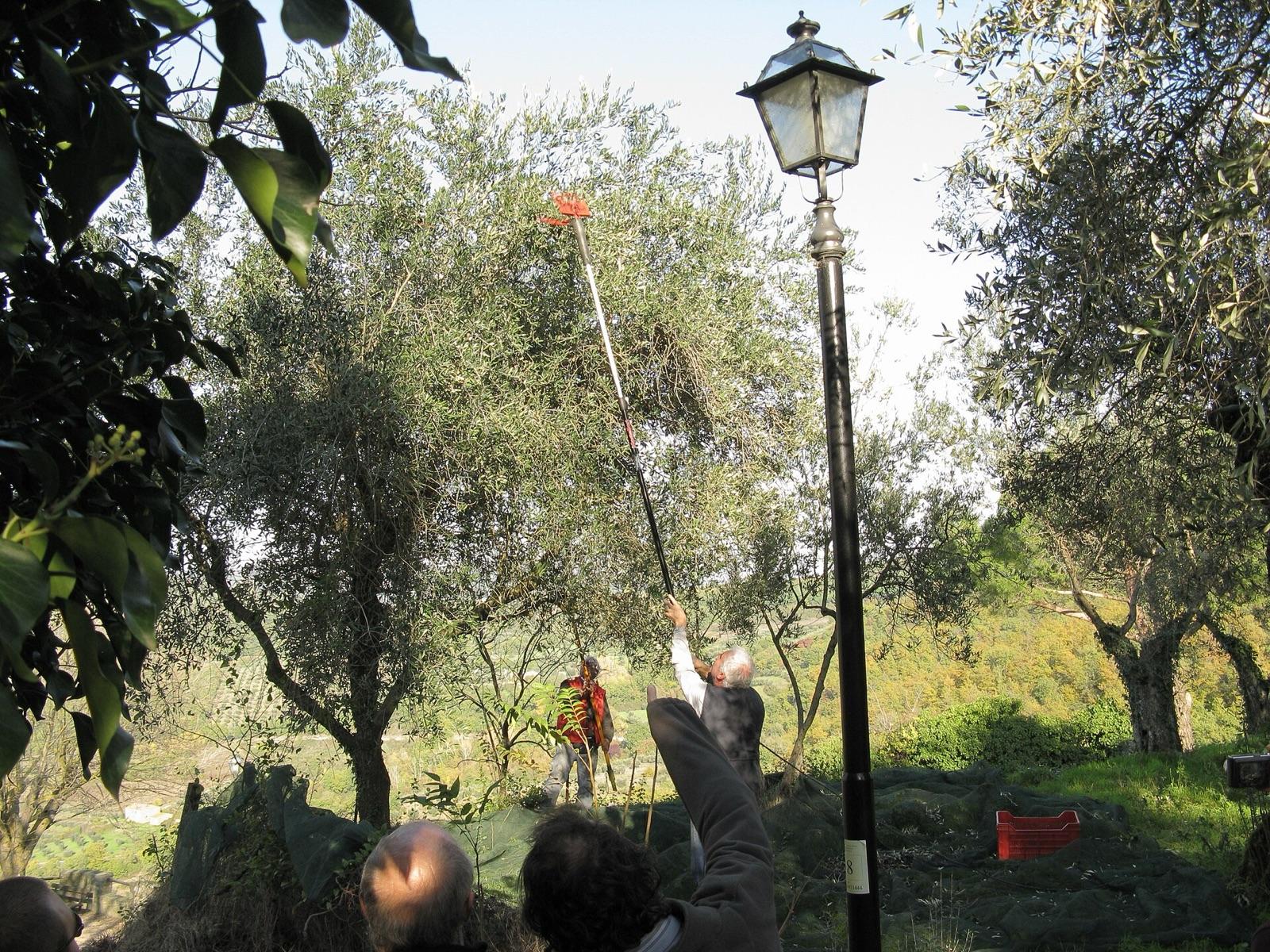
There is no fixed date: it depends on the variety and on the year. For Umbria the regional portal names October and November as the best time to see production up close, and those are the weeks when Frantoi Aperti takes place.
We have about 450 olive trees, and in the kitchen we use the oil from our own trees. If the harvest is the reason for your trip, our advice is not to trust a calendar and to plan around the mills, which are the places where you can watch the new oil being made.
Frantoi Aperti: what is really on offer
Frantoi Aperti in Umbria is the event that brings all this together. It is organised by the Associazione Strada dell'Olio DOP Umbria and in 2026 reached its twenty-ninth edition: it ran from 17 October to 15 November, over five weekends. In past editions the formula was the same, with dates that shift by a few days (in 2024, the twenty-seventh edition, it ran from 19 October to 17 November).
The programme combines visits to working mills, guided oil tastings, walks among the olive trees, lunches at the mill and, in some editions, bike rides and motorbike tours. What you find at each mill changes from producer to producer.
The 2026 edition is over. The event returns every autumn, but next year's dates have not been published yet: look at frantoiaperti.net when the programme comes out, and only then choose your weekend.
Mills and oil festivals between Trasimeno and the hills
On the lake side, among the mills listed as taking part in the 2026 edition are, in Castiglione del Lago, the Cooperativa Oleificio Pozzuolese and, in Magione, the Antico Frantoio Fattoria Luca Palombaro and the Frantoio CM Centumbrie. These names are there to help you get your bearings for next autumn: it does not mean they are receiving visitors right now. The regional portal, speaking of the area, says that a dozen mills work around Trasimeno.
There are also two festivals of the new oil that the portal mentions for the lake: Olivagando in Magione and Oliamo in Passignano sul Trasimeno. The dates change every year and need to be checked against that year's programme. The other autumn festivals around the lake are collected in Sagre e mercati del Lago Trasimeno.
If you want to venture towards Assisi, which is an hour from here, the mills in the villages on the hills are another possible stop, but the programme has to be checked village by village. In a single day it is worth doing one mill and one lunch, not three mills: each one deserves its time.
DOP Umbria, and what Colli del Trasimeno means
According to the regional tourism portal, Umbria was the first Italian region to obtain the DOP for extra virgin oil across its whole territory. The name "Umbria" always comes with one of five geographical mentions: Colli Assisi-Spoleto, Colli Martani, Colli Amerini, Colli del Trasimeno and Colli Orvietani.
For Colli del Trasimeno the production area includes, among others, the territories of Perugia, Castiglione del Lago, Magione and Passignano sul Trasimeno. Castiglione del Lago is also the municipality where we are. Città della Pieve, 20 minutes from here, falls instead in the Colli Orvietani area: the boundary of the oil does not follow the one you imagine when looking at a map.
The recipe of olives for the Trasimeno mention is precise: Frantoio and Leccino together must make up at least 65%. In Colli Assisi-Spoleto, by contrast, at least 60% Moraiolo is required, the variety with the strongest bitterness and pepperiness: whoever wants an oil that bites hard starts from that side.
What changes in the bottle with the DOP
Common rules apply to all the mentions, and the easiest to read is acidity: at most 0.65 grams per 100 grams of oil, against 0.8 for ordinary extra virgin. The colour of Colli del Trasimeno oil runs from green to golden yellow, and the organoleptic characteristics are checked by a tasting panel.
These figures are there to tell you what to look for on the label, not to judge an oil by eye. The next step is to taste.
How to taste: bruschetta, and the glass
Bruschetta is the simplest way: Tuscan or Umbrian bread, toasted, a pinch of salt, the oil poured in a thin stream. Nothing else is needed. Garlic masks the fruitiness, so the first slice is tasted without it.
The panel method is different: the oil in a glass, warmed to about 28 degrees by holding it between your hands and covering it with the other, smelled, then a small sip, drawing in a little air to carry it to the throat. It serves to tell fruitiness, bitterness and pepperiness apart.
In practice, to understand a new oil two tastings are enough, one on bread and one in a glass, plus a second oil to compare it with. If your throat tingles after the sip, the pepperiness is that of the variety and of the year.
At a restaurant, in the new-oil season, it is worth asking how it is served and with which dishes: our restaurant cooks with the oil from our roughly 450 olive trees, and the restaurant menu is the place to see what is on offer when you come.
What not to expect
For those setting out with the wrong idea, three things.
The first: the harvest cannot be seen on demand. Frantoi Aperti shows the mill at work, not necessarily the countryside with people up in the trees, and a mill does not work every hour. If you arrive when it is idle, you will see the machines and not the oil coming out.
The second: olio nuovo is not to everyone's taste at first sip. If you do not like pepperiness, it can seem too much, and there is nothing wrong with waiting for it to soften.
The third: the 2026 edition of Frantoi Aperti closed on 15 November, and outside the event there are fewer organised visits: you need to contact the individual mills directly. For the season as a whole, with the other things to do, there is Cosa fare in Umbria d'autunno.
An idea for pairing: olio nuovo, pici and fagiolina
New oil goes well with simple things. For the lake, the regional portal suggests tasting the oil raw together with the fagiolina del Trasimeno, the small bean of the lake. On the cooking of the border, between pici, fagiolina and pecorino, we have written more in Piatti tipici umbri e toscani.
If you want to make the new oil the reason for a weekend, you will find the rooms and the spa on the page our rooms: the indoor pool, after a day among the mills and the hills, is a good reason to come back.
Frequently asked questions
When are olives picked in Umbria?
Generally between October and November, with the exact date depending on the variety and the year. The Region's tourism portal names October and November as the best time to see oil production up close, and those are the weeks when Frantoi Aperti takes place.
What is olio nuovo, and how does it differ from oil that has been in the bottle for months?
It is the extra virgin oil of the current harvest, pressed only a few weeks ago. It is greener, more fragrant, and its bitterness and peppery kick are more marked, then soften with time. It is the same oil, tasted when it is at its liveliest.
When does Frantoi Aperti in Umbria take place?
Every autumn. The twenty-ninth edition ran from 17 October to 15 November 2026, over five weekends. Next year's dates have not been published yet and they change from one edition to the next, so it is worth checking frantoiaperti.net before you plan the trip.
Can you visit an olive mill after Frantoi Aperti has ended?
It depends on the mill, because outside the event there is no common programme. The safest thing is to contact the mill you are interested in directly before setting off.
What does DOP Umbria Colli del Trasimeno mean?
That the extra virgin oil comes from olives grown in the production area of the mention, which includes municipalities such as Castiglione del Lago, Magione and Passignano sul Trasimeno, and that it follows the rules on varieties: Frantoio and Leccino together must make up at least 65% of the olives.
How do you taste olio nuovo at home?
On toasted bread, as in bruschetta, with nothing but a pinch of salt: it is the simplest way to pick up the fruitiness and the pepperiness. If you want to taste like a professional, pour it into a glass and warm it to about 28 degrees in your hand, as in panel tests.
- Frantoi Aperti in Umbria 2026, Frantoi Aperti
- Frantoi Aperti 2026, elenco dei frantoi, Frantoi Aperti
- Extra-virgin Protected Designation of Origin (PDO) Umbria olive oil, Umbria Tourism, Regione Umbria
- From Magione to Passignano: history and flavours along the road of the Trasimeno Hills, Umbria Tourism, Regione Umbria
- Disciplinare di produzione della denominazione di origine controllata dell'olio extravergine di oliva Umbria, Commissione europea, registro eAmbrosia
- Frantoi Aperti 2024: in Umbria alla scoperta dell'olio evo novello, Il Resto del Carlino, QN

Bruno e Marisella Batinti
Owners and hosts of Le Torri di Porsenna
Bruno and Marisella Batinti own Le Torri di Porsenna, the abbey they found derelict in 2014 and brought back as a charme agriturismo on the Umbria-Tuscany border. They live here all year: the roads, villages and seasons L'Almanacco writes about are the ones they drive every week.