

The funicular from Orvieto's valley station reaches Piazza Cahen, in the historic centre, in a few minutes, and from there the well-worn route is always the same: straight to the Duomo, half an hour in front of the facade, lunch, back down. Orvieto sits in Umbria, on Italy's western side roughly two hours north of Rome and just over an hour south of Florence, its cliff-top old town looking like a single postcard from below. That short loop is not a bad way to spend an afternoon, but it is a fifth of Orvieto, maybe less: what you see from Piazza Cahen is only the middle level of a town that rises and drops across three real levels, and the lowest one, cut into the rock underfoot, is the part that loop leaves out entirely.
In short: Orvieto is the only destination on this list that genuinely needs visiting on three levels, not one: the valley where you leave the car or the train, the cliff-top town with the Duomo, and the underground carved into the tufa beneath both, with at least three separate sites to choose from. A day here well spent covers two of those three levels unhurried, not all three in a rush. This guide builds the day around that vertical structure, with distances and facts we checked, not ones repeated from memory.
It is written for anyone with a single day free from Le Torri di Porsenna, 54 minutes away, the last and furthest of the Umbrian destinations in this almanac, who does not want to drive back having seen only a facade, however remarkable.
The middle level: the cliff, the Duomo and the facade everyone photographs
Orvieto stands on a cliff of volcanic tufa visible for miles, and its Duomo is the most photographed point on it. It was commissioned in 1290 by Pope Nicholas IV, with Lorenzo Maitani as chief architect from the early 1300s until his death in 1330. The gothic design of the facade, with reliefs telling the story of humanity from Creation to the Last Judgement, is his.
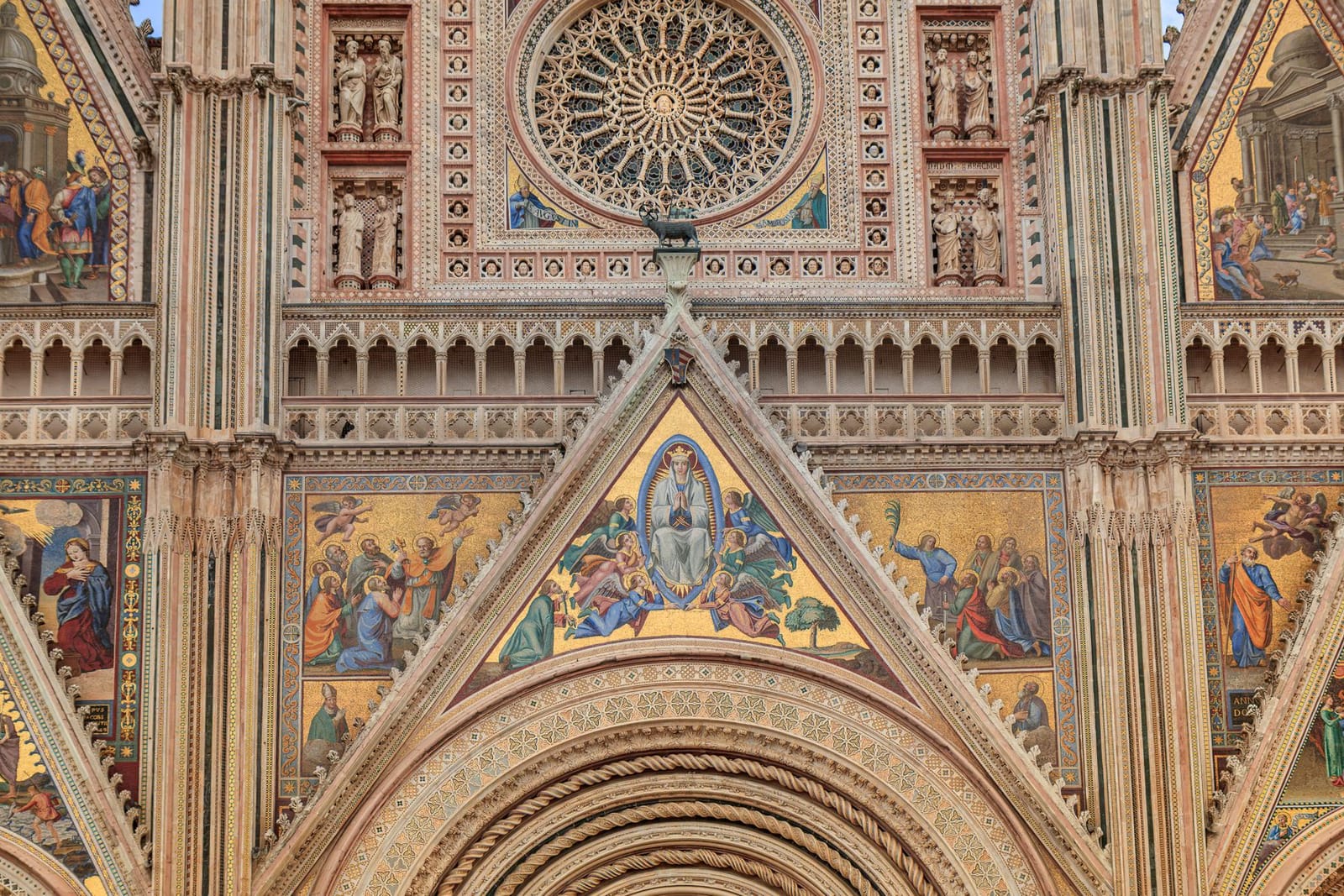
It is worth knowing before you get lost in the golden mosaics: most of what you see today is a remake from between the 14th and 16th centuries. The one original mosaic that survives, the Nativity of Mary, is no longer on the facade at all: it now hangs in the Victoria and Albert Museum in London. The central rose window is by Andrea Orcagna (1354-1380), and the bronze doors showing the works of mercy are a later addition, by Emilio Greco (1965-1970).
The Cappella di San Brizio: why going inside is not optional
The facade is why most people stop in front of the Duomo. The Cappella di San Brizio, inside, is why it is worth going in. Built between 1408 and 1444, it was frescoed in stages: Fra Angelico and Benozzo Gozzoli painted two sections of the vault in 1447, but the bulk of the work, and the cycle that makes the chapel famous, is by Luca Signorelli, between 1499 and 1504.
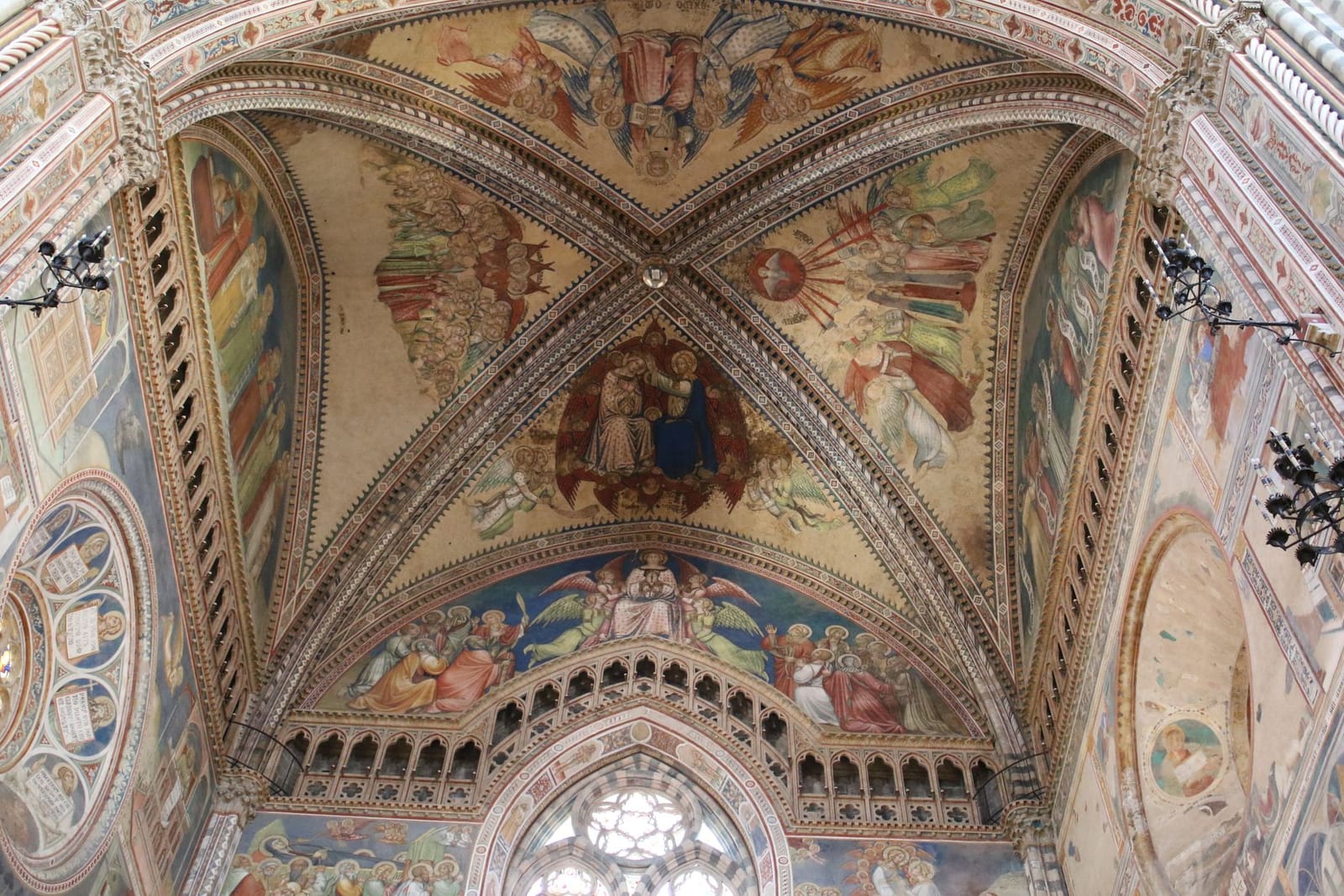
The theme is the Last Judgement, with apocalyptic scenes that include the fall of the Antichrist, the end of the world and the resurrection of the body, a cycle that influenced Michelangelo's own Sistine Chapel decades later. Nearby, the Cappella del Corporale still holds the relic of the 1263 Miracle of Bolsena, the episode that led Pope Urban IV to extend the feast of Corpus Domini to the whole Church with the papal bull of 11 August 1264. Orvieto still marks the occasion today with a historic procession.
The level underfoot: why the underground is the part almost everyone misses
This is where the part of Orvieto that most day visitors never see begins, and it is also the reason for a dedicated guide rather than repeating what our general guide to what to see in Umbria already covers. Under the cliff, residents have been cutting into the tufa for around two and a half thousand years: wells, cisterns, dovecotes, quarries, cellars, olive presses. The guided Orvieto Underground route covers part of that network, an hour-long walk that shows the overlapping traces of Etruscan Velzna alongside medieval and Renaissance remains cut into the same rock.
The practical point: there is not one underground site in Orvieto, there are at least three, distinct from each other and run separately, which is why we separate them one by one below instead of lumping them into a single "caves tour".
The Pozzo di San Patrizio: 54 metres, two ramps that never meet
The most famous of the three is the Pozzo di San Patrizio, and it earns the fame. Pope Clement VII had it dug between 1527 and 1537, after taking refuge in Orvieto following the Sack of Rome that same year, to guarantee the city a water supply in case of siege. The design is by Antonio da Sangallo the Younger: a cylindrical well 13 metres in diameter, dropping 54 metres over 248 steps, lit by 72 windows.
The most elegant part is the engineering solution: two independent spiral ramps, each with its own entrance, so men and mules could go down empty on one side and climb back up loaded with water on the other, never meeting on the spiral. A natural spring at the bottom keeps the water level constant. The well was completed under the papacy of Paul III, after Clement VII's death.
Pozzo della Cava: another well, a different story
A few minutes' walk from the Duomo, on the opposite side of the cliff, Pozzo della Cava is an entirely different story. The well, Etruscan in origin, was found again on 25 April 1996, when clearance work at the site uncovered the spring buried under twelve metres of rubble built up over the centuries. Around the well, visitors see rooms that tell different layers of the city's history: Etruscan remains, a large grotto, and medieval pottery kilns.
In 2023 the complex joined UNESCO's Global Network of Water Museums, a recognition that says a lot about what this place really is: not an attraction built for tourists, but a piece of Etruscan and medieval water infrastructure, uncovered and opened up.
The Necropoli del Crocifisso del Tufo, outside the walls
Outside the old town, at the foot of the cliff, the Necropoli del Crocifisso del Tufo shows a different side of the same underground story: here the digging happens beside the city, not beneath it. The necropolis was in main use between the mid-7th and mid-6th centuries BC, with over two hundred chamber tombs, each around three metres by two, laid out along a grid of streets, an unusual arrangement for an Etruscan necropolis.
The name of the deceased and their family was carved on the lintel above each tomb's door, a detail that makes the place feel more like an open-air archive than a cemetery in the modern sense. Nineteenth-century digging was disorganised and scattered many finds; proper scientific excavation only resumed in 1961, and it is that work that let researchers reconstruct the layout visible today.
The third level, going up: Torre del Moro
Having gone underground, the last level of Orvieto is the highest one. Torre del Moro, where the town's four medieval quarters meet, is climbed by lift for the first half and then 236 steps on foot, up to a terrace with a 360-degree view over the city and the hills around it.
The tower was originally called Torre del Papa. Its current name, in the most common accounts, comes either from a local magistrate nicknamed "il Moro" or from a Moorish figure used in the town's old Saracen joust. For centuries it served as Orvieto's public clock, and next to it stands Palazzo dei Sette, once home to the magistrates of the town's main guilds and trades, now used for exhibitions.
The valley: where the day starts and ends
Orvieto's third and lowest level is the valley, home to Orvieto Scalo, with the railway station and the car parks. It is honest to say so: on its own it is not a stop, it is the starting point. Anyone arriving by car, as you would from here, has two ways up into town: park at Campo della Fiera and take the lifts and escalators that lead inside the old walls, or leave the car near the station and take the funicular, which climbs in a few minutes to Piazza Cahen, right in the historic centre. It is not a destination to add to the plan, but the time spent going up and coming back down, however short, counts twice: once on arrival and once on departure.
How much time you actually need, and what to leave out
The honest part of this guide is the choosing, not the full list. In a single day from here, starting early, the Duomo with the Cappella di San Brizio plus one underground site, seen without rushing, fill the available hours well. Trying to add a second well or the necropolis in the same day means seeing all of it in a rush, and it is better to decide in advance what to leave for another visit than to discover it at four in the afternoon with a queue still ahead of you.
Of the three underground sites, the simplest choice is to plan on one well: Pozzo di San Patrizio if Renaissance engineering is the draw, Pozzo della Cava if the Etruscan and medieval layers of the city interest you more. The Necropoli del Crocifisso del Tufo, being outside the walls, fits better into a second day in Orvieto than the first. And if an extra hour turns up, Civita di Bagnoregio is close by, but it already lies outside Umbria, in Lazio: anyone with only one day for Orvieto is better off not squeezing it in too, since it deserves an unhurried visit rather than a rushed one at the end of the day.
When to come
April, May, June and September remain the easiest months for walking the steep streets of the old town without the full weight of summer heat, and the queues at the main sites, the Duomo included, are shorter outside the busiest months. Summer brings more visitors and a hotter climb up Torre del Moro. Winter shows Orvieto with fewer people on the streets, but the short days leave less room for combining the Duomo with an underground site in the same visit, and are best planned with a lighter itinerary.
Le Torri di Porsenna sits in Umbria, on the province's Tuscan border near Lake Trasimeno, and driving to Orvieto takes 54 minutes, the longest of the distances covered in this almanac. Anyone after something closer, on the Tuscan side, can read our guide to Cortona in a day, 22 minutes away; anyone with more than a day for Umbria will find the fuller picture in our guide to Umbria in 3 days. Book one of our rooms and you will find the full list of distances from here, with every other destination in the area, on the surroundings page.
Frequently asked questions
How far is Orvieto from Le Torri di Porsenna?
54 minutes by car, the furthest of the Umbrian destinations covered in this almanac, and the only one that comes close to the border with Lazio.
Pozzo di San Patrizio or Pozzo della Cava, which is the better well to see?
Pozzo di San Patrizio if Renaissance engineering is the draw, the two spiral ramps and the 248 steps down. Pozzo della Cava if the Etruscan and medieval layers of the city interest you more, with its rediscovered spring and pottery kilns. Both are underground sites, not the same thing, and one is usually enough alongside the Duomo.
How do you reach Orvieto's historic centre without driving up to the walls?
Park at Campo della Fiera and take the lifts and escalators up into the old town, or park near the station down in the valley and take the funicular, which climbs in a few minutes to Piazza Cahen.
What is there to see underground in Orvieto?
More than one thing, and it helps to know that before you go down. The guided Orvieto Underground route runs through caves cut into the tufa over two and a half thousand years, the Pozzo di San Patrizio is a separate sixteenth-century well, and Pozzo della Cava is another well again, Etruscan in origin, with medieval pottery kilns attached.
Can Civita di Bagnoregio be added to the same day?
Only if time allows, and it already sits outside Umbria, in Lazio. Anyone with a full day for Orvieto is better off not squeezing Civita in too; it deserves an unhurried visit of its own.
When is the best time to visit Orvieto?
April, May, June and September, when the steep old-town streets are easier walking and the queues at the main sites are shorter. Winter shows Orvieto with fewer people, but the short days leave less room for combining the Duomo with more than one underground site.
- Pozzo di San Patrizio, Wikipedia
- Duomo di Orvieto, Wikipedia
- Miracolo eucaristico di Bolsena, Wikipedia
- Mappe e Trasporti Orvieto, Orvieto Viva
- Torre del Moro, Orvieto Viva
- Necropoli del Crocifisso del Tufo, Wikipedia
- Orvieto Underground, Orvieto Underground
- Pozzo della Cava - Complesso archeologico in Orvieto - I sotterranei del quartiere medi..., Pozzo della Cava
- Pozzo di San Patrizio, Comune di Orvieto
- PAESE DI BAGNOREGIO E CIVITA, FAI

Bruno e Marisella Batinti
Owners and hosts of Le Torri di Porsenna
Bruno and Marisella Batinti own Le Torri di Porsenna, the abbey they found derelict in 2014 and brought back as a charme agriturismo on the Umbria-Tuscany border. They live here all year: the roads, villages and seasons L'Almanacco writes about are the ones they drive every week.