

A March weekend fully booked, and the weekend right after it, with almost identical weather, nearly empty: it happens most years, because the date of Easter shifts and takes with it the week when this part of Umbria genuinely fills up. Anyone looking at a March or April calendar without knowing when Easter falls that year risks booking the wrong week, assuming spring is one single season that behaves the same way throughout.
Spring here runs from the still-brown fields of March to the full green of May, with an April that can hand you the best week of the year or the wettest, and an outdoor pool that stays shut through all three months. This guide covers how spring changes across March, April and May: the rule behind the date of Easter, when the lake is at its highest point of the year, what genuinely happens to the green of the countryside, why the outdoor pool is not yet an option, the towns before the summer crowds arrive, Calendimaggio in Assisi, and how to plan two or three days in this period.
It is written for anyone weighing up a spring stay who wants to know what to expect month by month, not a photograph of May sold as the whole season. Le Torri di Porsenna is an agriturismo, a working countryside estate combining rooms, a spa and a restaurant, in Umbria on the Tuscan border, in the hills above Lake Trasimeno, roughly midway between Florence and Rome. A car is effectively required to make the most of a stay here.
March, April and May: three different springs
Calling it "spring" as if it were a single three-month block is the first mistake. In Perugia the average temperature rises from around 8°C in March, with highs around 13°C, to around 16°C in May, with highs close to 22°C: an eight-degree gap between the first and last month of the season.
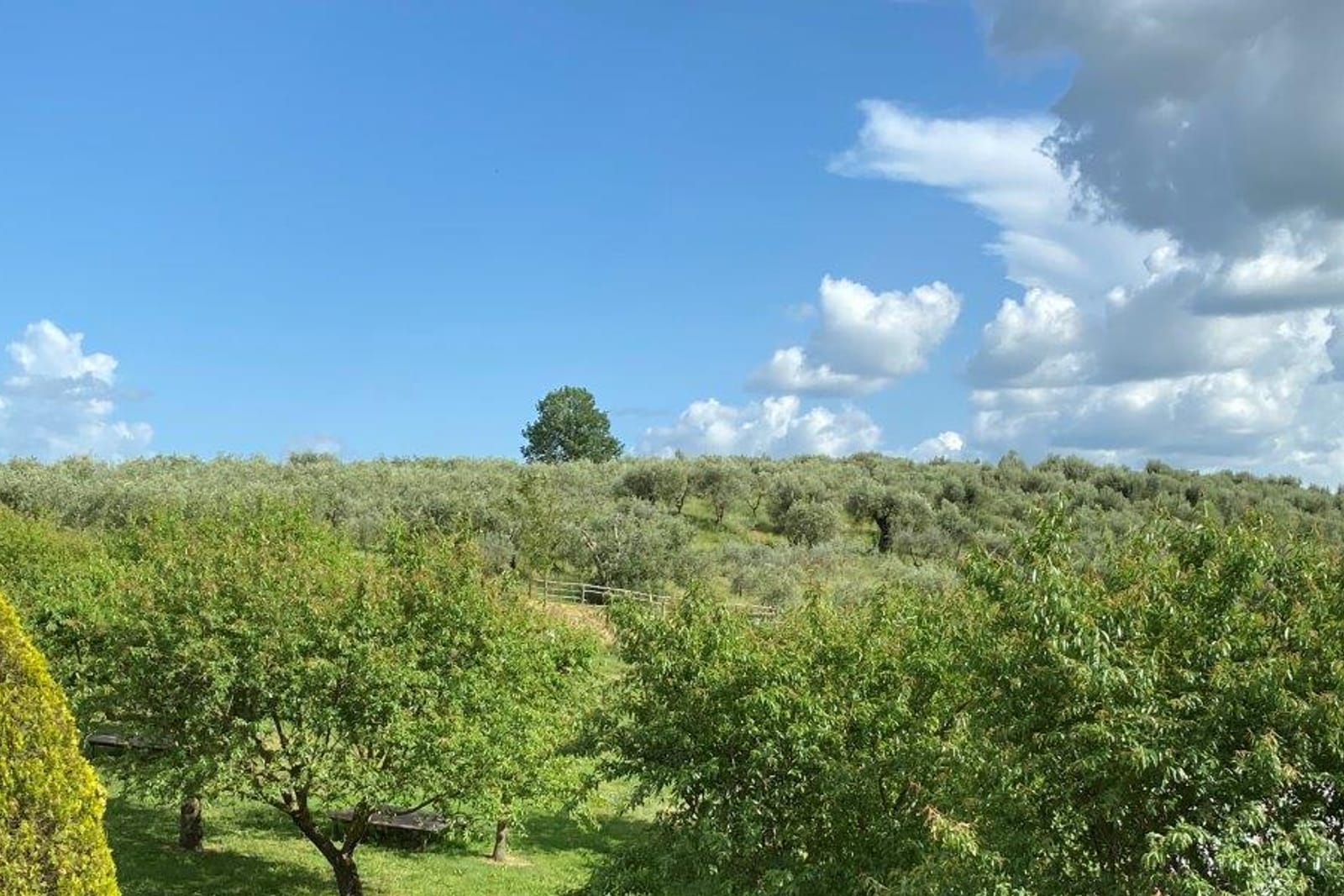
April is the least predictable of the three, not the wettest overall: total rainfall, around 50 millimetres, is similar across all three months, but it falls across more days, averaging 8.2 out of thirty against 6.9 in March and 7.9 in May. In practice April rains more often, not necessarily harder, and cloud cover stays at 47%, the same as March. May is the month with the clearest skies, with average cloud cover of 43%.
The practical consequence: book March and you should expect cool evenings and heavy-jacket mornings, book May and you get the most reliable weather of the three, and book April and you are making a genuine gamble, one that can go either way within the same week. March still carries some of what we describe in Umbria in winter: cool mornings, a lake that can turn grey, and an indoor pool that matters more than the outdoor one.
Easter, the rule behind the date that moves every year
Easter always falls between 22 March and 25 April, but never on the same point of the calendar two years running. It is the single date that decides more than any other how full this area will be on a given spring weekend: whichever month it lands in, Easter week remains the one that fills up first among every week in March and April.
We see it clearly every year: Easter weekend arrives with the restaurant full several nights running and the roads around the lake busier than usual, while the weekend right before or right after, with almost identical weather, can be noticeably quieter. Anyone after the calm that low season usually brings would do well to check the calendar for the specific year before choosing a week, rather than trusting "April" as a generic month.
The lake at its highest point of the year
Lake Trasimeno, 5 to 10 minutes from here, has no natural outflow: it lives mostly on rainfall, which is why its level shifts considerably over the year. It is at its highest precisely between April and May, once the winter and spring rains have filled the basin, and at its lowest between September and October.
For anyone visiting in this period that means shorelines full right to the edge, a different view from late summer, when tens of metres of exposed lakebed appear in front of the beaches. It does not automatically mean warm water: the lake is shallow and warms up faster than a deep lake, but March and April remain months when swimming stays an idea rather than a real plan. We cover this in more detail, islands included, in what to see at Lake Trasimeno.
The green countryside, without promising blossom
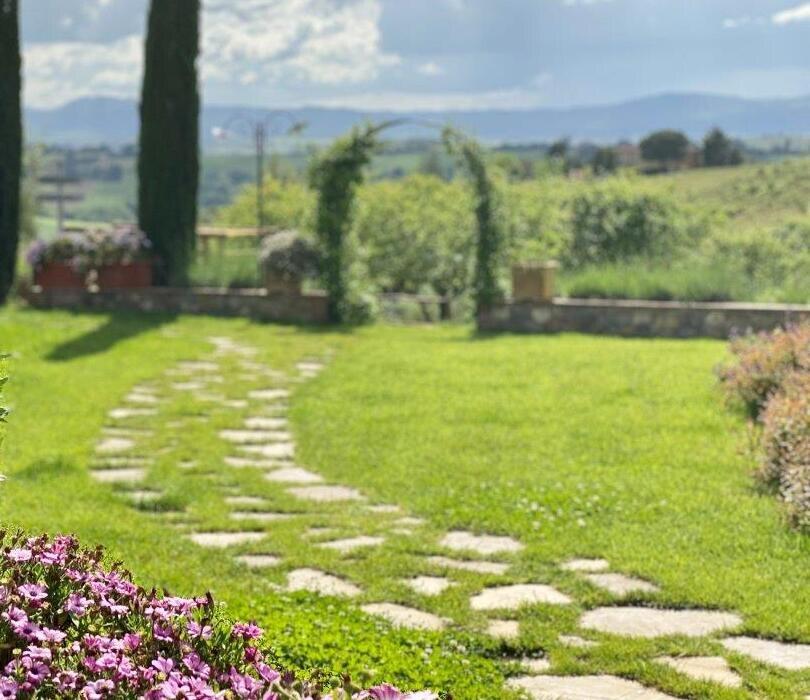
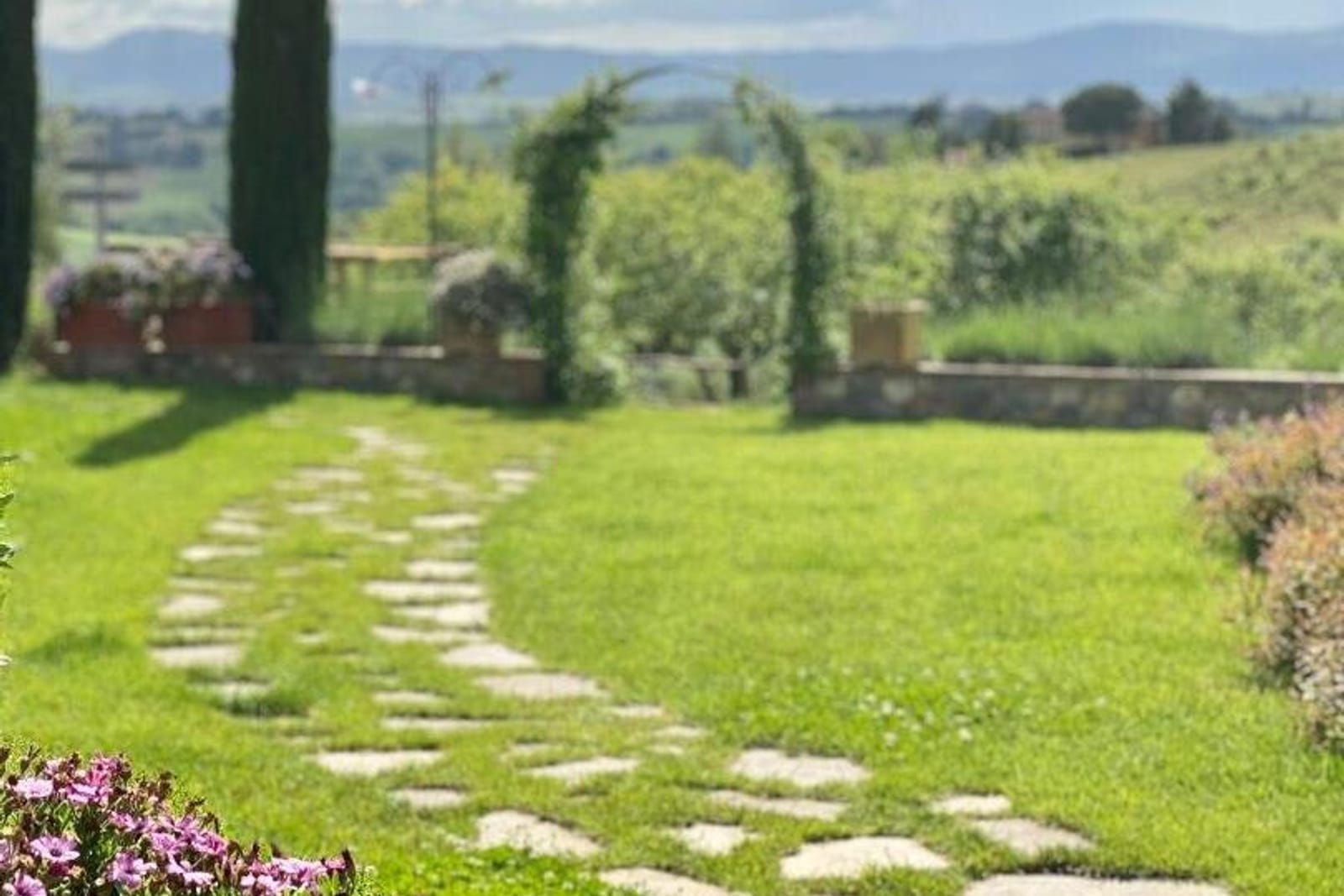
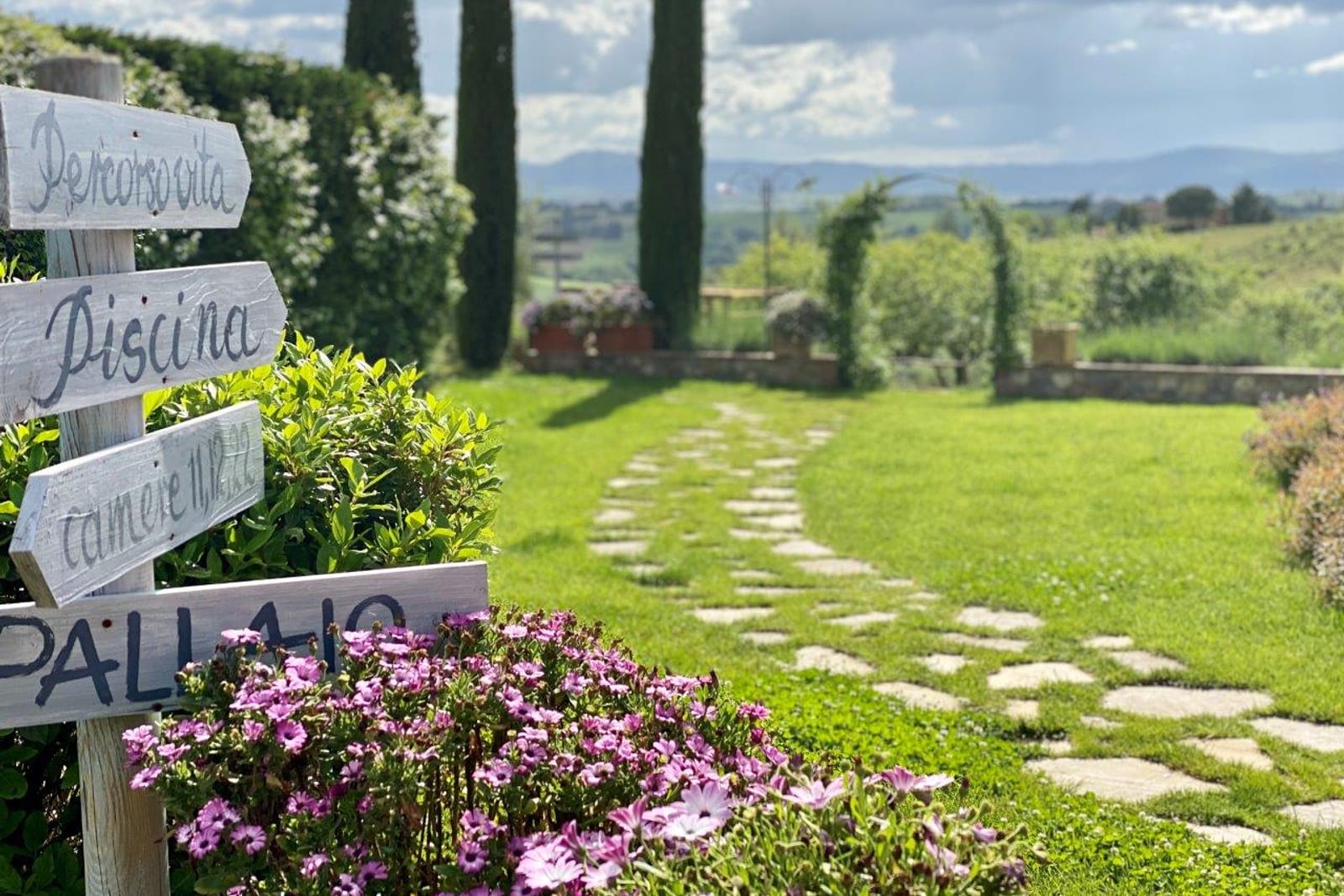
One thing needs to be said clearly: we are not giving a date here for when the fields or meadows come into bloom, because it changes from year to year with that season's weather, and a wrong date left on a page stays there long after it stops being true. What can be said with certainty is simpler: the meadows around the grounds turn green again after winter, the grass grows faster with the March and April rain, and the wheat fields in the valley are green rather than golden the way they are in summer.
The olive trees, around 450 of them on our own grounds, do not follow this calendar: they stay silvery green all year, so they are not the marker of the season changing. The real markers are the meadows, the vineyards putting out their first leaves, and daylight that runs noticeably longer in April and May than in March. It is the opposite of the countryside you see in autumn, when the fields turn golden and the olive harvest keeps the property busy for weeks: we write about that in autumn in Umbria.
The outdoor pool is not open: the honest warning
This needs saying clearly, before you book, not after you arrive: the outdoor panoramic pool in the grounds is seasonal, and it stays shut through March, April and May. We do not state a reopening month here, because it changes from year to year and a wrong date would be worse than no date at all. Anyone booking a spring stay expecting to swim outdoors under the sun will be disappointed, and it is better to know that in advance than to find out poolside.
Anyone who still wants to swim has the heated indoor panoramic pool, open all year alongside the Finnish sauna, the hammam and the relaxation area: in spring, with the weather still unsettled, it is often the more used option even among guests who would choose the outdoor pool in summer. The grounds themselves remain open for a walk or a coffee outside during the warmer part of the day, even with the outdoor pool out of action. Full details of the sauna, hammam and treatments are on the spa page; for the heated indoor pool, see the dedicated indoor pool page.
The towns before the summer crowds
Perugia is 44 minutes from here, Cortona 22, Montepulciano 30, Assisi an hour: these are the most natural day trips from this base, and in spring, Easter aside, they come with far less crowding than June or July brings. The coach parties that fill historic centres in high season are still few, and the same streets that turn into a queue of cars hunting for parking in summer stay easy to drive in spring.
The exception already mentioned holds for Easter week, when the area's art towns, Assisi above all for religious as well as touristic reasons, fill up as much as in peak summer. For the rest of spring, a morning in Cortona or an afternoon in Perugia moves at a pace that is almost impossible to find in July. We cover this in more detail in Cortona in One Day and in Montepulciano and Vino Nobile.
The weekly markets in the villages around the lake, which run all year, also pair well with a day on the lake in spring, before the summer heat makes them less pleasant to walk around: we cover the exact days in Sagre and Markets of Lake Trasimeno. It is also the season when the lakeside path is at its best for exploring by bike, before summer heat and the busiest weekends make it more crowded: see Lake Trasimeno by bike.
Calendimaggio in Assisi, the festival that marks the start of May
Assisi has a moveable date all of its own, on top of Easter: Calendimaggio runs every year from the Wednesday to the Saturday following 1 May, with the town split into two rival quarters, Sopra and Sotto, competing in choral singing, historic games and re-enactments for a banner awarded by a jury.
It is a genuine local festival, felt by the town more than staged for visitors, and precisely for that reason Assisi fills up in a way similar to Easter week during the days of the contest: anyone after a quiet town would do well to deliberately avoid those four days, while anyone who wants to see the festival should plan their arrival around that specific week, checking the exact date each year rather than simply marking 1 May on the calendar.
Two or three days in spring, how to plan them
With two nights, the simplest combination is a day on the lake, with Castiglione del Lago 5 to 10 minutes away, plus a day towards Cortona or Montepulciano, which together add up to just 22 and 30 minutes from here. If it rains, the indoor pool and spa become the natural plan B for half the day, without having to rearrange everything else.
With three nights you can add Perugia or Assisi, both far enough away, 44 minutes and an hour, to deserve a full day of their own. The rule of thumb we use in every season here still holds: one stop a day that takes more than an hour to drive to, not two, and in spring, keep an indoor alternative ready too, given April's average of 8.2 rainy days.
When to book, what to pack, and what to do if it rains
Check-in is from 15:00, check-out by 11:00, the same as the rest of the year. For Easter week or Calendimaggio, it is worth booking further ahead than usual, precisely because these are the two weeks when demand rises more than any other in spring.
Pack layers and something waterproof, especially for an April stay: a light jacket is enough in the middle of the day, but mornings stay cool into late May. If the weather turns for a whole day, the heated indoor pool, the Finnish sauna and the hammam become the part of the day everything else is built around, alongside a longer than planned stop at our restaurant, which in spring still cooks Umbrian and Tuscan dishes side by side. To compare rooms before booking, the rooms page shows the property's five categories.
Frequently asked questions
When is the best time to visit Umbria in spring, March, April or May?
May, if you want the most settled and warmest weather, with an average of 16°C in Perugia and less chance of being stuck indoors for a whole day. March, if what you are after is the lake at its fullest and lower rates, and you can live with cool temperatures. April is the least predictable of the three, capable of the best week of the year or the wettest, and the date of Easter also decides how busy it will be.
Does it rain a lot in Umbria in spring?
April has more rainy days than either March or May, averaging 8.2 out of thirty, even though the total rainfall in millimetres is similar across all three months. In practice that means more frequent showers rather than heavier ones, so it is worth packing something waterproof and not planning a whole day outdoors.
Why is the outdoor pool not open if I book in spring?
The outdoor panoramic pool in the grounds is seasonal and stays shut through March, April and May. We do not state a reopening month here because it changes from year to year, and a wrong date would be worse than no date. Anyone wanting to swim in this period has the heated indoor pool, open all year alongside the Finnish sauna and the hammam.
Why does the date of Easter change a spring stay so much?
Because Easter week is the busiest week of the whole spring here, and the date always falls between 22 March and 25 April, never landing on the same point of the calendar twice. A March weekend that is fully booked one year can be noticeably quiet the next, if that year Easter falls in April.
What is Calendimaggio in Assisi and when does it take place?
It is a historic festival in which the town splits into two rival quarters, Sopra and Sotto, competing in choral singing, historic games and re-enactments for a banner judged by a jury. It runs every year from the Wednesday to the Saturday following 1 May, so the exact date changes from year to year, just like Easter.
How many days do you need to see Umbria in spring?
Two days are enough for the lake and a nearby town such as Cortona or Montepulciano. With three days you can add a longer trip to Perugia or Assisi, which is far enough to deserve a full day of its own.
- Condizioni meteorologiche medie a Perugia, Weather Spark
- Lago Trasimeno, Wikipedia
- Calcolo della Pasqua, Wikipedia
- Calendimaggio (Assisi), Wikipedia

Bruno e Marisella Batinti
Owners and hosts of Le Torri di Porsenna
Bruno and Marisella Batinti own Le Torri di Porsenna, the abbey they found derelict in 2014 and brought back as a charme agriturismo on the Umbria-Tuscany border. They live here all year: the roads, villages and seasons L'Almanacco writes about are the ones they drive every week.